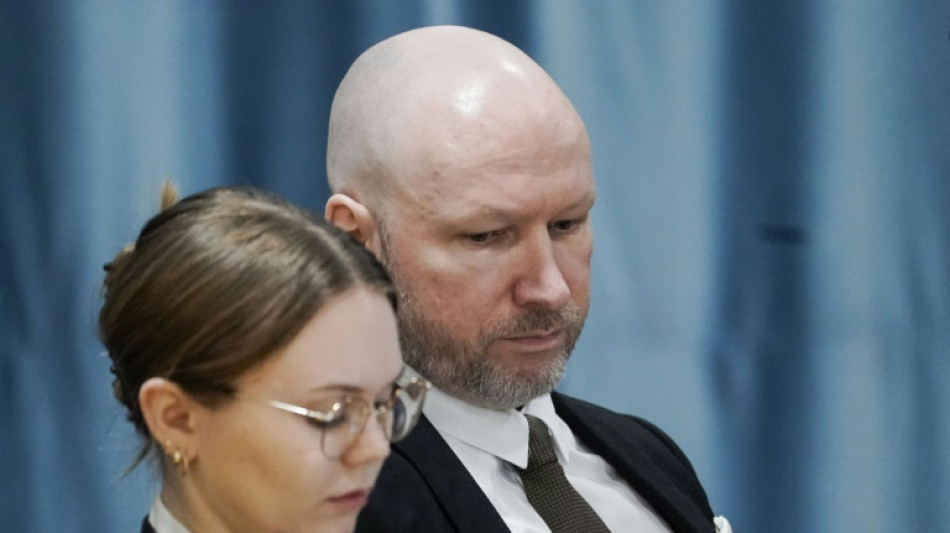
Norway says Breivik still poses risk of 'unbridled violence' / Photo: © NTB/AFP

 Finnish president Stubb speaks to AFP about Trump, Russia and saunas

 Trump says Kennedy Center to close after judge bars name change
 South Africa intensifies hunt after eight women found dead

 'Battle of Chile' documentary-maker Patricio Guzman dies, aged 85
 Tuchel wanted to eat grass after England's World Cup win in Mexico
 OpenAI, Anthropic and Google are working to create an AI standards body
 Lens sack Toppmoeller after six games in charge
 Rob Reiner son will not face death penalty, prosecutor says
 Referees chief Webb 'really disappointed' over VAR error in Manchester derby
 Maiden Renshaw ODI century sets up Australia win in Zimbabwe
 EU calls Russia 'reckless' after flares fired at Danish helicopter

 US Treasury chief says to meet Chinese counterpart at weekend

 Trump slams 'horrible' Supreme Court mail-in ballot ruling

 Brazil's crisis-hit Supreme Court probes judge's ties to jailed banker
 Sterling admits dangerous driving after Lamborghini crash
 Ambassador to Thailand plays down anti-Israeli protests
 BingX Evolves into a Multi-Asset Trading Platform, Connecting Users to Global Opportunities
 Flick supporting 'self-confident' Yamal Ballon d'Or bid
 As Ballon d'Or vote nears, stars campaign for the award
 Markets on edge as US Fed meets to tackle high inflation

 International Trading Institute Expands Professional Trader Development Beyond the Master’s in Trading

 Nairobi to host 2029 world athletics championships in African first
 Ukraine winemakers defy war to make a splash at home
 Prominent Greek neo-Nazi exits prison, vows return to politics: AFP
 Saudi Arabia vows to respond 'firmly' to Houthi attacks

Anders Behring Breivik, the right-wing extremist who killed 77 people in 2011, still poses a risk of "totally unbridled violence", the Norwegian state argued Tuesday in a lawsuit over his prison conditions.
Breivik has sued the state, claiming his extended isolation is a violation of Article 3 of the European Convention on Human Rights, which prohibits "inhuman" and "degrading" treatment.
Now 44, he has been held apart from other inmates in high-security facilities for over 11 years.
The trial, which opened Monday, is being held for security reasons in the gymnasium of Ringerike prison where Breivik is serving his sentence.
More than 12 years after committing the bloodiest attack on Norwegian soil since World War II, Breivik still poses "an absolutely extreme risk of totally unbridled violence", the state's lawyer Andreas Hjetland told the court.
On July 22, 2011, Breivik set off a bomb near government offices in Oslo, killing eight people, before gunning down 69 others, mostly teens, at a Labour Party youth wing summer camp on the island of Utoya.
He was sentenced in 2012 to 21 years in prison, which can be extended as long as he is considered a threat, which was Norway's harshest sentence at the time.
"Breivik represents the same danger today as on July 21, 2011," the eve of the twin attacks he prepared meticulously for years, Hjetland said.
"His ideology remains the same, his aptitude for unlimited violence is evident and his personality... further reinforces all these factors," he said.
- No remorse -
Hjetland cited assessments written by psychiatrists and prison wardens about the danger he still presents, which show that he still believes his attacks were justified.
Asked one day if "more terrorist attacks are necessary", Breivik replied: "Absolutely."
Another time he was asked how he felt about having killed children on Utoya, to which he responded: "If you're old enough to be politically active, you're old enough to be the target of terrorism."
On several occasions as the state presented its defence on Tuesday, Breivik, wearing a dark suit, silently shook his head in disagreement.
On Monday, Breivik's lawyer Oystein Storrvik had asked for an easing of the prison conditions, saying they had made Breivik "suicidal" and depressed.
Storrvik argued that Norwegian authorities had not put sufficient measures in place to compensate for Breivik's relative isolation.
His human interactions are mostly limited to contacts with professionals such as wardens, lawyers and a chaplain.
Citing another article of the Convention on Human Rights that guarantees the right to correspondence, Breivik has also asked for an easing of restrictions on his incoming and outgoing letters.
At the Ringerike prison, located on the shores of the lake that surrounds the island of Utoya, Breivik has access to several rooms including a kitchen, a TV room with a game console, and an exercise room.
Prison officials have also complied with his request for a pet by providing him with three budgies.
Norway prides itself on a humane prison system aimed at rehabilitation rather than punishment.
- Suicide attempt -
During Tuesday's proceedings it emerged that Breivik tried to kill himself in 2020 by hanging himself with a towel.
But the state's lawyers noted that he had also made sure to inform prison guards of his plan.
In 2018, he also launched a disobedience campaign, drawing symbols such as swastikas with his feces, shouting "Sieg Heil" and undertaking a hunger strike.
"There is still no indication suggesting any (psychological) suffering linked to his isolation or that he is suicidal," said another lawyer for the state, Kristoffer Nerland.
He said psychiatrists had merely noted "periods of depression" that were linked to "personality issues".
The state argued that to compensate for his isolation, Breivik has access to "a wide range of activities" for over eight hours a day, including cooking, video games, walks, basketball, studies and visits from the chaplain and the Red Cross.
In 2016, Breivik sued the Norwegian state on the same grounds, with a lower court ruling in his favour before higher courts found in the state's favour.
In 2018, the European Court of Human Rights dismissed his case as "inadmissible".
L.Dubois--BTB