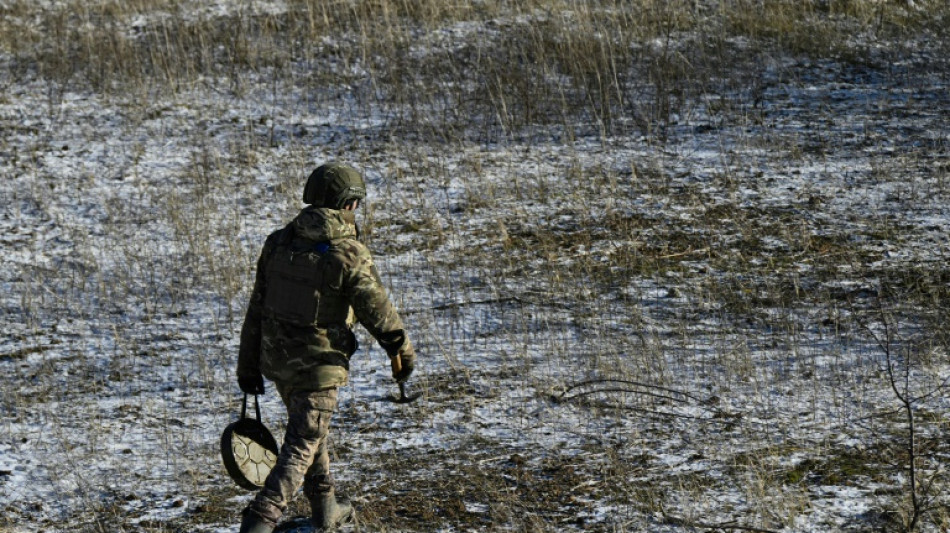
'Definitely a trap': Ukraine's sappers face new dangers / Photo: © AFP

 Finnish president Stubb speaks to AFP about Trump, Russia and saunas

 Trump says Kennedy Center to close after judge bars name change

 South Africa intensifies hunt after eight women found dead

 'Battle of Chile' documentary-maker Patricio Guzman dies, aged 85

 Tuchel wanted to eat grass after England's World Cup win in Mexico
 OpenAI, Anthropic and Google are working to create an AI standards body

 Lens sack Toppmoeller after six games in charge

 Rob Reiner son will not face death penalty, prosecutor says

 Referees chief Webb 'really disappointed' over VAR error in Manchester derby
 Maiden Renshaw ODI century sets up Australia win in Zimbabwe

 EU calls Russia 'reckless' after flares fired at Danish helicopter
 US Treasury chief says to meet Chinese counterpart at weekend

 Trump slams 'horrible' Supreme Court mail-in ballot ruling

 Brazil's crisis-hit Supreme Court probes judge's ties to jailed banker
 Sterling admits dangerous driving after Lamborghini crash

 Ambassador to Thailand plays down anti-Israeli protests

 BingX Evolves into a Multi-Asset Trading Platform, Connecting Users to Global Opportunities

 Flick supporting 'self-confident' Yamal Ballon d'Or bid

 As Ballon d'Or vote nears, stars campaign for the award

 Markets on edge as US Fed meets to tackle high inflation

 International Trading Institute Expands Professional Trader Development Beyond the Master’s in Trading

 Nairobi to host 2029 world athletics championships in African first

 Ukraine winemakers defy war to make a splash at home

 Prominent Greek neo-Nazi exits prison, vows return to politics: AFP
 Saudi Arabia vows to respond 'firmly' to Houthi attacks

A deafening explosion shakes the ground, sending lumps of dirt and smoke into the air, breaking the seeming tranquility of a cold January morning in the frozen fields of war-torn Ukraine's eastern Donbas region.
After almost two years of grinding trench warfare against invading Russian troops, some 30 percent of Ukrainian territory is thought to be littered with unexploded mines.
"The Russians connect the mines," Sergeant Boller, a Ukrainian sapper teaching recruits, told AFP.
"If you try to remove them, you can kill your entire unit," he warned.
Getting rid of the mines is essential to Ukraine's war effort, as they clear the way for offensive operations and allow civilians to return to their homes.
But sappers warn their already dangerous job is being complicated by a lack of recruits and ever-more lethal Russian minelaying techniques.
Holding mines in his hand, Anatolii, another sapper, warned new recruits of potential booby-traps.
"A banknote, a pack of cigarettes, a phone... It's definitely a trap," he told worried soldiers in the freezing cold.
"We have even lost soldiers because of a booby-trapped pack of Pepsi cans."
- 'I heard them' -
Sappers are often the first to get to the frontline, clearing territory before assault troops arrive.
The motto of Ukraine's sappers is "always ahead of the first", and they have more direct contact with the frontline than other military units.
But it is difficult to find people willing to take such risks.
"In addition to distinguishing explosives, you need to know their chemical composition and how to handle them... You need to be educated," said Boller.
"It's hard to find intelligent people who are not afraid," he said.
Their job is "indispensable" in the war with Russia, the head of the Ukrainian army's anti-mining department Colonel Oleg Shyvarskiy said.
"Mechanised units will never start an offensive until the sappers have cleaned up," he told AFP.
He said their situation was "not critical" thanks to international assistance and the opening of new training centres.
But he acknowledged recruitment difficulties and that most people "are simply afraid to train to become a sapper."
Boller said he was once no more than 120 metres from Russian troops.
"I heard them insulting me," he said.
- 'Innovation' -
Ukrainian sappers increasingly encounter Russian tactics designed to make their job harder.
Kyiv says Russia's minelaying strategy is constantly improving, combining anti-personnel mines and anti-tank mines, as well as explosives dropped by helicopter.
There is "innovation on the Russian side", Colonel Shyvarskiy admits.
He said Moscow is laying mines "randomly."
"In some areas, mines are laid less than half a metre from each other."
The true number of mines planted by Russia in Ukraine, he said, is impossible to know.
"We will only know after the de-occupation of our territory."
For Anatolii, 42, the job requires "flare and intuition" since Russia is constantly setting traps.
"It is no secret that Russia has very good sappers, perhaps the best," he added.
- 'That will not stop us' -
Sergeant Boller was covered in dirt after detonating an anti-tank mine during a training exercise.
He tapped a mine with a shovel, as soldiers near him cautiously stepped back.
"It allows soldiers to get used to explosions," the 43-year-old said, smiling.
"We mostly work at night, testing the ground with a stick in our hands," he said.
"We crawl on the ground, in the mud, in the shit...," he lamented. "The Russians plant them everywhere."
In his previous life before Russia invaded in February 2022, Boller was a landscaper in Germany, earning a good salary.
He has lost friends and colleagues in his new job.
"Those who did not die have lost their legs," he said, solemnly.
"But that will not stop me."
afptv-oc/cad/bc
J.Horn--BTB