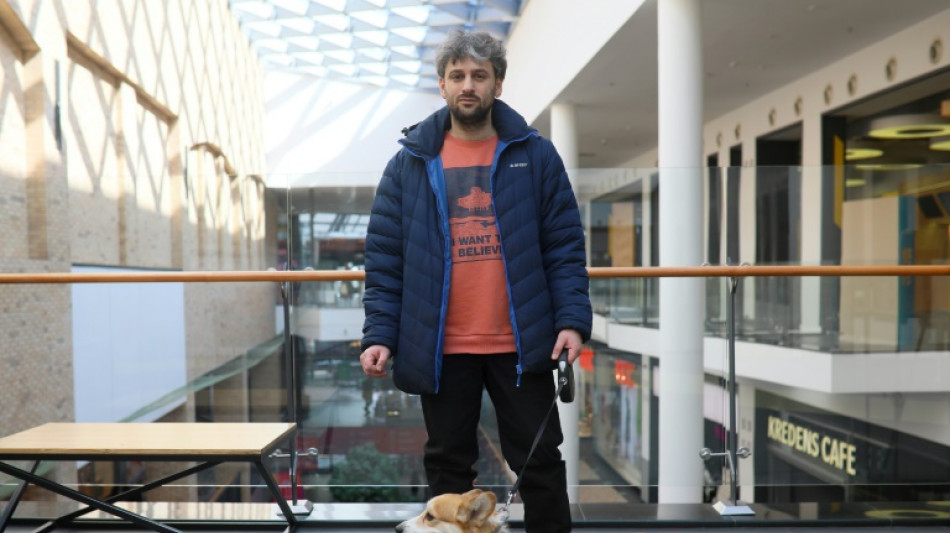
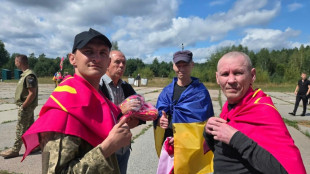
East Ukrainians twice in flight from Russian offensive / Photo: ©

 'More confrontational': Iran's new hardline security leadership

 UK summons Israeli envoy over West Bank settlement project
 Trump vows 'tremendous' economic costs on Iran partners
 Germany, France, UN condemn far-right Israeli minister's 'inhumane' Gaza remarks
 Prince Harry and Meghan moving back to UK: British press
 Lee, Baena guide Atletico to opening Liga win over Malaga
 Ecuador intel chief, five Americans killed in Kenya helicopter crash
 Robinson and Tongue share match ball after dismissing Pakistan
 Israel army admits firing on car in death of five-year-old Hind Rajab
 Honduras places 80% of country on El Nino drought alert

 Some of Meta's safety tools were 'designed to fail': witness
 PSG Ligue 1 opener moved over state of Parc des Princes pitch

 UK PM launches bid to help homeless, donating part of his wages
 Golden Shoe winner Kane hopes for Ballon d'Or after 'best season ever'

 Kyiv's ex-defence chief makes risky bet by venturing into electoral grounds
 Coventry have survival inspiration says Lampard

 Reijnders leaves Man City for Saudi's Al Qadsiah
 Trump says will meet North Korea's Kim later this year

 Stocks waver, dollar drops as US Treasury moves to lower bond yields
 France recalls rare disease drug Tavneos after deaths
 Arsenal agree to sign Villa defender Konsa: reports

 Evacuation orders lifted in Belgian wildfire zone
 UK media skewered for 'hounding' black academic
 More than 7,300 excess deaths in France's historically hot summer so far
 US socialists score shock Florida win as Trump picks stumble

Fledgling film director Eugene Koshin talks about his ordeal like images on a screen -- vivid "flashes" of action that were somehow distant and unreal.
Kateryna Bosiachenko describes it like the end of innocence, her idyllic childhood marred by violence between "brother and brother".
For Milan Zaitsev it "turned the page" as a chapter of his life was snatched away.
All three Ukrainians describe a common experience. They were displaced from their homes in the east by Russia's 2014 military machinations.
Now, after starting new lives further west, they have been forced to flee a second time when President Vladimir Putin commanded a broader invasion on February 24.
They spoke to AFP in the city of Lviv. Just 70 kilometres (45 miles) from the Polish border, they can travel no further west without leaving Ukrainian soil.
- A grim sequel -
Koshin, 34, hails from the city of Donetsk in Ukraine's Donbas industrial heartland.
He was studying in Moscow when Russia-backed separatists launched an insurgency there after a pro-European uprising toppled Kremlin ally President Viktor Yanukovych from office.
On sporadic visits home he witnessed his city transformed. Soldiers in the streets. The rumble of artillery fire. A man menacing him with a rifle as he stood at his window.
"All the events that were happening in 2014, they were like flashes," he told AFP. "For me it was really like editing -- like you're watching some film."
That summer he left Donetsk, eventually settling in Kyiv with his family. "We decided to go somewhere, maybe for a week or two or three," he said. "All that time we invented some explanations."
"For us it was a long, long vacation. I could even say that we are still on that vacation."
Kyiv was where Koshin found footing as a director, recently securing his first commission for a feature film.
He was alerted to the invasion by his father's car keys beeping at 4 am. The alarm was triggered by the first air strikes hammering the city. He says he experienced the invasion in "Dolby surround".
The family swiftly quit the capital. "I try not to reflect because if I'm starting to reflect I have these bad thoughts," he said.
"Even after all these events during all these eight years I hoped that there were some limits."
- End of innocence -
Bosiachenko, 20, talks about her upbringing in the small city of Debaltseve in the Donetsk region with wide-eyed fondness, describing moments spent in nature.
One grandmother kept cows, another goats. Her days were spent swimming in lakes. "It was an amazing town, amazing for childhood," she said.
Every year on May 9 she would sing in the city centre to mark the date World War Two ended. But in 2014 something had changed. Her decision to sing in Ukrainian was potentially inflammatory.
Her uncle joined pro-Russian forces whilst her father was pro-Ukraine.
"It's not ok that brother and brother with different political opinions were ready to kill," Bosiachenko said.
The family quit their home in June 2014, staying away for two months, before moving to the Kharkiv region and settling down.
When war came once more last month she was studying geography in Kharkiv city. "It's two times," she says through tears of disbelief.
She left her second home on February 27, first by car and then by train from Dnipro to Lviv.
"I suffered half of my life because of Russia," she said.
"Now I understand it will be like this all my life."
- Another chapter -
Zaitsev, 31, grew up in the northern Donetsk region and worked as a mining equipment engineer.
He left for Kyiv in May 2014 after separatist gunmen burst into his home to interrogate the family about their pro-Ukrainian leanings.
"I turned the page just 100 percent and I started a new life," he said.
But Zaitsev continued to travel back to the Donbas region, guiding journalists and humanitarian organisations.
"I tried to be useful somehow," he said.
Though he was wracked with burnout, stress and "depression from time to time" he found a "family" among his colleagues, most of whom had also fled the region.
In February Zaitsev "met the war" in the Donbas city of Kramatorsk.
He travelled home to Kyiv and held out for two weeks before leaving for Lviv as Russian troops sought to encircle the capital.
Uprooting for a second time was easier.
He said he had premonitions of duct taping his apartment windows to prevent glass shattering from artillery strikes. "I was ready for this," Zaitsev said.
He left for Lviv with the same belongings in a small backpack he used for his trips back and forth to the Donbas.
"I don't think that I will stay here, but I'm not sure what to do next," Zaitsev said.
"I'm just a person in constant movement."
M.Odermatt--BTB