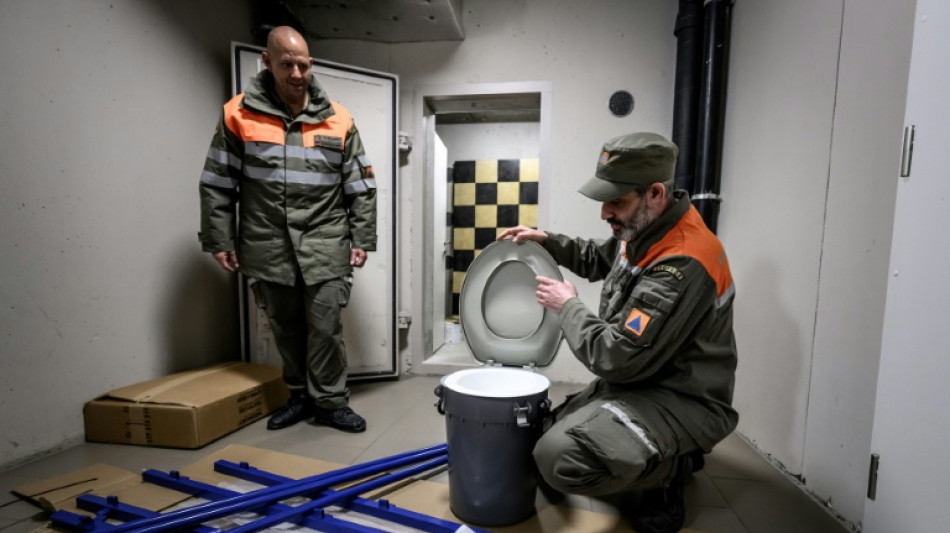
Swiss Cold War bunkers back in vogue as Ukraine conflict rages / Photo: ©

 'More confrontational': Iran's new hardline security leadership
 UK summons Israeli envoy over West Bank settlement project

 Trump vows 'tremendous' economic costs on Iran partners

 Germany, France, UN condemn far-right Israeli minister's 'inhumane' Gaza remarks

 Prince Harry and Meghan moving back to UK: British press

 Lee, Baena guide Atletico to opening Liga win over Malaga
 Ecuador intel chief, five Americans killed in Kenya helicopter crash
 Robinson and Tongue share match ball after dismissing Pakistan

 Israel army admits firing on car in death of five-year-old Hind Rajab

 Honduras places 80% of country on El Nino drought alert
 Some of Meta's safety tools were 'designed to fail': witness
 PSG Ligue 1 opener moved over state of Parc des Princes pitch

 UK PM launches bid to help homeless, donating part of his wages

 Golden Shoe winner Kane hopes for Ballon d'Or after 'best season ever'

 Kyiv's ex-defence chief makes risky bet by venturing into electoral grounds
 Coventry have survival inspiration says Lampard
 Reijnders leaves Man City for Saudi's Al Qadsiah

 Trump says will meet North Korea's Kim later this year

 Stocks waver, dollar drops as US Treasury moves to lower bond yields

 France recalls rare disease drug Tavneos after deaths
 Arsenal agree to sign Villa defender Konsa: reports
 Evacuation orders lifted in Belgian wildfire zone
 UK media skewered for 'hounding' black academic
 More than 7,300 excess deaths in France's historically hot summer so far
 US socialists score shock Florida win as Trump picks stumble

Russia's invasion of Ukraine has reawakened interest in Switzerland's concrete nuclear fallout shelters, built during the Cold War with enough space to shelter everyone in the country.
Since the 1960s, every Swiss municipality has had to build nuclear bunkers for their residents, while such shelters have also been mandatory in all homes and residential buildings over a certain size built since then.
The shelters have become an integral part of the Swiss identity, on a par with the country's famous chocolate, banks and watches.
But the underground spaces, long seen as a quirky curiosity mostly used for storage or as very well-protected wine cellars, are being viewed in a new light since Russia invaded Ukraine on February 24.
Just days into the attack, Russian President Vladimir Putin put the country's strategic nuclear forces on high alert, sparking global alarm.
Fierce fighting near Ukraine's nuclear power plants, including Chernobyl -- the sight of the world's worst nuclear accident in 1986 -- have also heightened fears that even traditionally neutral Switzerland could be affected by the war.
- 'Ukraine is very nearby' -
"People are discovering that Ukraine is very nearby," Marie Claude Noth-Ecoeur, who heads civil and military security services in the mountainous southern Wallis region, told AFP.
The wealthy Alpine country has pledged that each and every resident will have a shelter space if needed.
In fact, the country of 8.6 million people counts nearly nine million spaces across 365,000 private and public shelters.
But while there are more than enough spots at a national level, there are vast regional differences.
Geneva is worst off, with only enough places for 75 percent of its population.
Nicola Squillaci, head of Geneva's civil protection and military affairs division, said the shelters were conceived to provide protection "especially in the case of a bombing and a nuclear attack".
They would help protect the population "against the shock waves, and against radioactivity in the air", he told AFP.
Ducking into a private shelter for around 150 people, underneath a brand new residential building in the Geneva suburb of Meyrin, Squillaci pointed out how, in peace time, it was equipped with basement storage units for the apartment dwellers above.
But unlike most storage facilities, this one comes with composting toilets, kits for quickly assembling beds, and a ventilation system that filters the air coming in from the outside.
- 'Capsule' -
"It is like a capsule, with airlocks on emergency exits and main exits," Squillaci said.
"If the building were to collapse, the shelter would remain intact."
Switzerland's vast network of nuclear bunkers have a range of other day-to-day uses, including as military barracks or as temporary accommodation for asylum seekers.
But Swiss authorities require that they can be emptied and reverted back to nuclear shelters within five days.
So far, Switzerland's population has never been ordered down into the shelters, not even in the wake of the Chernobyl disaster.
Experts say the most likely scenario for needing to use them has always been a possible accident at one of Switzerland's own nuclear power plants.
But now the conflict raging in Ukraine has added a new, urgent layer to the national nuclear anxiety.
With public concern growing, Swiss authorities have published overviews of the available shelter spots, and have urged households to always maintain a stock of food to last at least a week.
With Ukraine, "the geopolitical situation has altered the paradigms a bit," Squillaci said, adding that authorities were receiving "enormous numbers of legitimate questions from citizens."
A number of property owners who previously sought to pay a fine rather than build bunkers were also backtracking, he said.
- 'Temporary protection' -
To compensate for the lack of shelters under chalets and other traditional mountain homes, Alpine cantons like Wallis meanwhile rely heavily on large collective bunkers.
In Evionnaz, a municipality with around 1,000 inhabitants, the collective shelter can accommodate around 700 people, counting 15 dormitories filled with row after row of three-storey bunk beds.
"The country asks us to be on the ready," Noth-Ecoeur said.
"Today we are in a preparatory phase, and we are ready to put the shelters to use."
Experts caution though that the level of protection provided by the shelters in the case of actual nuclear weapons use would depend heavily on the intensity and proximity of the strikes.
"The shelters could offer the population a certain level of temporary protection against radioactive events," Swiss defence ministry spokesman Andreas Bucher told AFP.
"A large-scale nuclear war would however be catastrophic, and no state would be able to guard against the effects."
B.Shevchenko--BTB