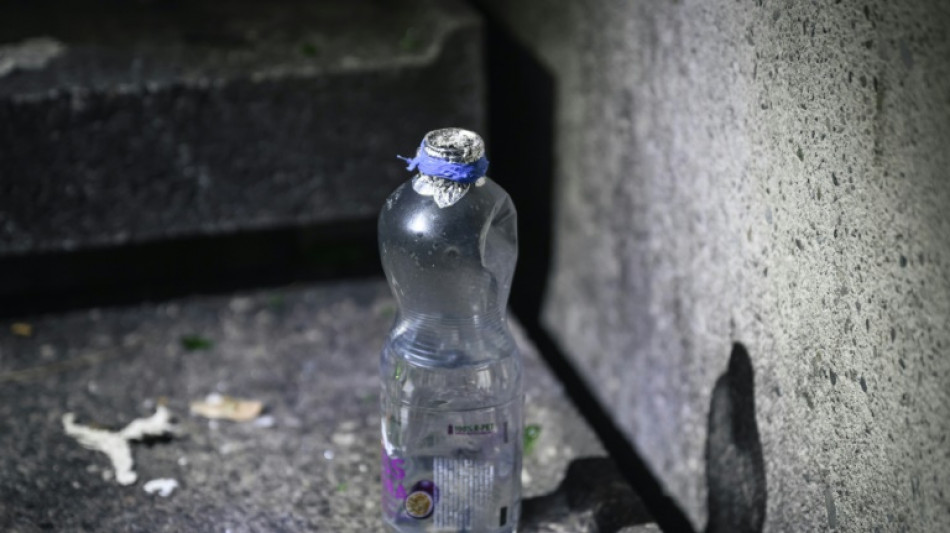
Booming crack use challenges progressive Swiss drug strategy / Photo: © AFP

 Toogood Gold's Table Mountain Sits in the Shadow of a Nevada Gold Rush

 MEXC July–August Security Report: 38.66M USDT in Risk Funds Intercepted, Futures Insurance Fund Hits 792M USDT

 'Breathing toxin every day': Indonesians choked by haze feel helpless
 Stocks edge higher ahead of US Fed rate call

 Philippines ex-leader Duterte makes first in-person ICC appearance

 2027 Formula One calendar includes Monaco sprint race

 Palestinians are the real victims, Thunberg tells Ed Sheeran

 Hashim Thaci: From 'George Washington of Kosovo' to Hague convict

 Amnesty says Iran committed 'crimes against humanity' in crackdown on 2022 protests

 EU to ban social media for under 13s, curb access until 15

 Philippines ex-leader Duterte makes first appearance at ICC

 EU chief pitches 'associate member' status for Canada

 English village votes to 'secede' from UK over asylum centre plan

 Wildfires push endangered Sumatran elephants to brink: Indonesian NGO

 Stocks head higher as traders prepare for Fed decision
 English village votes to 'secede' from UK over asylum centre

 Hong Kong unveils plan to align economy with China's goals

 Brazilian voters the latest to eye Bukele security model with envy

 EU chief hosts Canada's Carney in push to 'deepen' alliance
 EU chief to unveil social media, gaming curbs for under-15s
 Saudi says Houthis target Mecca, warn of 'red line'

 Asian stocks stutter as traders prepare for Fed decision

 US touts its power, avoids Iran war at G20 Energy meeting

 Dead animals, barren fields, and hunger - El Nino chokes Central America

 In hydropowered Bhutan, solar starts to rise

A boom in cheap crack cocaine is posing challenges to Switzerland's permissive drug strategy, not least to Geneva's safe injection rooms.
Behind Geneva's main railway station, a lime-green container structure called Quai 9 offers a space where people can legally shoot up, inhale or sniff drugs under medical supervision.
The site has more than two decades of experience in handling and supporting hard drug users.
But it has been unable to deal with a sudden surge in the use of crack: a cheap cocaine derivative which can cause paranoia, and aggressive and violent behaviour.
The boom has triggered rampant insecurity, forcing Quai 9 to temporarily close its "shoot-up room" to crack users.
"We have been open for 20 years, working with heroin and injected cocaine, but crack has caused us some difficulties," said Olivier Stabile, who works with the Premiere Ligne (Front Line) association that runs Quai 9.
"We couldn't ensure the safety of the other drug users, and we preferred to take a little break," he told AFP.
- $10 hits -
The use of crack, a highly addictive drug with dire health impacts, has been surging in several European countries in recent years.
In Geneva, the boom really took off in late 2021 as the Covid lockdown period ended, with consumption doubling in 2022, according to regional authorities.
Observers point to the emergence of small, ready-made doses which suddenly became widely available at record low prices of around $10.
But that means users are seeking out $10 hits "around every 15 minutes", David Perrin, a social health worker with Premiere Ligne, told AFP, adding that the constant hunt for cash was synonymous with violence.
Wary of the risks posed by crack users, Quai 9 nonetheless remains intent on providing support.
While waiting for the authorities to find a solution for safely welcoming crack users back into the shoot-up room, Quai 9 has set up a night-time watch system.
Once a week, Premiere Ligne volunteers patrol the areas where users hang out, handing out water, energy bars and clean crack pipes, which are aimed at helping reduce the transmission of diseases like hepatitis C.
"It's crucial," a crack user who only gave his name as Alvin told AFP.
"They take care of the young people, the social rejects," he said, stressing that "the human contact is essential".
The Geneva University Hospital has also set up a daytime watch system, with nurses going around to check on crack users.
- Change of approach -
Quai 9 was set up in 2001, less than a decade after Switzerland began moving away from penalising drug addicts and introduced one of the world's most progressive drug policies.
The shift was aimed at reining in an out-of-control drug scene that emerged in Zurich and other Swiss cities the 1980s, with people injecting heroin out in the open.
The new approach, which treated users as people needing help rather than delinquents, included safe injection sites and the dispensing of heroin.
Addicts coming with their own doses can obtain injection equipment, under the government's "four-pillar" policy: prevention, therapy, harm reduction and repression.
The policy has paid off, earning international recognition. Annual overdose deaths in Switzerland have plunged from more than 400 in the early 1990s to below 150 in recent years.
And the Swiss have broadly supported the strategy.
- 'Electroshock' -
But the crack boom is creating tensions in Geneva, with residents upset over strung-out drug users filling the streets outside Quai 9.
"Until now, Quai 9 was seen in a positive light in the neighbourhood... Now, with the swelling use of crack, some see it as the source of trouble", lamented Paula Quadri Sanchez, a Premiere Ligne social worker.
Increased crack use has resulted in more street dealing, insecurity, prostitution and other disturbances in the neighbourhood, forcing Quai 9 to request a greater police presence around the centre.
Closing Quai 9 to crack users was a real "electroshock" for the authorities, Pierre Maudet, in charge of health policy in the canton of Geneva, told AFP.
He said crack had undercut the whole structure created for handling drug addiction.
In a bid to deal with the problem, Geneva recently launched a three-year "crack plan", and aims to open a new space specifically dedicated to crack users.
"We must re-find a balance, with strengthened police and public security action... but also a slightly different health care approach," Maudet said.
Former Swiss president Ruth Dreyfus, behind Switzerland's drug policy shift in 1991, agreed crack posed a challenge.
"What worked with heroin is not working today with crack," she told AFP. "Other answers are needed."
P.Anderson--BTB