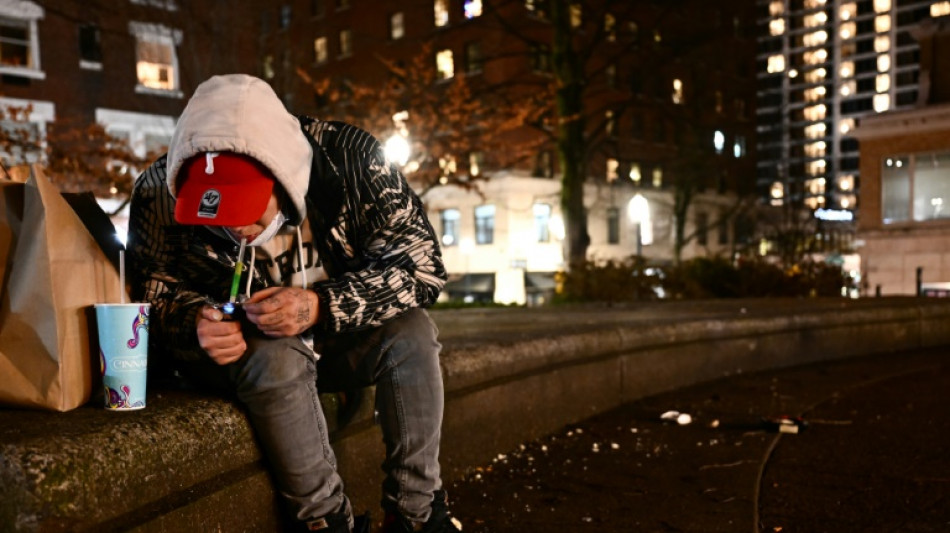
Three years after decriminalization, Oregon frets over drug use / Photo: © AFP

 IR-MED and Dice Technologies Announce collaboration to Evaluate and Advance Pressure-Injury Prevention Platform in Japan

 Watts, Pitt, Cruz to light up Spain's top film festival

 Sweden expels Iran embassy employee over anti-Jewish threats
 Toogood Gold's Table Mountain Sits in the Shadow of a Nevada Gold Rush

 MEXC July–August Security Report: 38.66M USDT in Risk Funds Intercepted, Futures Insurance Fund Hits 792M USDT

 'Breathing toxin every day': Indonesians choked by haze feel helpless

 Stocks edge higher ahead of US Fed rate call

 Philippines ex-leader Duterte makes first in-person ICC appearance

 2027 Formula One calendar includes Monaco sprint race

 Palestinians are the real victims, Thunberg tells Ed Sheeran

 Hashim Thaci: From 'George Washington of Kosovo' to Hague convict

 Amnesty says Iran committed 'crimes against humanity' in crackdown on 2022 protests

 EU to ban social media for under 13s, curb access until 15

 Philippines ex-leader Duterte makes first appearance at ICC

 EU chief pitches 'associate member' status for Canada

 English village votes to 'secede' from UK over asylum centre plan

 Wildfires push endangered Sumatran elephants to brink: Indonesian NGO

 Stocks head higher as traders prepare for Fed decision

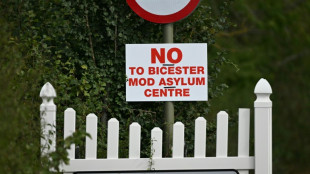 English village votes to 'secede' from UK over asylum centre
 Hong Kong unveils plan to align economy with China's goals

 Brazilian voters the latest to eye Bukele security model with envy

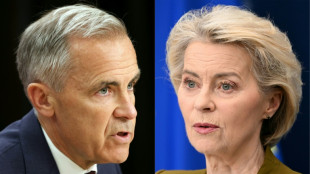 EU chief hosts Canada's Carney in push to 'deepen' alliance

 EU chief to unveil social media, gaming curbs for under-15s
 Saudi says Houthis target Mecca, warn of 'red line'

 Asian stocks stutter as traders prepare for Fed decision

When police officer Eli Arnold stops a homeless man smoking methamphetamine on the street in Portland, he simply writes him a ticket with a $100 fine.
Since hard drugs were decriminalized in Oregon three years ago, there are no arrests, just the fine and a card with a telephone number where the user can get help.
"Give them the ticket number and they'll just ask you if you want treatment," he tells the man.
"Just call the number, the ticket goes away."
In February 2021, possession and use of all drugs -- including cocaine, heroin, ecstasy and fentanyl -- was decriminalized in the western state. Sale and production remain punishable.
Like in Portugal, where drugs were decriminalized two decades ago, the idea is to instead treat users as people who need help.
But unlike in Portugal, there is no robust public health system in the United States.
The country is also in the grips of an epidemic of fentanyl -- an opioid up to 50 times more powerful than heroin, which is laying waste to communities everywhere.
In Oregon alone there were 956 fatal overdoses in 2022, a number that has trebled in three years.
2023 looks on track to smash that grim record, with over 600 deaths in the first six months.
- 'Terrible' -
His newly issued fine in hand, addict James Loe can attest to the devastation. At age 39, he says he has lost several acquaintances to fentanyl.
He has also saved more than 50 people from overdoses by giving them naloxone, a nasal spray antidote now considered essential in Portland.
"It’s terrible," says Loe, whose promising college basketball career was cut short by an injury that left him dependent on the opioid oxycodone, and on a downward spiral to ever-more powerful drugs.
Before too long he was on the streets, feeding a drug habit he now says he is sick of.
"I just need to get my act together and change. And I guess this, this will be a time to reflect," he says, promising to call the helpline.
Arnold is not so sure. He arrested Loe for shoplifting a few weeks earlier.
"Will James do something now?" he sighs. "Statistically, the odds are not great."
The toll-free number Arnold and his colleagues give out gets around 10 calls a month, according to a recent audit, which also found police handed out a low number of fines.
- Failure -
Many Portland residents that AFP met said decriminalization has been a failure, describing their city as an open-air drug market.
Arnold sees it all on his rounds.
"I don't think people realized that these groups would begin to use so brazenly, you know, that they'll be out in front of a preschool, smoking fentanyl," he says.
The discontent is such that Democrats, who control the state, are considering reversing course with a bill that would levy a $1,250 fine, or up to 30 days' jail, on people caught with hard drugs.
But health professionals insist it's not possible to say decriminalization has been a failure, because -- they argue -- it was smothered at birth.
"The spirit of Measure 110 was to stop using the criminal justice system to treat addiction. Instead, treat it as a medical issue and provide treatment. However, we haven't done that yet," says Solara Salazar, director of the Cielo Treatment Center, which helps addicts wanting to get clean.
The 2021 law was supposed to improve Oregon's abysmal drug treatment record by strengthening the health care system through taxes levied on cannabis sales.
But the Covid-19 pandemic overwhelmed the administration and funds were not released until almost 18 months after drugs were decriminalized.
"You put the cart before the horse," says Salazar. "You decriminalized, but you don't build any infrastructure and you don't have any services for folks that need it."
More than $260 million has now been spent, but the lack of residential treatment capacity remains stark.
One criticism of decriminalization -- that it would increase harmful drug use -- does not stand up to scrutiny.
In the 12 months after decriminalization, Oregon's overdose rate increased in line with that of 13 similar states that did not change their law, according to a recent New York University study.
- Culture change -
For Salazar, the system needs teeth to be effective.
"In Portugal, (addicts) have to go talk to a panel and they utilize skills to basically do an intervention and get folks to really buy into the treatment process," she says.
It is a model Oregon is slowly beginning to copy.
In Portland, police are starting to patrol with social workers, and reformers say they want law enforcement to be compelled to send users to see a professional.
It's a change that some addicts welcome.
One young woman who did not wish to give her name told AFP she has found herself stuck in a cycle of numbing her emotional pain with drugs.
When she was last arrested, she says, a police officer shouted at her and lectured her.
"How does that make me want to reach out or feel like I want help?" she said.
"That's gonna make me feel like I want to run and go use. "An addict really needs support."
E.Schubert--BTB