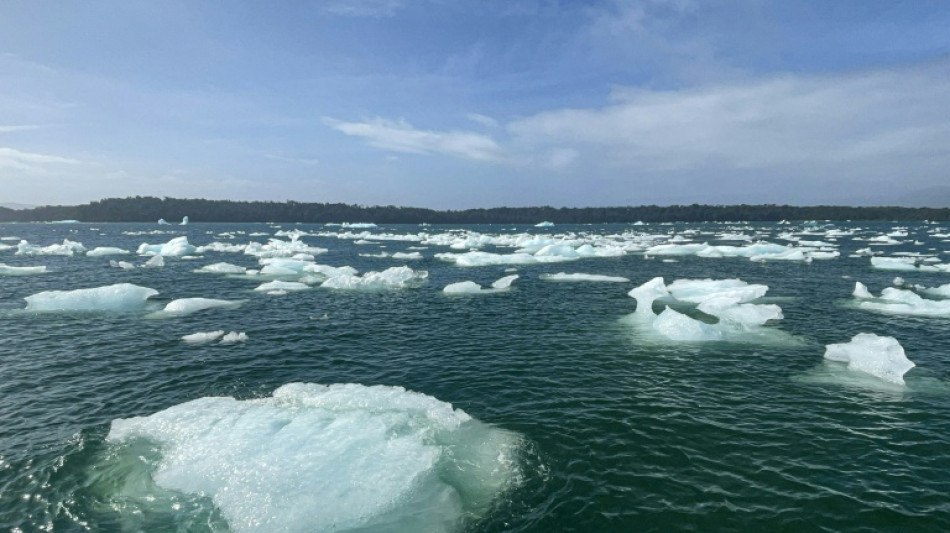
The UN's 10,000-page red alert on climate change / Photo: ©

 PSG start Ligue 1 defence with eye on Champions League hat-trick

 Arsenal can become world's best club: Arteta
 Japan's King Kazu, 59, scores twice from spot to make cup history

 Kyiv's desperate vendors persevere outside obliterated flea market
 Australia races to shield little penguins from H5N1 bird flu

 Messi scores first goal since father's death

 US national debt exceeds $40 trillion for first time

 Brazilian narco violence spills over into tranquil Bolivia

 Trump's devoted 'human printer' in media glare

 Top seed Zverev bundled out by Paul in rain-hit Cincinnati upset

 WADA pledges vigilance on Russian athletes ahead of 2028 Olympics

 NASA satellite rescue mission fails
 Cobolli halts Jodar to reach Cincinnati quarter-finals

 As election looms, Netanyahu puts Turkey in Israel's crosshairs

 McIlroy questions LIV stars 'value' as talk of PGA return builds
 'Breakthrough' mRNA cancer drug curbs melanoma in large trial

 Many US Fed policymakers back interest rate hikes if inflation stays high

 Robinson and Tongue star as Pakistan collapse in England opener

 All Blacks must get 'everything right' to beat Springboks, says legend Fitzpatrick

 Robinson and Tongue star as Pakistan all out for 171 in England opener

 Lake Zurich sees water level hit record low amid drought

 Merck and Moderna's tailored cancer drug curbs melanoma recurrence in trial

 Referees chief Webb wants clamp-down on Premier League set-piece grappling

 Robinson makes history as Pakistan collapse against England
 Alvarez can win back Atletico fans in two games: club chief

Accelerating global warming is driving a rising tide of impacts that could cause profound human misery and ecological disaster, and there is only one way to avoid catastrophe: drastically reduce greenhouse gas emissions.
Spread across 10,000 pages, these are the main takeaways from a trio of UN reports on climate change published in August 2021, February 2022 and on Monday. The three tomes -- each with its own roster of hundreds of authors -- focus on physical science, impacts and the need to adapt, and finally how to slash carbon pollution.
This will be the sixth such trilogy since the Intergovernmental Panel on Climate Change (IPCC) delivered its first report in 1990 and positioned itself as the final word on the science behind global warming.
Here are five key findings from the three reports:
- Beyond a doubt -
Whatever climate sceptics might say, scientific evidence has removed any lingering doubt that human activity is "unequivocally" responsible for global warming, which has seen the planet heat up an average of 1.1 degrees Celsius above preindustrial levels.
The atmospheric concentration of CO2 -- the main driver of warming, emitted mainly by burning fossil fuels -- rose at least 10 times faster between 1900 and 2019 than any time in the last 800,000 years, and is at its highest in two million years.
- Bye bye 1.5C? -
The 2015 Paris Agreement calls for capping global warming "well below" 2C, and 1.5C if possible. A crescendo of deadly impacts already being felt and a slew of new science has led most countries to embrace the more ambitious aspirational goal.
But that ship may have sailed.
In every IPCC projection for a liveable future, Earth's average surface temperature increases by 1.5C or 1.6C by around 2030 -- a decade earlier than estimates made only a few years ago.
In theory, it will be possible to cap temperature increases to below the 1.5C threshold by the end of the century, but even a temporary "overshoot" could cause irreversible damage to fragile ecosystems at the poles, in the mountains, and in coastal areas.
If countries do not improve on the emissions reduction pledges running to 2030, made under the Paris treaty, even staying under 2C will be a serious challenge. Current national policies would see Earth warm 3.2C by 2100.
- Avalanche of suffering -
Once a problem on the distant horizon, the devastating consequences of climate change have become a here-and-now reality. Nearly half the world's population -- between 3.3 and 3.6 billion -- are "very vulnerable" to global warming's deadly impacts, which are certain to get worse.
Heatwaves so extreme as to literally be unliveable; superstorms made more deadly by a water-logged atmosphere and rising seas; drought, water shortages, more disease-carrying mosquitoes and ticks...
These and other impacts are set to become worse, and will disproportionately ravage Earth's most vulnerable populations, including indigenous peoples.
Hundreds of millions could eventually be forced from their homes by sea levels -- pushed up mainly by melting ice sheets on Greenland and Antarctica -- that will continue to rise across the next century no matter how quickly humanity draws down emissions.
Even if global heating is capped at 2C, oceans could gain half-a-metre by 2100 and two metres by 2300, double the IPCC's estimate from 2019.
- Only option left -
The IPCC insists that it does not provide recommendations, only background information and policy options so decision makers can make the right choices to ensure a "liveable future" for the planet and its inhabitants.
But all roads leadiing to a 1.5C or even a 2C world "involve rapid and deep and in most cases immediate greenhouse gas emissions reductions in all sectors" -- including industry, transportation, agriculture, energy and cities.
Hitting those temperature goals will require a massive reduction in fossil fuel use, the IPCC says: 90 percent, 25 percent and 40 percent less coal, gas and oil, respectively, by 2050, and 90 percent, 40 percent and 80 percent less by 2100.
The use of coal plants that do not deploy carbon capture technology to offset some of their pollution to generate power must decline by 70 to 90 percent within eight years.
- Tipping points -
The new trio of IPCC reports emphasise as never before the danger of "tipping points", temperature thresholds in the climate system that could, once crossed, result in catastrophic and irreversible change.
The good news is that we seem to have pulled back from emissions scenarios from human sources that could by themselves result in a 4C or 5C world. The bad news is that "low probability/high impact" tipping point scenarios in nature could lead us there all the same.
The disintegration of ice sheets that would lift ocean levels a dozen metres or more; the melting of permafrost containing vast stores of the same greenhouse gases we are desperately trying to keep out of the atmosphere; the transformation of the Amazon basin from tropical forest to savannah -- all could be triggered by additional global warming.
Where are those triggers? Scientists are not sure, but they do know that the risk is much higher in a world that has warmed 2C above 19th-century levels than one that has warmed 1.5C.
Above 2.5C, the risk is "very high".
J.Horn--BTB