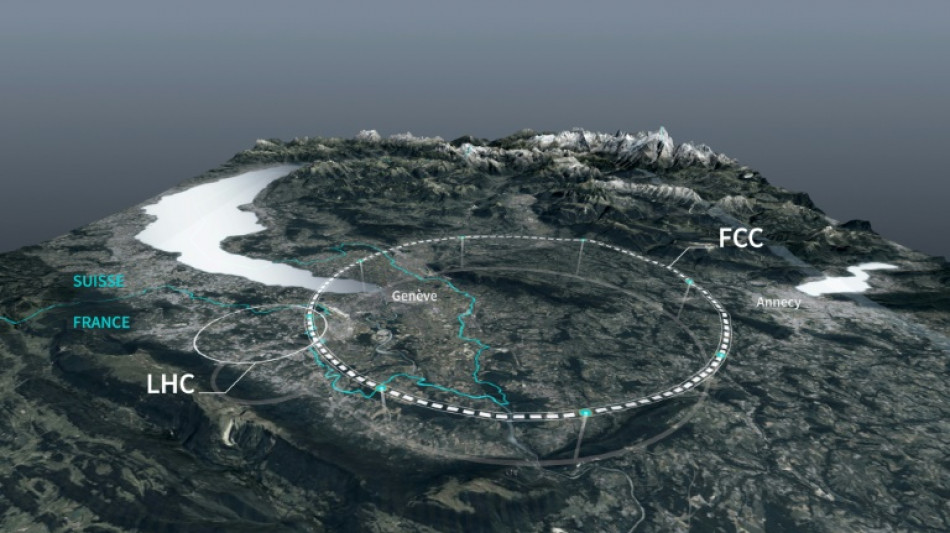
Plan for Europe's huge new particle collider takes shape / Photo: © European Organization for Nuclear Research (CERN)/AFP/File

 US House targets data centers as midterm backlash grows

 French ex-minister Dati goes on trial in Renault-Nissan corruption case

 'Being Heumann' captures joy in fight for disability rights

 Retired great Nadal to play in exhibition matches

 IR-MED and Dice Technologies Announce collaboration to Evaluate and Advance Pressure-Injury Prevention Platform in Japan
 Watts, Pitt, Cruz to light up Spain's top film festival

 Sweden expels Iran embassy employee over anti-Jewish threats

 Toogood Gold's Table Mountain Sits in the Shadow of a Nevada Gold Rush

 MEXC July–August Security Report: 38.66M USDT in Risk Funds Intercepted, Futures Insurance Fund Hits 792M USDT

 'Breathing toxin every day': Indonesians choked by haze feel helpless

 Stocks edge higher ahead of US Fed rate call

 Philippines ex-leader Duterte makes first in-person ICC appearance

 2027 Formula One calendar includes Monaco sprint race

 Palestinians are the real victims, Thunberg tells Ed Sheeran

 Hashim Thaci: From 'George Washington of Kosovo' to Hague convict

 Amnesty says Iran committed 'crimes against humanity' in crackdown on 2022 protests

 EU to ban social media for under 13s, curb access until 15

 Philippines ex-leader Duterte makes first appearance at ICC

 EU chief pitches 'associate member' status for Canada

 English village votes to 'secede' from UK over asylum centre plan

 Wildfires push endangered Sumatran elephants to brink: Indonesian NGO

 Stocks head higher as traders prepare for Fed decision

 English village votes to 'secede' from UK over asylum centre

 Hong Kong unveils plan to align economy with China's goals

 Brazilian voters the latest to eye Bukele security model with envy

Europe's CERN laboratory revealed more details Monday about its plans for a huge new particle accelerator that would dwarf the Large Hadron Collider (LHC), ramping up efforts to uncover the underlying secrets of the universe.
If approved, the Future Circular Collider (FCC) would start smashing its first particles together around the middle of this century -- and start its highest-energy collisions around 2070.
Running under France and Switzerland, it would be more than triple the length of CERN's LHC, currently the largest and most powerful particle accelerator.
The idea behind both is to send particles spinning around a ring to smash into each at nearly the speed of light, so that the collisions reveal their true nature.
Among other discoveries, the LHC made history in 2012 when it allowed scientists to observe the Higgs boson for the first time.
But the LHC, which cost $5.6 billion and began operating in 2010, is expected to have run its course by around 2040.
The faster and more powerful FCC would allow scientists to continue pushing the envelope. They hope it could confirm the existence of more particles -- the building blocks of matter -- which so far have only been theorised.
Another unfinished job for science is working out exactly what 95 percent of the universe is made of. About 68 percent of the universe is believed to be dark energy while 27 percent is dark matter -- both remain a complete mystery.
Another unknown is why there is so little antimatter in the universe, compared to matter.
CERN hopes that a massive upgrade of humanity's ability to smash particles could shed light on these enigmas and more.
"Our aim is to study the properties of matter at the smallest scale and highest energy," CERN director-general Fabiola Gianotti said as she presented an interim report in Geneva.
The report laid out the first findings of a FCC feasibility study that will be finalised by 2025.
- $17 billion first stage -
In 2028, CERN's member states, which include the UK and Israel, will decide whether or not to go through with the plan.
If given the green light, construction on the collider would start in 2033.
The project is split into parts.
In 2048, the "electron-positron" collider would start smashing light particles, with the aim of further investigating the Higgs boson and what is called the weak force, one of the four fundamental forces.
The cost of the tunnel, infrastructure and the first stage of the collider would be about 15 billion Swiss Francs ($17 billion), Gianotti said.
The heavy duty hadron collider, which would smash protons together, would only come online in 2070.
Its energy target would be 100 trillion electronvolts -- smashing the LHC's record of 13.6 trillion.
Gianotti said this later collider is the "only machine" that would allow humanity "to make a big jump in studying matter".
After eight years of study, the configuration chosen for the FCC was a new circular tunnel 90.7 kilometres (56.5 miles) long and 5.5 metres (feet) in diameter.
The tunnel, which would connect to the LHC, would pass under the Geneva region and its namesake lake in Switzerland, and loop round to the south near the picturesque French town of Annecy.
Eight technical and scientific sites would be built on the surface.
CERN said it is consulting with the regions along the route and plans to carry out impact studies on how the tunnel would affect the area.
J.Horn--BTB