Ukraine war brings bitter harvest to Moldovan orchards / Photo: ©

 PSG start Ligue 1 defence with eye on Champions League hat-trick

 Arsenal can become world's best club: Arteta
 Japan's King Kazu, 59, scores twice from spot to make cup history

 Kyiv's desperate vendors persevere outside obliterated flea market
 Australia races to shield little penguins from H5N1 bird flu
 Messi scores first goal since father's death
 US national debt exceeds $40 trillion for first time
 Brazilian narco violence spills over into tranquil Bolivia
 Trump's devoted 'human printer' in media glare

 Top seed Zverev bundled out by Paul in rain-hit Cincinnati upset

 WADA pledges vigilance on Russian athletes ahead of 2028 Olympics

 NASA satellite rescue mission fails
 Cobolli halts Jodar to reach Cincinnati quarter-finals
 As election looms, Netanyahu puts Turkey in Israel's crosshairs

 McIlroy questions LIV stars 'value' as talk of PGA return builds
 'Breakthrough' mRNA cancer drug curbs melanoma in large trial

 Many US Fed policymakers back interest rate hikes if inflation stays high
 Robinson and Tongue star as Pakistan collapse in England opener
 All Blacks must get 'everything right' to beat Springboks, says legend Fitzpatrick
 Robinson and Tongue star as Pakistan all out for 171 in England opener

 Lake Zurich sees water level hit record low amid drought
 Merck and Moderna's tailored cancer drug curbs melanoma recurrence in trial
 Referees chief Webb wants clamp-down on Premier League set-piece grappling
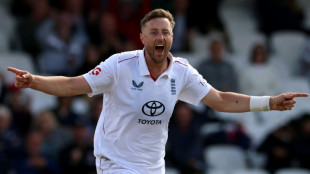 Robinson makes history as Pakistan collapse against England
 Alvarez can win back Atletico fans in two games: club chief

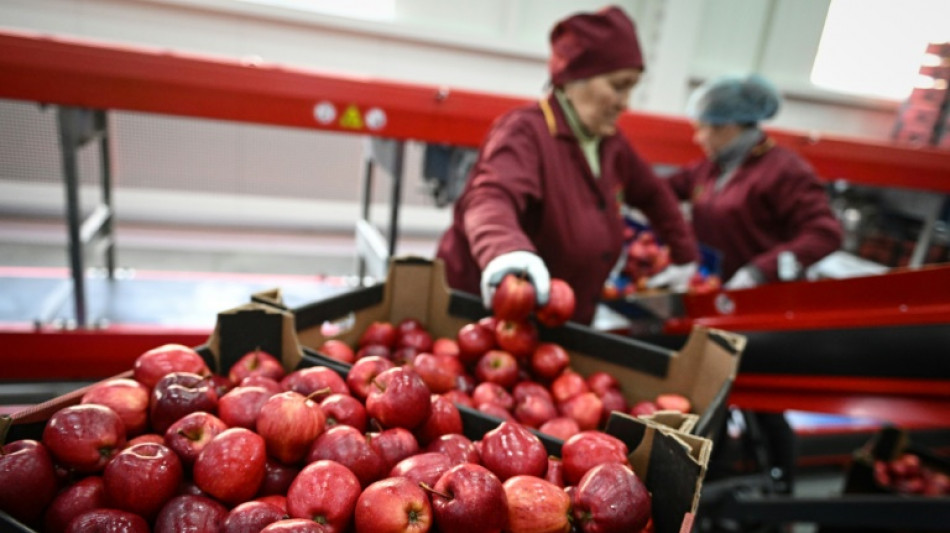
A warehouse in Moldova is piled high with crates of red apples but for an industry reeling from war in neighbouring Ukraine, the sight is far from appetising.
The conflict has all but ended apple exports to Russia, traditionally the main buyer of produce from Moldova's orchards.
"I don't know what we are going to do with the apples that are left over," admits grower Valeriu Matcovschi.
"There are too many for us to sell on the Moldovan market," he says in the northern village of Bilicenii-Vechi.
In normal times, lorries would arrive at least five times a week to take his 2,000-tonne yearly harvest to Russia.
Now he is scrambling to find new customers.
In late March he sent a first shipment to Kuwait, but he had to slash his prices by a third and accommodate clients with different demands about which varieties of apple they will take.
"I hope I won't have to start pulping the fruit. That would be a tragedy," he says.
Moldova is one of the poorest countries in Europe. The former Soviet republic of around 2.6 million people is sandwiched between Ukraine and Romania.
- Desperate appeals -
Moldova is in a "difficult situation", senior government official Dumitru Udrea told AFP.
More than 360,000 Ukrainians have fled into Moldova since the start of Russia's invasion. The vast majority have travelled on elsewhere, but 90,000 have stayed.
Energy price hikes, already rising but now exacerbated by the war, could push inflation to 30 percent by the end of the year.
Udrea fears the effects of the war mean that "in 2022 we could see a recession of between three and 15 percent".
The largely rural country, whose gross domestic product (GDP) is 0.4 percent that of Britain's, was already struggling to recover from a string of political and economic crises.
These came on top of a 2014-15 banking scandal that led to the disappearance of around one billion dollars (911 million euros).
Responding to desperate appeals from Moldova -- which formally asked to begin the process of joining the EU at the beginning of March -- Germany, France and Romania are holding a donors' conference in Berlin on Tuesday to help lighten the load.
Udrea says the government hopes for four billion euros from donors to boost energy security and protect Moldovans' purchasing power.
Thanks in part to a 2014 association agreement with the EU -- which drew the ire of Moscow -- trade with countries to its west now accounts for more than 60 percent of Moldova's total foreign trade.
- Ties to Russia -
But some traditional economic ties with Russia, Ukraine and Belarus have been less easy to replace.
"At first sight the share of exports to these countries -- 15 percent -- doesn't seem huge but several sectors are very dependent on it, above all apple growers," economist Adrian Lupusor, from the Expert-Grup think tank, told AFP.
Construction and agriculture are dependent on materials shipped from Russia and Ukraine. "Even if importers find suppliers elsewhere, the prices will be much higher," Lupusor says.
Udrea says the war could also see a plunge in the vital remittances sent back to Moldova by the more than one million people who have emigrated over the past 20 years.
That stream of income is a lifeline for many who remain in the country and represents some 15 percent of GDP.
Lupusor says that some of the 300,000 or so Moldovans working in Russia may decide to come back, putting the labour market and social security system under fresh pressure.
Meanwhile in Bilicenii Vechi, as workers sort shiny apples and forklift trucks trundle around him, Matcovschi worries for the future of the 50 or so people he employs.
Asked about possible redundancies, he replies, "I dare not think about it."
"I hope we'll be able to hold out."
C.Kovalenko--BTB