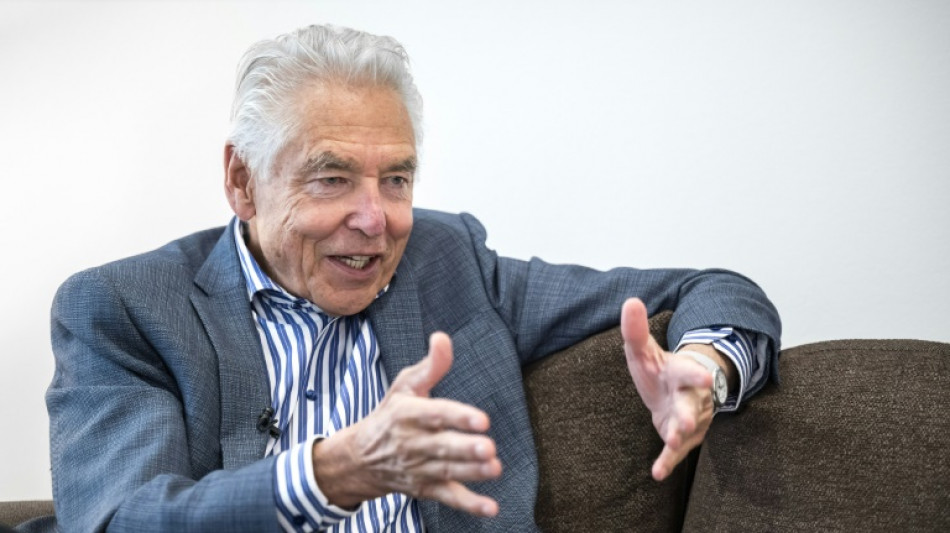
Scientists launch hub to channel quantum power for good / Photo: © AFP

 Abhishek hits record T20 ton as India post 221-7 against Afghanistan

 Macron hosts Lebanon security talks to back 'indispensable' army

 Final rally of season in Saudi Arabia cancelled due to Middle East conflict

 Gaza documentary sparks political storm in Israel

 King Charles warns tech bosses of 'existential dangers' of AI

 French fishermen block ports over petrol prices

 AFP photo shows Trump examining image of Kennedy Center apparent demolition

 Andersson vows to take Sweden in 'new direction' after election win

 Turkey's Erdogan to run again in early 2028 vote, top adviser says

 Sweden's Andersson: a trusted, no-nonsense political operator

 Canada's Carney pushes 'new alliance' with EU despite Trump threats

 Ireland to boycott Eurovision 2027 over Gaza

 India's Tata Sons reappoints N. Chandrasekaran as chairman

 Sweden's left-wing wins election thriller

 Germany urges EU action against China to defend carmakers

 Stocks mostly rise after US Fed rate hike, oil eases

 Palestinians turn rugged caves into homes after Israeli demolitions

 Two unseen Monet paintings to be sold in Paris: auction house

 Klopp wants German team to help reclaim national pride from far-right

 Ninth woman found dead in South Africa killing spree

 Smog scuppers Japan force helping fight Indonesia wildfires

 King Charles to call on tech giants for 'reassurances' over AI

 Lebanon security talks in Paris focus on replacing UN mission

 Most stocks rise as Fed hikes and oil prices drop

 'Vande Mataram': Why is India's freedom song in spotlight?

Scientists will work to channel the huge emerging power of quantum computers for the common good at a new institute that opened in Geneva on Tuesday, its founders said.
The Open Quantum Institute is calling on researchers from around the world to pinpoint the most promising future applications for the fast-emerging technology -- and ensure they are open and accessible to all.
"Quantum computing has the potential of changing almost everything," said Peter Brabeck-Latmathe, chairman of the science and diplomacy platform GESDA that conceived of the project.
He told AFP the future technology was expected to be "1,000 to 10,000 times more potent than the computing power we have today", insisting it was vital to begin thinking hard about how to govern it and ensure it is used for good.
During a ceremony late Tuesday at Europe's science lab CERN, where the institute will be housed during its three-year pilot period, experts summed up discussions after a day of workshops focused on the various visions for the role it will play.
- 'Huge risk' -
It is important to reflect on "the duality of the technology", Ozge Aydogan of the United Nations-run SDG Lab told the gathering.
"It can be an asset for the future, but it can be a huge risk".
CERN chief Fabiola Gianotti meanwhile said the landmark nuclear research lab was the perfect place for the centre, which would benefit from its long experience in "employing scientific and technological progress to the benefit of society."
Quantum computing combines advances in scientific understanding of the subatomic world with leaps in information theory to solve mathematical problems that are impossible for today's conventional computers.
While traditional computers process information in bits that can be represented by 0 or 1, quantum computers use qubits, which can be a combination of both at the same time, allowing them to solve more complex problems.
The first commercial quantum computers are still believed to be up to a decade away, and the technology is not expected to be fully developed before around 2050.
Brabeck-Latmathe, the former longtime head of Swiss food giant Nestle, said it was important to make sure that such a powerful technology was governed in an open and transparent way and was not allowed to be controlled by a handful of giant tech companies.
With quantum computing still under development, there is "time to think about what's going to be the impact of these new technologies ... the ethical considerations."
The institute will seek out applications of the technology that can move the world closer to implementing the UN Sustainable Development Goals.
Quantum computing simulations and calculations might for instance help determine how to reduce carbon dioxide in the atmosphere to help rein in climate change.
It could also potentially predict patterns of antibiotic resistance, and identify new, more effective chemical compounds for battling deadly bacteria.
In a bid to speed up the search for the best applications of the technology, GESDA has joined forces with Google and non-profit tech group XPrize and launched a competition Tuesday calling for researchers everywhere to submit proposals.
The three-year competition will reward the teams submitting the best projects, with $5 million in prizes at the end.
M.Ouellet--BTB