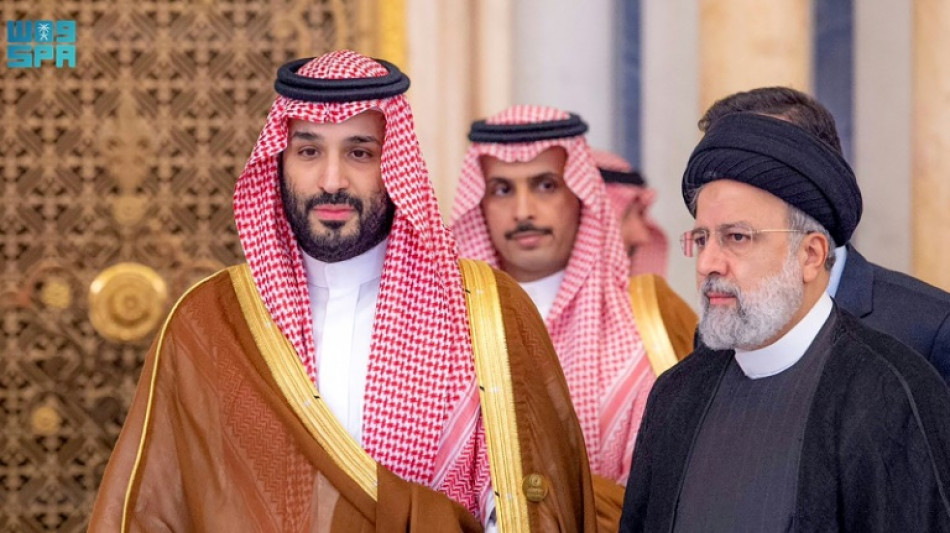
'Reframed' Iran ties shield Saudi in Gaza war: analysts
/ Photo: © SAUDI PRESS AGENCY/AFP/File

 Princess Diana's brother makes new explosive claims against Charles

 Ovechkin on Russian political video: 'I support my country'
 Can we shut down AI?
 Teenager Sullivan named in new-look US squad

 Travis Scott and Keith Richards feature on GTA VI soundtrack

 AFP photo shows Trump examining image of apparent Kennedy Center razing
 Pochettino rings changes for USA friendlies
 Alonso says Chelsea ambition 'very clear' after end of Boehly era
 Mbappe draws political fire over Ceuta t-shirt controversy
 Third malaria death in Germany from outbreak tied to Frankfurt airport

 AtlasClear Holdings Reports Preliminary Fiscal 2026 Revenue of Approximately $20.1 Million, Up 85%; Revenue Plus Interest Income of Approximately $21.9 Million

 Alonso says Chelsea ambition clear after end of Boehly era
 Micron's Taiwan workers say 68 months' bonus not enough
 'Another arrow to the quiver': World Bank posts record private capital mobilization
 Macron hosts Lebanon security talks as UN mission nears end
 From land to race laws: what's driving the US-South Africa rift?

 Beyond Investment Returns: Families Are Measuring Wealth by Freedom, Continuity, and Legacy, According to Nour Private Wealth
 King Charles disputes claims in book by Princess Diana's brother
 Real Madrid fan group wants Mbappe apology over Ceuta shirt snub

 Nepal floods among 'most challenging' disasters: WFP
 Doubts as Italy eyes electric future for steel plant
 'One of the kindest people': Taraneh, 21, facing execution in Iran

 Japan eyes changing prostitution law to punish sex buyers

 After record rain, typhoon threatens new challenge to Asian Games
 Kids and social media: what would change under new EU law
A surprise deal reached one year ago to mend ties with Iran has paid dividends for Saudi Arabia, largely shielding it from the Israel-Hamas war and related unrest, analysts say.
Though thorns remain in the complex relationship between the Middle East rivals, the rapprochement amounts to a signature diplomatic achievement for Crown Prince Mohammed bin Salman, Saudi Arabia's hard-charging de facto ruler.
After a turbulent rise to power that saw Prince Mohammed launch a war in Yemen and mount a boycott of Qatar, the 38-year-old has since adopted a more conciliatory approach that culminated in the deal with Iran announced on March 10, 2023.
The goal has been to focus on an ambitious domestic economic and social reform drive meant to position Saudi Arabia, the world's biggest crude exporter, for post-oil prosperity –- a dream that could collapse if the war raging in Gaza were to engulf the wider region.
So far, Riyadh has managed to stay above the fray while voicing support for the Palestinian cause, in no small part because it is no longer officially at loggerheads with Hamas-backer Tehran.
"Now it is clear how strategic of a choice it was to normalise relations between Saudi Arabia and Iran," said Saudi analyst Aziz Alghashian.
"They have basically shown that they are not each other's enemy, even if suspicion will always be there... The relationship has been reframed."
- Gains and gaps -
Sunni-majority Saudi Arabia and Shiite-majority Iran have often found themselves on opposing sides of regional conflicts, from Syria to Lebanon and Iraq.
Before last year's landmark deal, bilateral ties had been severed for seven years –- a rupture triggered by attacks on Saudi diplomatic missions in Iran during protests over Riyadh's execution of Shiite cleric Nimr al-Nimr.
The terms of the rapprochement called for the swift reopening of diplomatic missions and the implementation of security and economic cooperation agreements signed more than two decades ago.
Other benefits soon became clear, such as when –- just over a month after the deal was signed -– 65 Iranians fled via ferry from war-hit Sudan to the Saudi Red Sea port city of Jeddah, where they were greeted by four newly arrived Iranian diplomats.
The deal also facilitated the return of Syrian President Bashar al-Assad, a close Iran ally, to the Arab fold –- a previously improbable rehabilitation capped by his attendance at an Arab League summit for the first time in more than a decade.
Yet the promise of the deal has only been partly fulfilled, with no apparent breakthroughs on some lingering disagreements, including over a disputed gas field Saudi Arabia wants to develop jointly with Kuwait.
"The steps taken by the two countries are good, but the agreement still requires many confidence-building measures," said Huda Raouf, head of the Iranian programme at the Egyptian Center for Strategic Studies in Cairo.
- 'There will be tensions' -
The clearest example of the Iran deal's chequered record is the war in Yemen, where in 2015 Saudi Arabia mobilised a military coalition to topple the Iran-backed Huthi rebels, who had seized the capital Sanaa the previous year.
The conflict has killed hundreds thousands of people directly from fighting or from indirect causes such as lack of food.
After the Saudi-Iranian rapprochement was announced, expectations swelled for a lasting ceasefire, with Saudi and Huthi delegations trading visits.
But while a truce that first took hold in April 2022 has largely held despite officially expiring after six months, momentum on the peace process appears to have stalled.
In November, the Huthis launched a campaign of attacks on Red Sea shipping -- a move they said was intended to show solidarity with Palestinians.
Unrest in the Red Sea region threatens Riyadh's economic and tourism goals, though the Huthis have avoided reprising their attacks on Saudi soil, and Saudi Arabia has not joined a US coalition to protect Red Sea waters.
Analysts say that, by ramping up communication to contain the Israel-Hamas war, Saudi Arabia and Iran have strengthened their bond.
This has led to the first phone call between Prince Mohammed and Iranian President Ebrahim Raisi -- just five days after the war broke out -- and a visit by Raisi to Riyadh in November for a meeting of the Organisation of Islamic Cooperation.
"Yes, there will be tensions and I think nobody thought there won't be any tensions, but the fact they are talking about it is something that is bringing a lot of strategic benefit," Alghashian said.
If the deal weren't in place, said Rabha Saif Allam of the Cairo Center for Strategic Studies, Saudi-Iranian rancour "could have increased the possibility of a broader regional conflict erupting."
E.Schubert--BTB