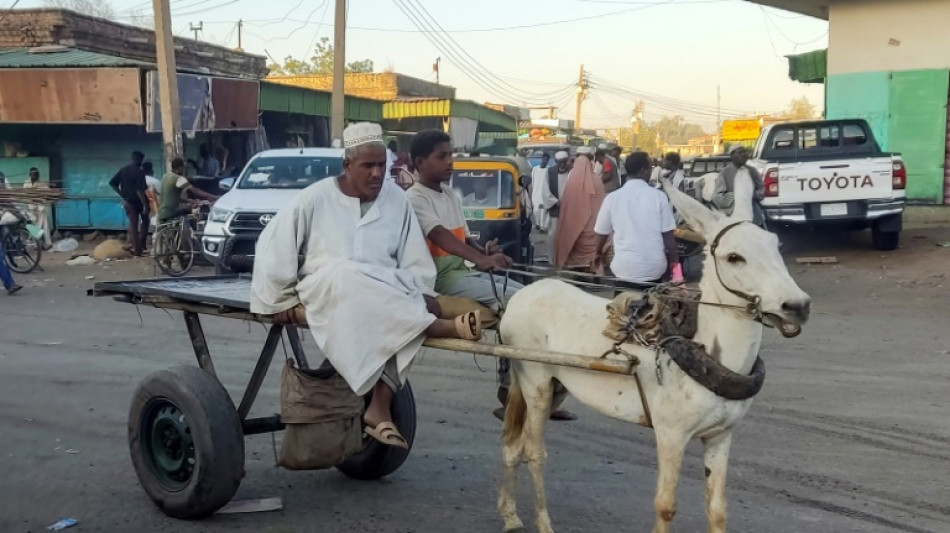
War-weary Sudanese without fuel turn to donkey carts / Photo: © AFP

 Princess Diana's brother makes new explosive claims against Charles

 Ovechkin on Russian political video: 'I support my country'
 Can we shut down AI?
 Teenager Sullivan named in new-look US squad
 Travis Scott and Keith Richards feature on GTA VI soundtrack

 AFP photo shows Trump examining image of apparent Kennedy Center razing
 Pochettino rings changes for USA friendlies

 Alonso says Chelsea ambition 'very clear' after end of Boehly era

 Mbappe draws political fire over Ceuta t-shirt controversy

 Third malaria death in Germany from outbreak tied to Frankfurt airport
 AtlasClear Holdings Reports Preliminary Fiscal 2026 Revenue of Approximately $20.1 Million, Up 85%; Revenue Plus Interest Income of Approximately $21.9 Million
 Alonso says Chelsea ambition clear after end of Boehly era

 Micron's Taiwan workers say 68 months' bonus not enough
 'Another arrow to the quiver': World Bank posts record private capital mobilization
 Macron hosts Lebanon security talks as UN mission nears end
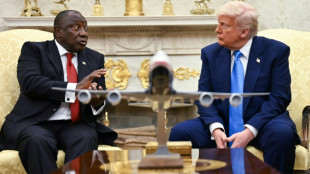 From land to race laws: what's driving the US-South Africa rift?

 Beyond Investment Returns: Families Are Measuring Wealth by Freedom, Continuity, and Legacy, According to Nour Private Wealth
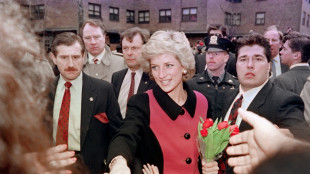 King Charles disputes claims in book by Princess Diana's brother

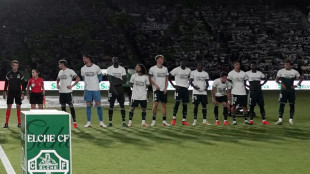 Real Madrid fan group wants Mbappe apology over Ceuta shirt snub

 Nepal floods among 'most challenging' disasters: WFP

 Doubts as Italy eyes electric future for steel plant
 'One of the kindest people': Taraneh, 21, facing execution in Iran
 Japan eyes changing prostitution law to punish sex buyers

 After record rain, typhoon threatens new challenge to Asian Games
 Kids and social media: what would change under new EU law
In war-torn Sudan, where chaos and fuel shortages have ground normal motor traffic to a halt, people once more rely on donkey carts -- even for urgent trips to the hospital.
In a small town south of the capital Khartoum, Hussein Ali has been busy carting patients to a clinic on a rickety wooden carriage that now serves as an ambulance.
"Just an hour ago, I brought a woman who went into labour in a village 15 kilometres (nine miles) away," Ali told AFP near a clinic in Tamboul, Al-Jazira state.
"The carriage is the only way to get patients from villages to the hospital," he said of his vehicle, called a "caro" in Sudanese Arabic and now once more a common sight in many states.
Sudan has been rocket by a brutal war that has killed thousands -- including up to 15,000 in a single Darfur town, according to UN experts -- and displaced millions since last April.
The conflict has pitted the regular army of de facto leader Abdel Fattah al-Burhan against the paramilitary Rapid Support Forces (RSF) of his former deputy, Mohamed Hamdan Daglo.
Burhan's government has retreated east to Port Sudan, while the RSF now controls much of Khartoum, nearly the entire western Darfur region and much of the country's south.
When the RSF in December overran central Al-Jazira state, until then a relative safe haven, nearly half a million people fled, many for the second or third time.
But millions more, who were unable or unwilling to leave, remain trapped there, enduring insecurity, dire shortages and a deepening health crisis.
- Roadblocks and no petrol -
Civilians have also been left stranded without regular road transport as the RSF has set up checkpoints and petrol stations have run dry.
Since the RSF rolled in, fuel suppliers from army-controlled areas "have not resupplied petrol stations in Al-Jazira", said a petrol station worker who requested anonymity.
The price for scarce fuel rose 20-fold to 25,000 Sudanese pounds or about $20 a litre.
When the RSF conquers new territory, its fighters are known to commandeer homes, businesses and vehicles.
A local bus driver, Al-Taher, said that "when the RSF took over the area, I hid my bus so it wouldn't be stolen".
Al-Taher said he too has shifted to driving a donkey cart. He was speaking on condition of being identified by one name only for fear of retaliation.
He now mostly takes passengers on a six-kilometre trip between his village and Rufaa, a town 40 kilometres north of the state capital Wad Madani.
At any rate, he doesn't have a choice. "Even if I did take my bus out, there are no petrol stations to get fuel from," Al-Taher said.
Also impacted is village shop-owner Bakri Khaled, who said he now has to pay for a bumpy 13-kilometre ride on a horse-drawn cart every day to the market in Tamboul.
"Since the war came here, this horse-drawn carriage is the only way to get groceries to my store in the village," he told AFP.
He said that what used to be a 15-minute truck ride can now take more than two hours, and that the price of the journey has doubled.
One of the few businessmen to see a benefit was donkey and horse trader Abdelrahman Al-Zein.
Rising demand in recent times, he said, has seen "the prices of donkeys, horses and carts all increasing".
O.Bulka--BTB