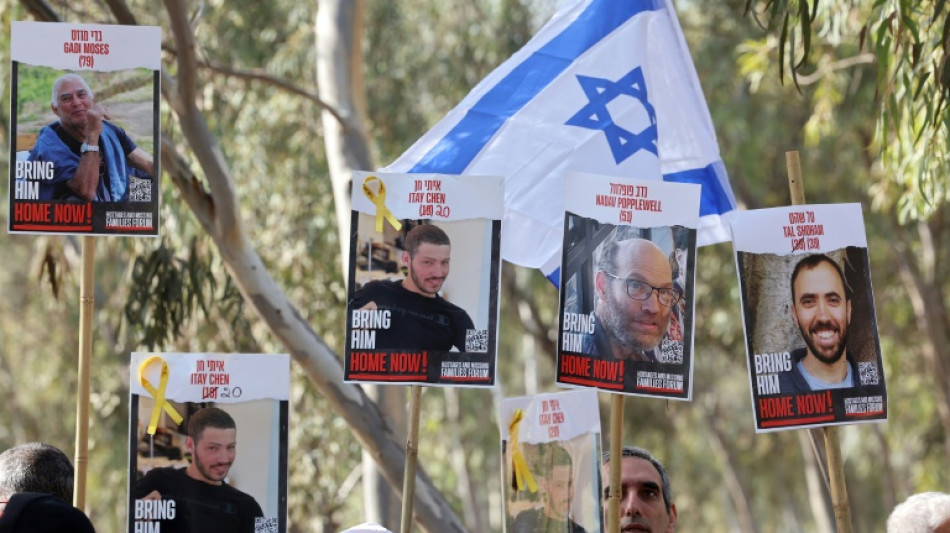
Gaza hostages risk lasting psychological trauma: experts / Photo: © AFP

 Princess Diana's brother makes new explosive claims against Charles

 Ovechkin on Russian political video: 'I support my country'

 Can we shut down AI?
 Teenager Sullivan named in new-look US squad

 Travis Scott and Keith Richards feature on GTA VI soundtrack

 AFP photo shows Trump examining image of apparent Kennedy Center razing

 Pochettino rings changes for USA friendlies

 Alonso says Chelsea ambition 'very clear' after end of Boehly era

 Mbappe draws political fire over Ceuta t-shirt controversy

 Third malaria death in Germany from outbreak tied to Frankfurt airport

 AtlasClear Holdings Reports Preliminary Fiscal 2026 Revenue of Approximately $20.1 Million, Up 85%; Revenue Plus Interest Income of Approximately $21.9 Million

 Alonso says Chelsea ambition clear after end of Boehly era

 Micron's Taiwan workers say 68 months' bonus not enough
 'Another arrow to the quiver': World Bank posts record private capital mobilization

 Macron hosts Lebanon security talks as UN mission nears end
 From land to race laws: what's driving the US-South Africa rift?

 Beyond Investment Returns: Families Are Measuring Wealth by Freedom, Continuity, and Legacy, According to Nour Private Wealth

 King Charles disputes claims in book by Princess Diana's brother

 Real Madrid fan group wants Mbappe apology over Ceuta shirt snub

 Nepal floods among 'most challenging' disasters: WFP

 Doubts as Italy eyes electric future for steel plant
 'One of the kindest people': Taraneh, 21, facing execution in Iran

 Japan eyes changing prostitution law to punish sex buyers

 After record rain, typhoon threatens new challenge to Asian Games

 Kids and social media: what would change under new EU law

If and when the hostages held by Hamas in Gaza are released under any deal, they face the risk of lasting psychological trauma, experts warned, citing the suffering of people freed previously.
"There are some that are living dead. As if they were frozen in time and place in Gaza, and haven't returned," said Merav Roth, a clinical psychologist who treated some of those former hostages and their families.
Israel launched an assault to destroy Hamas after the group's unprecedented attack on southern Israel on October 7. The hostages' possible release is one of the points at stake in truce talks under way in Egypt.
Hamas's attack resulted in the deaths of about 1,160 people, mostly civilians, according to an AFP tally of official figures, and saw some 250 hostages taken, most of them Israelis.
Israel's retaliatory bombardment and ground offensive have killed more than 30,700 people, most of them women and children, according to the territory's Hamas-run health ministry.
- 'World of chaos' -
Some hostages were released under a week-long truce in November but around 130 others remained in the hands of Hamas in Gaza.
"We're going to have to immediately take care of these hostages... to help them overcome their fear and their stupor and bring them back to real life," Marilyne Baranes, a psychologist who specialises in post-traumatic stress disorder (PTSD), told AFP.
Of the approximately 100 Israeli hostages freed under the earlier truce, half are undergoing treatment or therapy, the country's government said.
Those who were kept in more dangerous or traumatic conditions, experience "more severe symptoms of anxiety, depression", Roth said.
"But among them all, there's great difficulty in returning to functionality."
Christine Roulliere-Le Lidec, a PTSD specialist, told AFP that survivors need both physical and psychological support in order to move on from a "world of chaos, of hell, to the world of life."
"I've seen cases of people who... supported of course by the health care teams and their families, can finally get through it... to be able to finally find meaning in your life when you've been living in nonsense and barbarism and chaos."
- Limited research -
Research indicates it is difficult to measure the risk of mental illness in different hostages after their release.
While some former hostages have suffered severely -- French journalist Brice Fleutiaux took his own life in 2001 after being held hostage in Chechnya -- others appeared to overcome their trauma.
Briton Terry Waite, who spent four years detained in Lebanon in the 1980s, has dedicated his life to helping hostages and their families.
A 2009 study in the Journal of the Royal Society of Medicine concluded: "As yet there is no clear delineation of all factors which conduce to an adverse outcome following being taken hostage."
- Post-release monitoring difficult -
The study found evidence that those facing worse after-effects included women, people with little education but also those held for long periods -- as is the case with the hostages in Gaza.
However, the findings are dated and research is difficult to carry out.
"For ethical and practical reasons, particularly if children are involved, the follow-up of hostages on release is difficult," the study said.
"Thus, the scientific and clinical database is relatively modest."
Many studies are based on autobiographies by former hostages which gives a limited point of view.
Experts agree that a lot depends on the first few hours after a hostage is released.
"You can get over this type of thing, but you won't go back to the way you were," psychologist Baranes said.
M.Ouellet--BTB