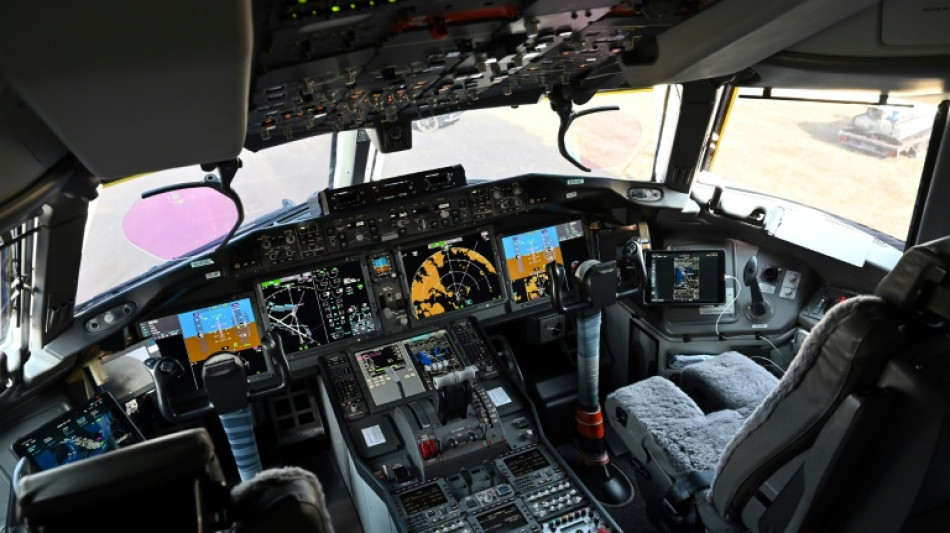
False GPS signal surge makes life hard for pilots / Photo: © AFP

 Juventus, Palace cruise to Europa League wins, Bournemouth beat Sociedad
 Stocks climb as oil retreats, Fed calms inflation fears

 Russians begin voting in controlled election as war drags
 Hispanics feel 'betrayed' on immigration, Republican warns Trump

 High-scoring Bears face Vikings in battle of NFL unbeatens

 'In our lane': Fed's Warsh defies Trump but still fighting for credibility
 Trump admin makes major cut to endangered species protections

 Princess Diana's brother makes new explosive claims against Charles

 Ovechkin on Russian political video: 'I support my country'

 Can we shut down AI?
 Teenager Sullivan named in new-look US squad
 Travis Scott and Keith Richards feature on GTA VI soundtrack

 AFP photo shows Trump examining image of apparent Kennedy Center razing

 Pochettino rings changes for USA friendlies

 Alonso says Chelsea ambition 'very clear' after end of Boehly era

 Mbappe draws political fire over Ceuta t-shirt controversy

 Third malaria death in Germany from outbreak tied to Frankfurt airport

 AtlasClear Holdings Reports Preliminary Fiscal 2026 Revenue of Approximately $20.1 Million, Up 85%; Revenue Plus Interest Income of Approximately $21.9 Million
 Alonso says Chelsea ambition clear after end of Boehly era

 Micron's Taiwan workers say 68 months' bonus not enough
 'Another arrow to the quiver': World Bank posts record private capital mobilization

 Macron hosts Lebanon security talks as UN mission nears end
 From land to race laws: what's driving the US-South Africa rift?

 Beyond Investment Returns: Families Are Measuring Wealth by Freedom, Continuity, and Legacy, According to Nour Private Wealth

 King Charles disputes claims in book by Princess Diana's brother

False GPS signals that deceive on-board plane systems and complicate the work of airline pilots are surging near conflict zones, industry employees and officials told AFP.
A ground collision alert sounds in the cockpit, for instance, even though the plane is flying at high altitude -- a phenomenon affecting several regions and apparently of military origin.
This includes the vicinity of Ukraine following the Russian invasion two years ago, the eastern Mediterranean and the air corridor running above Iraq, according to pilots and officials interviewed by AFP.
Disruptions which were previously limited to jamming preventing access to signals from geolocation satellites are now also taking a more dangerous form making it difficult to counter spoofing.
This sees a plane receive false coordinates, times and altitudes.
By comparing this data to the geographical maps in its memory banks, its systems can conclude there is imminent danger ahead, Thierry Oriol, a Boeing 777 pilot and member of the SNPL, the main French pilots' union, told AFP.
"There were some untimely alarms ordering people to pull back as far as possible on the stick and apply full power to avoid an obstacle, while the plane was in cruise... and in any case no mountain reaches so high," explained Oriol.
He also mentioned an incident "departing from Beirut where the plane thought it was at the level of the Alps, at 10,000 feet" (three kilometres/1.8 miles) above sea level.
- Risk management -
The problem, explained a manager at a European airline speaking on condition of anonymity, is that this adulterated information enters the navigation system and can cause false alerts hours afterwards as the flight nears its destination.
"At first, crews quickly see that it is a false alarm. But as it is an alarm warning of immediate danger, we ask the crews to still carry out the emergency manoeuvre, to make a return and an analysis.
"If the problem occurs a second time and the analysis has not revealed any danger, then the only way is to turn off this alarm, knowing other systems remain active to detect possible risk," the European airline manager added.
The commonly used GPS actually only covers the global navigation satellite system (GNSS) managed by the American army.
Two others exist -- the European Galileo and Russia's GLONASS.
On board airliners, GNSS are the main tools which pilots can rely on in order to determine their position, but they are not the only ones.
Without needing to return to the sextants of bygone days, these devices are equipped with inertial orientation devices capturing movement in order to deduce an object's trajectory.
But their precision deteriorates throughout the flight.
- 'Sharp rise' -
Since the start of the war in Ukraine, the European Union Aviation Safety Agency (EASA) has been warning that GNSS signal disruptions have intensified, affecting relatively remote regions beyond the conflict zone such as Finland and the Mediterranean.
In certain cases, this can lead to a modified trajectory or even a changed destination as it was impossible to carry out a landing in secure conditions, the EASA says.
The commission governing health and safety conditions for Air France pilots last month posted a warning of what it termed a "grave and imminent danger" of GPS spoofing, estimating the phenomenon was affecting as many as 3.7 flights in 1,000, according to an informed source.
In late January the EASA made it a priority to act against such disruptions in unveiling a partnership with the International Air Transport Association (IATA), the world's main airline association with more than 300 carriers, to counter spoofing and jamming.
"GNSS systems offer tremendous advantages to aviation in increasing the safety of operations in a busy shared airspace," said EASA acting executive director Luc Tytgat.
"But we have seen a sharp rise in attacks on these systems, which poses a safety risk."
Tytgat added that "in the medium term, we will need to adapt the certification requirements of the navigation and landing systems.
For the longer term, we need to ensure we are involved in the design of future satellite navigation systems."
For IATA director general Willie Walsh, "we need coordinated collection and sharing of GNSS safety data; universal procedural GNSS incident guidance from aircraft manufacturers; a commitment from States to retain traditional navigation systems as backup in cases where GNSS are spoofed or jammed."
Those systems include beacons or transmitters on the ground emitting radio signals that help planes to triangulate their position.
"Airlines will be critical partners. And whatever actions are taken, they must be the focal point of the solution as they are the front line facing the risk," said Walsh.
J.Fankhauser--BTB