Labour crunch forces Croatia to open doors to Asian workforce / Photo: © AFP

 Most Asian stocks track Wall St rally, yen drops after BoJ rate hike
 Russians begin voting in controlled election as war drags on
 Trump 'clearly' wants dialogue with Pyongyang: South Korean President

 Bank of Japan hikes rates to 31-year high to battle inflation
 Thailand's Muslim separatists vow to fight to the end

 Mideast turmoil, AI set to dominate UN gathering of world leaders
 Australia to detain tourists who overstay visa, minister says

 Championship rivals brace for renewal of bitter feuds

 In Brazil's Amazon, the hunt for oil fuels hopes and fears
 Australian athlete who soiled herself apologises for continuing Hyrox race

 Baby orangutans in India expose 'frightening' scale of trafficking
 Doom Loop? Ed Sheeran struggles against Gaza tide
 Sudanese women hold fast to threatened henna body art

 Man Utd misery puts Carrick under pressure, Spurs feeling the heat

 Prized Mexican relic returns on loan, two centuries on

 Venezuela unblocks some censored news sites

 Samba stars on debut in Man City rout of Norwich
 Oversight Board blasts 'inadequate' Meta safeguards for AI deepfakes
 The Easter Island origins of buzzy Malkovich drama 'Wild Horse Nine'

 Third body recovered after Grand Canyon flash flood

 Harry makes first public appearance since return to UK

 Abhishek hits record T20 ton as India sweep series 3-0

 Abhishek hits record T20 ton as India sweep T20 series 3-0

 English FA calls for Infantino to release World Cup sell-off documents

 GM delivers first components for US interceptor missiles

Durga Phuyal had hoped to start anew when she landed in Croatia, but the Nepali migrant faced an uphill battle to adjust to life in the Balkan country.
Phuyal is among the tens of thousands of migrants who have flocked to Croatia from as far afield as Asia, as the small EU country desperately tries to overcome a chronic labour shortage.
Traditionally reliant on seasonal workers from Balkan neighbours, Croatia is increasingly counting on labourers from Nepal, India, the Philippines and elsewhere to bridge the gap.
Mass emigration and a shrinking population has created tens of thousands of vacant positions in construction and the service industry in the tourism-dependent country, famous for its picturesque beaches along the Adriatic sea.
But not everyone has put out the welcome mat, with migrants facing cramped and expensive housing, and occasional anti-immigrant rhetoric that has spiked ahead of elections.
In Nepal, Phuyal paid 7,000 euros in total for the various fees, documents and travel expenses before landing Croatia.
But after barely a month after arriving, she had lost her job and was offered no assistance by the agency that helped hire her.
"It was very difficult," the 27-year-old said of the two-month ordeal.
"I had no job, no accommodation, no food."
The country provided nearly 120,000 non-EU nationals with work permits in 2023, a 40 percent jump over the figure from the previous year.
But in the run-up to general elections in April, right-wing parties have accused migrants of threatening the country's security and stealing jobs from Croatians.
Migrants have also been regularly pilloried online, with social media users mocking them for gathering during New Year's festivities in Zagreb, calling the celebrations "Advent in Kathmandu" and "Nepali New Year".
Ethnic Croats comprise more than 90 percent of Croatia's population -- nearly 80 percent of whom are Roman Catholics -- making it one of the more homogeneous societies in Europe.
Language barriers along with conservative attitudes toward outsiders have presented myriad obstacles to welcoming in the new labour force.
"Unlike countries that throughout their history had contacts with diverse cultures -- like France or Britain -- Croatia is facing for the first time a situation where it is encountering very different groups," said Dragan Bagic, a sociologist at the University of Zagreb.
- Not 'mentally' ready -
According to forecasts by the Croatian Employers' Association, the country of just 3.8 million could need as many as 500,000 foreign workers by the end of the decade.
Newly arrived migrants have been most vulnerable during their search for housing, according to experts.
An investigation in a local newspaper in the capital Zagreb said 32 foreign workers were found living in a cramped 83-square-metre (893-square-foot) apartment in the city.
Classified advertisements aimed at foreign workers typically offer tiny apartments with nearly a dozen beds, priced at 200 euros ($216) per person.
A Nepali workers representative said their wages in Croatia range between 560 and 1,000 euros per month.
To meet the challenge, the Croatian government is preparing to amend the law on foreigners to better regulate accommodation, provide language classes and oversee the growing number of temporary employment agencies.
Arcely Bhing, a 48-year-old Filipina who works at a printing company, said Croatia was not "physically or mentally" ready for this wave of immigration.
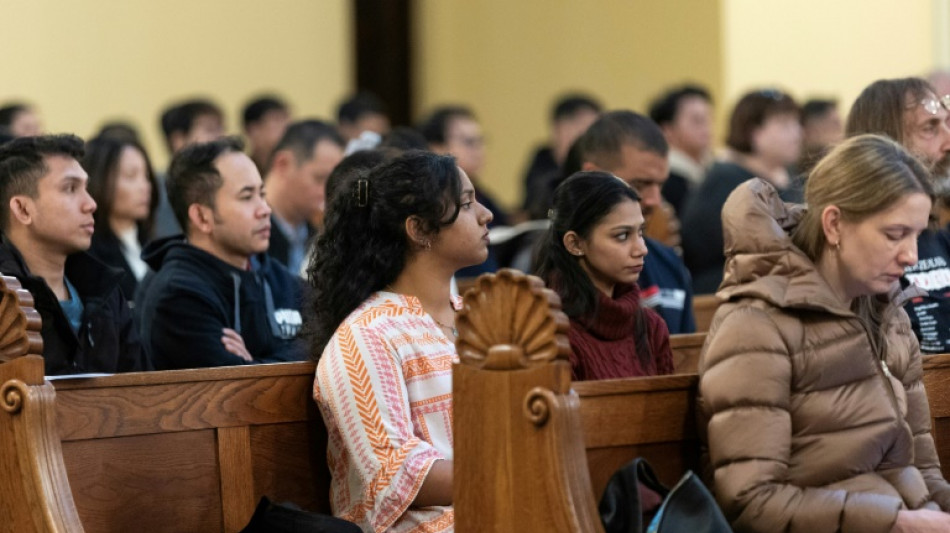
Attending mass in English every Sunday in Zagreb, where she is joined by dozens of other Filipinos, has helped fight homesickness.
"It's a big thing for us Filipinos because we are also a Catholic country, most of us go to church," she said.
Andjelko Katanec, a priest at the Saint-Blaise church that has been holding mass in English since 2019, said integrating into Croatian society was a "big challenge" for migrants.
"They risk being isolated outside work," he said.
"The history of mankind is the history of migrations," Katanec said.
"We have to organise better ... to welcome the immigrants better, offer them more opportunities and better conditions."
- 'Good workers' -
Many migrants came to financially support their families back home and often use Croatia as a starting point in Europe with an eye toward settling elsewhere.
Denson D'Cruz, who migrated from Kerala, India, said he chose Croatia because it is part of Europe's Schengen passport-free travel area.
The 30-year-old arrived last year to work as a mechanic but now runs his own import-export company.
He said he hopes to stay in Croatia for the foreseeable future because of its "climate and people who are friendly and speak English".
While some have sought to exploit the new arrivals, others have worked to help them find their footing.
After falling on hard times, Phuyal eventually found work at a temp agency and hopes to begin work in a beauty salon soon.
"Nepalis are very good workers, adjustable, and want to learn quickly," said the agency's owner, Ruzica Kerepcic.
J.Horn--BTB