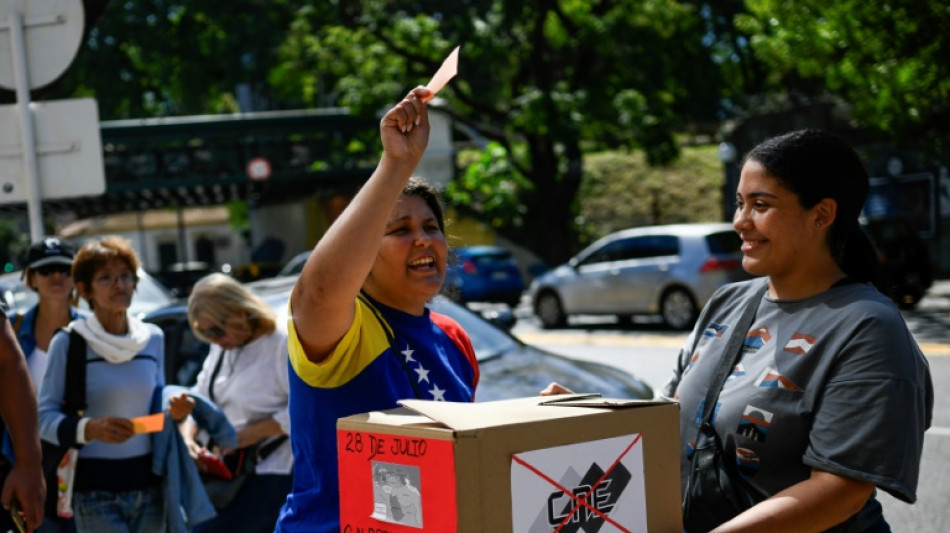
Venezuela's huge diaspora struggles to register to vote / Photo: © AFP

 Alexander-Arnold and Palmer return to England squad for Nations League
 Russians vote as Ukraine war drags on for fifth year

 Backpackers fret over Australian visa crackdown
 Most Asian stocks track Wall St rally, yen drops after BoJ rate hike
 Russians begin voting in controlled election as war drags on
 Trump 'clearly' wants dialogue with Pyongyang: South Korean President

 Bank of Japan hikes rates to 31-year high to battle inflation
 Thailand's Muslim separatists vow to fight to the end
 Mideast turmoil, AI set to dominate UN gathering of world leaders
 Australia to detain tourists who overstay visa, minister says

 Championship rivals brace for renewal of bitter feuds

 In Brazil's Amazon, the hunt for oil fuels hopes and fears
 Australian athlete who soiled herself apologises for continuing Hyrox race

 Baby orangutans in India expose 'frightening' scale of trafficking
 Doom Loop? Ed Sheeran struggles against Gaza tide
 Sudanese women hold fast to threatened henna body art

 Man Utd misery puts Carrick under pressure, Spurs feeling the heat
 Prized Mexican relic returns on loan, two centuries on

 Venezuela unblocks some censored news sites
 Samba stars on debut in Man City rout of Norwich

 Oversight Board blasts 'inadequate' Meta safeguards for AI deepfakes
 The Easter Island origins of buzzy Malkovich drama 'Wild Horse Nine'

 Third body recovered after Grand Canyon flash flood
 Harry makes first public appearance since return to UK

 Abhishek hits record T20 ton as India sweep series 3-0
Millions of Venezuelans who fled economic misery in their country could find themselves unable to vote in key July presidential elections, as complaints mount over hurdles at consulates abroad for those seeking to register.
"We want to vote, we want to vote!" chanted a small group of Venezuelans protesting outside their consulate in Argentina's capital in recent days, holding mock-ups of urns and ballot papers after being unable to sign up.
Election registration was meant to start on March 18 and will run for a month, before the July 28 vote in which President Nicolas Maduro is seeking a third term.
But in some countries in Latin America and Europe, the process hasn't even started yet.
"Each consulate has its own demands which they communicate verbally, there is nothing official... no uniform criteria" to register, said Venezuelan Adriana Flores outside the consulate in Buenos Aires.
- 'Ridiculous' excuses -
The United Nations estimates that almost eight million Venezuelans have fled their country since 2014 -- the year after Maduro took office.
The past decade has seen a severe economic crisis marked by runaway inflation and food and medicine shortages, plunging the population into misery.
The Venezuelan civil rights NGO Sumate estimates that 5.2 million citizens abroad will have to register to vote for the first time or update their information from abroad.
The last time the electoral register was updated was for 2018 elections, when only 107,000 Venezuelans signed up from abroad.
In Colombia, which is home to 2.8 million Venezuelans, registration opened a week late, and no-one has yet been able to sign up, said opposition figure Eduardo Battistini, who lives in the country.
"The same thing is happening here that we are seeing in other countries.... the excuse is that the digital fingerprint machines that the national electoral council is supposed to send have not arrived," he said, denouncing "ridiculous" excuses.
He said Venezuelan authorities did not consider the "temporary protection status" granted to its citizens by Colombia as an official proof of residence to allow them to register.
"That is causing a lot of worry," said Battistini, adding it would impact up to 90 percent of Venezuelans resident in the country.
- 'Systematic' hurdles -
Venezuelan authorities say the delays in shipping the machines are due to international sanctions, according to local media in the country.
In Spain, home to half a million Venezuelans, registration also began a week late.
Lorena Lima, 28, said she went on a five-day hunger strike and camped outside the consulate in Madrid to "pressure" authorities to open registration.
Those living in the United States face a different problem: consulates have not operated since diplomatic ties broke down in 2019.
Jesus Delgado, director of the NGO Electoral Transparency which monitors votes in Latin America, said the hurdles faced by Venezuelans abroad were "systematic."
Maduro's government has blocked the main opposition leader from running, as well as a proxy candidate, forcing the grouping to register a third "provisional" contender.
Opposition to Maduro is widespread in the diaspora, and observers say any hindrances to registration will only benefit the leader, whose approval ratings hover below 20 percent.
But some have distanced themselves entirely.
"To tell the truth, I don't think I will vote. I am very disconnected from politics, I have felt so much disappointment for ten years that I no longer follow it," said Carolina Pena, a 37-year-old clothes designer in Bogota, who said she last voted in 2013, when Maduro succeeded late leader Hugo Chavez.
Venezuelan authorities did not respond to AFP's requests for comment on the issue of voter registration.
O.Bulka--BTB