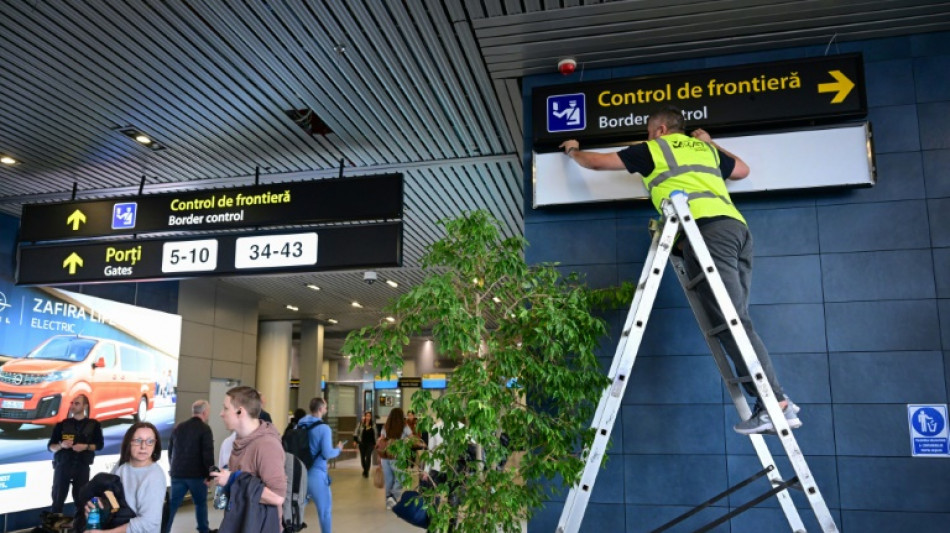
Bulgaria, Romania take first steps into Europe's visa-free zone / Photo: © AFP

 Russia seizes assets of Nestle, French firms over West's Ukraine support
 England can build on World Cup 'spirit', says Tuchel

 UNESCO can be 'moderator' in AI debate: chief to AFP

 Infantino 'must go', says German FA vice-president

 Russia seizes assets of Nestle, French firms

 Japan's busiest rail station tests robot bins

 Anthropic says AI systems moving towards building themselves

 Asian stocks boosted by falling oil, yen weakens after BoJ rate hike
 Pakistan court blocks expulsion of Afghan medical college students

 Athletes 'can't take it any more' as Asian Games issues mount

 Allen lights up Bills' new stadium with 41-31 win over Lions

 Afghan medical students in Pakistan hope court stops college expulsions
 AI doomsday warnings unlikely to slow IPOs but questions linger
 ICC eyes China in bid to expand cricket
 Nkunku craving freedom and fun on RB Leipzig return

 Bhutan's traditional archers lose ground to development
 Asian stocks track Wall St rally as oil prices drop

 South Korea makes Asian Games complaint over Japan warlord ceremony

 US aid cuts are killing Kenyan sex workers

 October 7 survivors, families take centre stage in Israel vote

 Captain Mat Ryan axed from Socceroos squad for Brazil games

 US approves sale of 48 F-35 jets to Saudi Arabia

 Juventus, Palace cruise to Europa League wins, Bournemouth beat Sociedad

 Stocks climb as oil retreats, Fed calms inflation fears

 Russians begin voting in controlled election as war drags

Bulgaria and Romania joined Europe's vast Schengen area of free movement on Sunday, opening up travel by air and sea without border checks after a 13-year wait.
A veto by Austria however means the new status will not apply to land routes, after Vienna expressed concerns over a potential influx of asylum seekers.
Despite the partial membership, the lifting of controls at the two countries' air and sea borders is of significant symbolic value.
Admission to Schengen is an "important milestone" for Bulgaria and Romania, symbolising a "question of dignity, of belonging to the European Union", according to foreign policy analyst Stefan Popescu.
"Any Romanian who had to walk down a lane separate from other European citizens felt being treated differently," he told AFP.
Ivan Petrov, a 35-year-old Bulgarian marketing executive who lives in France, said he was enthusiastic about less stressful travelling and the time he would be able to save.
"This is a great success for both countries, and a historic moment for the Schengen area -- the largest area of free movement in the world," EU chief Ursula von der Leyen said in a statement Saturday.
"Together, we are building a stronger, more united Europe for all our citizens."
- And they were 29 -
With Bulgaria and Romania arriving joining Sunday, the Schengen zone will comprise 29 members -- 25 of the 27 European Union member states as well as Switzerland, Norway, Iceland and Liechtenstein.
Romania's government said Schengen rules would apply to four sea ports and 17 airports, with the country's Otopeni airport near the capital Bucharest serving as the biggest hub for Schengen flights.
More staff including border police and immigration officers will be deployed to airports to "support passengers and detect those who want to take advantage to leave Romania illegally", it added.
Random checks will also be carried out to catch people with false documents and to combat human trafficking.
Bulgaria and Romania both hope to fully integrate into Schengen by the end of the year, but Austria has so far relented only on air and sea routes.
Croatia, which joined the EU after Romania and Bulgaria, beat them to becoming Schengen's 27th member in January 2023.
Created in 1985, the Schengen area allows more than 400 million people to travel freely without internal border controls.
- 'Irreversible process' -
While some have reason to celebrate, truck drivers, faced with endless queues at the borders with their European neighbours, feel left out.
Earlier this month, one of Romania's main road transport unions the UNTRR called for "urgent measures" to get full Schengen integration, deploring the huge financial losses caused by the long waits.
"Romanian hauliers have lost billions of euros every year, just because of long waiting times at borders," secretary general Radu Dinescu said.
According to the union, truckers usually wait eight to 16 hours at the border with Hungary, and from 20 to 30 hours at the Bulgarian border, with peaks of three days.
Bulgarian businesses have also voiced their anger over the slow progress.
"Only three percent of Bulgarian goods are transported by air and sea, the remaining 97 percent by land," said Vasil Velev, president of the Bulgarian Industrial Capital Association (BICA).
"So we're at three percent in Schengen and we don't know when we'll be there with the other 97 percent," he told AFP.
Bucharest and Sofia have both said that there will be no going back.
"There is no doubt that this process is irreversible," Romanian Interior Minister Catalin Predoiu said this month, adding it "must be completed by 2024 with the extension to land borders".
B.Shevchenko--BTB