'Dust and scorpions': Inside Iraq's crumbling school system / Photo: © AFP

 Russia seizes assets of Nestle, French firms over West's Ukraine support
 England can build on World Cup 'spirit', says Tuchel

 UNESCO can be 'moderator' in AI debate: chief to AFP

 Infantino 'must go', says German FA vice-president

 Russia seizes assets of Nestle, French firms

 Japan's busiest rail station tests robot bins
 Anthropic says AI systems moving towards building themselves

 Asian stocks boosted by falling oil, yen weakens after BoJ rate hike
 Pakistan court blocks expulsion of Afghan medical college students

 Athletes 'can't take it any more' as Asian Games issues mount
 Allen lights up Bills' new stadium with 41-31 win over Lions

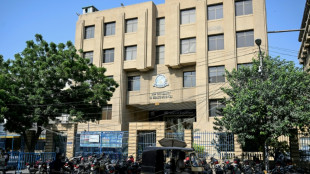 Afghan medical students in Pakistan hope court stops college expulsions
 AI doomsday warnings unlikely to slow IPOs but questions linger
 ICC eyes China in bid to expand cricket
 Nkunku craving freedom and fun on RB Leipzig return
 Bhutan's traditional archers lose ground to development
 Asian stocks track Wall St rally as oil prices drop

 South Korea makes Asian Games complaint over Japan warlord ceremony

 US aid cuts are killing Kenyan sex workers

 October 7 survivors, families take centre stage in Israel vote
 Captain Mat Ryan axed from Socceroos squad for Brazil games

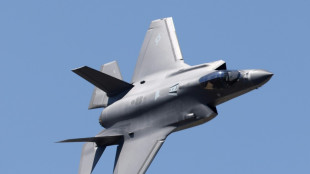 US approves sale of 48 F-35 jets to Saudi Arabia
 Juventus, Palace cruise to Europa League wins, Bournemouth beat Sociedad

 Stocks climb as oil retreats, Fed calms inflation fears

 Russians begin voting in controlled election as war drags

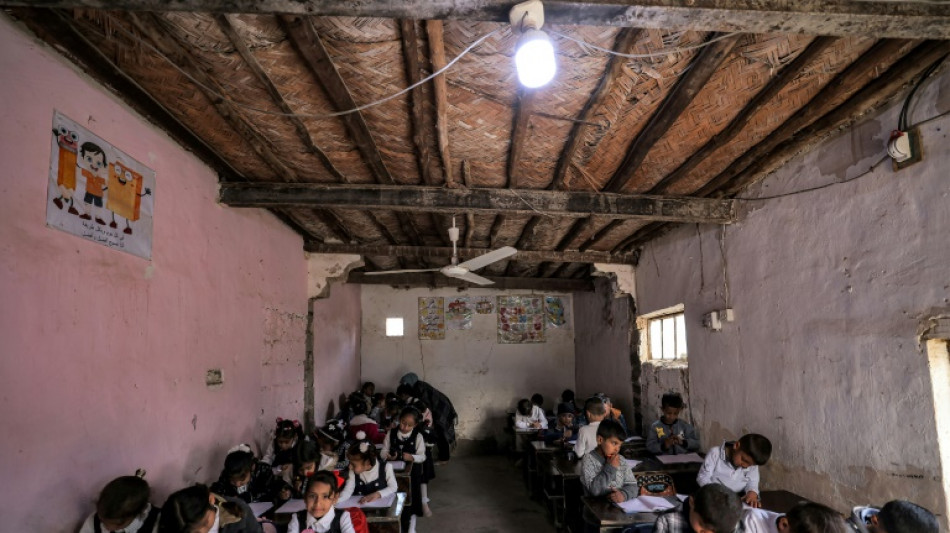
In a small village in central Iraq, children cram into dilapidated classrooms in a converted farmhouse with open-air toilets, a symptom of how education has been neglected in the oil-rich but war-weary country.
"We close the school when it rains because water leaks through the roof," said Oudai Abdallah, director of a public elementary school in Bani Saad district, 40 kilometres (25 miles) north of Baghdad.
"We fear it might collapse on students," he said of the makeshift roof of wood and straw.
It's a far cry from the 1970s and 1980s, when Iraq's education system was the envy of the region.
Students from around the Arab world came to study at Iraq's universities, and its schools were renowned for high quality teaching, even providing free meals and transport.
Since then, Iraq has suffered decades of conflict, chronic mismanagement and endemic corruption.
In Bani Saad, the authorities shut down the crumbling al-Tafawuq elementary school in 2011 to build a new one.
But the project stalled, and parents took matters into their own hands, renting a small farmhouse and converting it into a school for 200 pupils.
- 'Snakes and scorpions' -
Their school is not the only one in dire need.
UNICEF says half the country's schools are damaged and the number of qualified teachers has decreased, and the World Bank has warned that the fall in education standards is harming economic growth.
Officials say they need to build 8,000 schools to get the system back on track, and the government plans to boost the share of education in national budgets from 10 to 16 percent by 2031.
But long-term goals are cold comfort for the children in Bani Saad, who share a single sink and two outside toilets with no roofs.
The students are squashed into six unheated rooms, three of which were built and paid for by the teachers with the support of villagers.
A few rusted pieces of metal strung up to a palm tree serve as a makeshift bell.
Teachers seal the windows with wooden planks and cardboard during heavy rain to prevent chilly winds and water from seeping in.
"Dust, mud, snakes and scorpions -- it is a school on farmland that is unfit for anyone, even chickens," maths teacher Ahmed Latif said before beginning a class.
Latif, who is in his thirties and has worked at the school for over a decade, suggests using caravans rather than the farmhouse.
Iraqi students "have a right" to profit from the country's oil wealth, he said.
- 'Nothing has changed' -
The government does not deny the crisis.
Education ministry spokesperson Karim al-Sayyid conceded existing institutions were overcrowded and lacked even the basics for a "healthy environment".
Iraq's public services have been left shattered by a catastrophic 1980s war with neighbour Iran, a 1990s war with the United States and its allies and a US-led invasion in 2003.
This was followed by sectarian violence and the emergence of the Islamic State militant group, which was finally defeated in 2017.
Iraqis are only just seeing a return to relative stability, with education re-emerging as a priority in a country with 12 million school students, almost one quarter of the population.
Authorities hope to complete the construction of 1,000 schools by 2025 through an agreement with Chinese firms, Sayyid said.
He added that the ministry's priority was to "eliminate" mud-built schools and caravans.
But in Bani Saad, truck driver Naim Ali said he was fed up.
"We urged the authorities to find a solution. Committees came and left, but nothing has changed," the 50-year-old father of five said.
With few signs of progress, frustrated parents are increasingly looking to private schools, which are springing up across the country.
"Private schools are clean and better equipped, and teaching is of a higher quality," said government worker Wissam, 44, who moved his 10-year-old daughter out of the public system recently.
He knew he would struggle to pay the annual fees but felt he had no choice.
"What else should I have done," he asked. "She was in a classroom with more than 40 other students."
J.Fankhauser--BTB