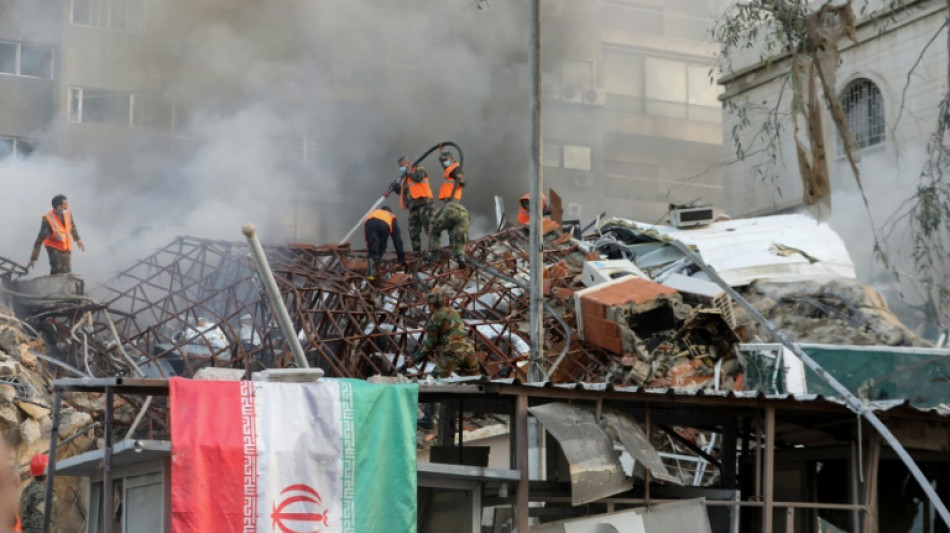
Deadly strike on Iran consulate 'crossed a line': analysts / Photo: © AFP

 Russia seizes assets of Nestle, French firms over West's Ukraine support

 England can build on World Cup 'spirit', says Tuchel

 UNESCO can be 'moderator' in AI debate: chief to AFP

 Infantino 'must go', says German FA vice-president

 Russia seizes assets of Nestle, French firms

 Japan's busiest rail station tests robot bins

 Anthropic says AI systems moving towards building themselves

 Asian stocks boosted by falling oil, yen weakens after BoJ rate hike

 Pakistan court blocks expulsion of Afghan medical college students

 Athletes 'can't take it any more' as Asian Games issues mount

 Allen lights up Bills' new stadium with 41-31 win over Lions

 Afghan medical students in Pakistan hope court stops college expulsions

 AI doomsday warnings unlikely to slow IPOs but questions linger
 ICC eyes China in bid to expand cricket

 Nkunku craving freedom and fun on RB Leipzig return

 Bhutan's traditional archers lose ground to development

 Asian stocks track Wall St rally as oil prices drop

 South Korea makes Asian Games complaint over Japan warlord ceremony

 US aid cuts are killing Kenyan sex workers

 October 7 survivors, families take centre stage in Israel vote

 Captain Mat Ryan axed from Socceroos squad for Brazil games

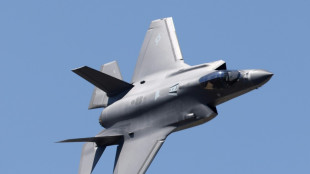 US approves sale of 48 F-35 jets to Saudi Arabia

 Juventus, Palace cruise to Europa League wins, Bournemouth beat Sociedad

 Stocks climb as oil retreats, Fed calms inflation fears

 Russians begin voting in controlled election as war drags

A deadly strike blamed on Israel against Iran's diplomatic mission in Damascus could trigger a spillover of the Gaza war across the region, an escalation Tehran had sought to avoid, analysts said.
Monday's strike levelled the consular annex of the Iranian embassy and killed 13 people, including seven members of Iran's Islamic Revolutionary Guard Corps (IRGC), Iranian state media reported.
They included two senior commanders of the Guards' Qud Force foreign operations arm, Brigadier Generals Mohammad Reza Zahedi and Mohammad Hadi Haji Rahimi, Iranian officials said.
Ali Vaez of the International Crisis Group called the attack "a significant escalation".
"By targeting an Iranian diplomatic facility, Israel has crossed a line," he told AFP.
After months of battling Iran-backed Hamas militants in Gaza, Israel is now stepping up its operations against Iranian and pro-Iran commanders in Lebanon and Syria, a move observers fear could spiral into all-out war.
Iran has denied prior knowledge of Palestinian militant group Hamas's unprecedented October 7 attack on Israel that triggered the war.
But it is one of Hamas's top supporters and backs a plethora of armed groups that have attacked Israel in solidarity with Hamas, including Lebanon's Hezbollah, which has exchanged near-daily fire with Israel for months.
Although Iran has said it wants to avoid full-scale war, supreme leader Ayatollah Ali Khamenei warned Tuesday that "Israel will be punished" for the Damascus strike, while President Ebrahim Raisi said the raid "will not go unanswered".
- 'Towards escalation' -
Bassam Abu Abdallah, who heads the Damascus Centre for Strategic Research and is close to the Syrian government, said that before Monday, "there were rules of engagement, but now it's an all-out war between Israel and the resistance axis".
Iran and its supporters use the term resistance axis to refer to its alliance with armed groups around the region which share its resolutely anti-Zionist and anti-American stance.
"It is now clear that the trend is towards escalation," Abu Abdallah said, adding: "We could start to see increased attacks against US bases in Syria, Iraq or elsewhere."
In late January, pro-Iran groups said they were suspending attacks against US troops in Iraq and Syria to avert a regional escalation, after both Baghdad and Tehran said they opposed the groups' campaign.
On Tuesday, Hezbollah warned that the strike on the Iranian consulate "will not pass without the enemy receiving punishment and revenge".
Israel has responded to Hezbollah fire from Lebanon by extending its attacks deeper into the country and multiplying assassinations of the group's commanders.
The Shiite Muslim militant group, which boasts a big arsenal of rockets and missiles, has largely restricted its attacks on Israel to the border region.
The Crisis Group's Vaez said: "Iran is more likely than not to impose a cost on Israel, but it is likely to do so in an indirect manner and through its partners and proxies in the region.
"Iran's dilemma is that failure to respond could signal weakness to Israel but retaliation risks a harsher US or Israeli action".
- 'Transnational war' -
The Damascus strike could signal that Israeli Prime Minister Benjamin Netanyahu, entangled in the Hamas war for nearly six months, is preparing for a wider regional conflict.
Under pressure from Washington, "Netanyahu is running out of time to conduct the war in Gaza, and is instead turning to Lebanon and Syria to weaken the Iranian regional military effort," said Nick Heras of the New Lines Institute for Strategy and Policy.
"Israel views the conflicts against Hamas in Gaza and Hezbollah in Lebanon as two fronts in a transnational war against Iran, which the Iranians run from Damascus," Heras added.
He said Netanyahu "expects Israel to have to soon fight a region-wide war with Iran" and for the United States to join it.
"The Israelis are trying to eliminate the most important and seasoned IRGC commanders to weaken Iranian planning and capabilities ahead of that war," he added.
But diplomatic efforts are underway to de-escalate tensions, with Syrian ally Russia calling for a UN Security Council meeting on the strike later Tuesday.
Washington has told Tehran it was not involved in the Israeli strike, according to an American official quoted by US media outlet Axios.
J.Horn--BTB