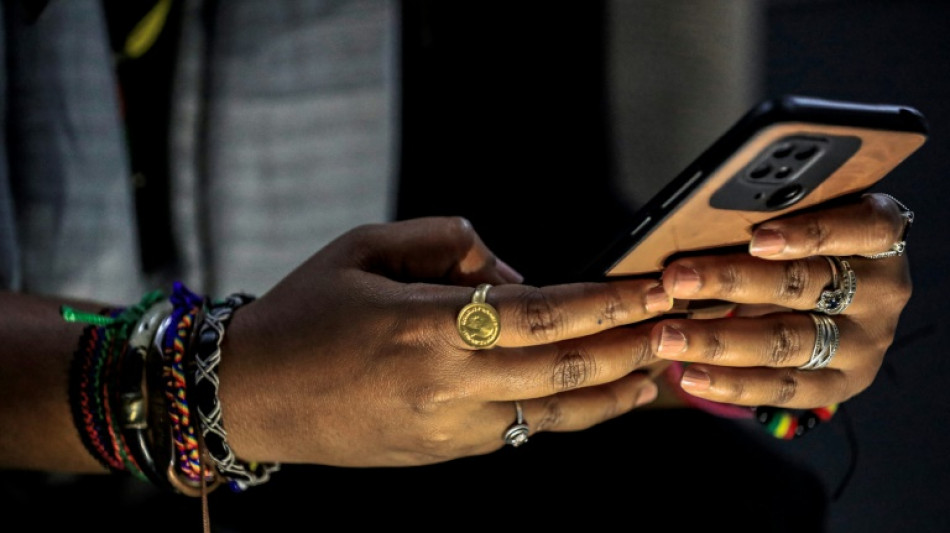
Smuggled Starlink dishes throw lifeline to some in war-torn Sudan / Photo: © AFP/File

 Carrick confident Man Utd can 'work through' tough time

 Mbappe ends Nike partnership to join Swiss brand On

 Liverpool boss Iraola puts Bournemouth love affair on hold
 'A disaster' if Man City do not win says Maresca after flawless start
 Kerry James Marshall: American 'blackness' painter celebrated in Europe

 Spain coach De la Fuente offers 'full support' to people of Ceuta

 Russia seizes assets of Nestle, French firms over West's Ukraine support
 England can build on World Cup 'spirit', says Tuchel

 UNESCO can be 'moderator' in AI debate: chief to AFP

 Infantino 'must go', says German FA vice-president

 Russia seizes assets of Nestle, French firms

 Japan's busiest rail station tests robot bins
 Anthropic says AI systems moving towards building themselves

 Asian stocks boosted by falling oil, yen weakens after BoJ rate hike
 Pakistan court blocks expulsion of Afghan medical college students
 Athletes 'can't take it any more' as Asian Games issues mount
 Allen lights up Bills' new stadium with 41-31 win over Lions
 Afghan medical students in Pakistan hope court stops college expulsions
 AI doomsday warnings unlikely to slow IPOs but questions linger
 ICC eyes China in bid to expand cricket
 Nkunku craving freedom and fun on RB Leipzig return

 Bhutan's traditional archers lose ground to development
 Asian stocks track Wall St rally as oil prices drop

 South Korea makes Asian Games complaint over Japan warlord ceremony

 US aid cuts are killing Kenyan sex workers

On a street corner in the Sudanese town of Tamboul, dozens of people tap feverishly on their phones, calling loved ones and moving money through online apps.
At the centre of their huddle is a bright white dish that connects to the internet via Starlink, the satellite system owned by Elon Musk's SpaceX rocket company.
Starlink has become a lifeline for some in a country where the internet has gone down regularly since war erupted last April between Sudan's army and paramilitary force.
But the system, which can bring connectivity where there is no land-based network, is not officially available in Sudan.
Instead, the kits have made their way into the country "illegally via Libya, South Sudan and Eritrea", one device reseller told AFP on condition of anonymity.
The cost for dishes and subscriptions can run into the hundreds of dollars, well out of reach for most Sudanese.
The fees are paid by Sudanese overseas or entrepreneurs like Mohamed Bellah, who runs an internet cafe in a village some 120 kilometres (75 miles) south of Khartoum.
"You can make your money back in three days," he told AFP, saying the investment was worth every penny.
- Anxious wait -
The conflict between the army of Abdel Fattah al-Burhan and the Rapid Support Forces (RSF) of his former deputy Mohamed Hamdan Daglo has displaced millions and killed many thousands.
The banking system has collapsed and millions can now access money only via the Bank of Khartoum's app, Bankak.
Officials have not offered an explanation for the blackouts, though a near-total shutdown in February was widely blamed on the RSF.
Now people like Issam Ahmed, huddled around the dish in Tamboul, some 140 kilometres (90 miles) southeast of Khartoum, are reliant on Starlink.
He has been anxiously waiting for family news and financial support from his son, who works in Saudi Arabia.
"He sent me money through the bank app and I just transferred it to a currency dealer who will give me cash," Ahmed told AFP.
Starlink, which is available in more than 70 countries, allows users on high-cost tariffs to take their dishes with them across national boundaries.
Musk made a big play of deploying the system in war-torn Ukraine and during protests in Iran in 2022.
But he has made no such gesture on Sudan and none of the tariffs advertised on Starlink's website would allow the kind of usage seen there. SpaceX has not responded to AFP's requests for clarification.
- RSF profiting -
The Sudanese government, which is loyal to the army, banned Starlink devices in December.
But by that stage, the RSF had already started exploiting the business opportunities.
In Qanab al-Halawein, a village southeast of Khartoum, RSF forces charge for access to their own dish.
They "set up the dish in the square every morning and leave in the evening with all the money they have made", one resident told AFP on condition of anonymity.
An internet cafe owner in another village said RSF personnel came "every day" and took 150,000 Sudanese pounds ($140 for currency dealers) in exchange for allowing the cafe to offer Starlink.
The army caught on and partly backtracked on its ban, announcing in late February it would donate some Starlink dishes to residents in Omdurman, part of greater Khartoum.
- Stiff commissions -
But the vast region of Darfur in Sudan's west, home to around a quarter of its 48 million people, has been particularly hit by the war-time blackout.
Huge areas have been without any connection for nearly a year and use of the dishes has spread rapidly in a region largely controlled by the RSF.
"Without (Starlink) we could have never figured out how to receive money," Mohammed Beshara told AFP via text message from the Otash camp in South Darfur.
But for Beshara and thousands like him, it takes money to get money.
He pays roughly $3 an hour for the connection and currency dealers take commissions for every Bankak transaction.
For desperate Tamboul residents like 43-year-old Arij Ahmed, paying commissions is a necessary sacrifice.
She walks five kilometres (three miles) with her 12-year-old son to the Starlink dish "every week, when my husband in Qatar gets his pay cheque and he sends us a transfer", she told AFP.
And every week, she hopes to get enough money to survive until her next connection.
G.Schulte--BTB