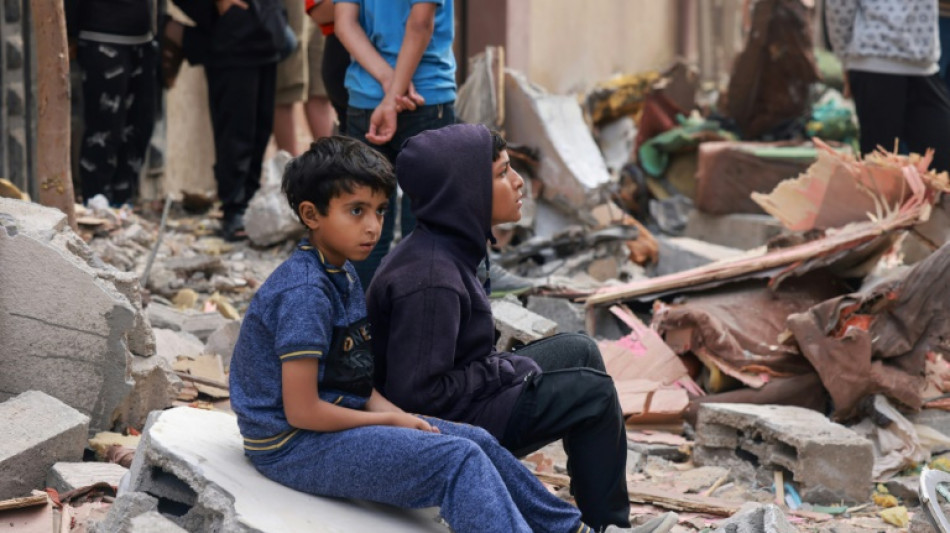
Peace feels further than ever at six months of Israel-Hamas war / Photo: © AFP

 Carrick confident Man Utd can 'work through' tough time

 Mbappe ends Nike partnership to join Swiss brand On

 Liverpool boss Iraola puts Bournemouth love affair on hold
 'A disaster' if Man City do not win says Maresca after flawless start
 Kerry James Marshall: American 'blackness' painter celebrated in Europe

 Spain coach De la Fuente offers 'full support' to people of Ceuta

 Russia seizes assets of Nestle, French firms over West's Ukraine support
 England can build on World Cup 'spirit', says Tuchel

 UNESCO can be 'moderator' in AI debate: chief to AFP

 Infantino 'must go', says German FA vice-president

 Russia seizes assets of Nestle, French firms

 Japan's busiest rail station tests robot bins
 Anthropic says AI systems moving towards building themselves

 Asian stocks boosted by falling oil, yen weakens after BoJ rate hike
 Pakistan court blocks expulsion of Afghan medical college students

 Athletes 'can't take it any more' as Asian Games issues mount
 Allen lights up Bills' new stadium with 41-31 win over Lions

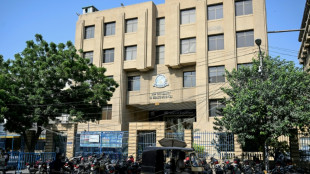 Afghan medical students in Pakistan hope court stops college expulsions

 AI doomsday warnings unlikely to slow IPOs but questions linger
 ICC eyes China in bid to expand cricket

 Nkunku craving freedom and fun on RB Leipzig return
 Bhutan's traditional archers lose ground to development
 Asian stocks track Wall St rally as oil prices drop

 South Korea makes Asian Games complaint over Japan warlord ceremony

 US aid cuts are killing Kenyan sex workers

The staggering suffering, death and destruction of six months of war since Hamas's October 7 attack has widened the gulf between Israelis and Palestinians, leaving both feeling that the prospect of peace is ever more elusive.
Israeli farmer Yarden Zemach, 38, said he felt safe when picking avocados with Palestinians on October 5 –- just two days before the attack.
But ever since the violence that claimed his brother's life in the devastated Beeri kibbutz some four kilometres (2.5 miles) from the Gaza border fence, he views Gazans as a threat.
"Maybe in many years peace will be possible, but not right now," he said next to burned-out homes.
Israeli shelling of Gaza thundered nearby.
The bloodiest-ever Gaza war erupted with Hamas's October 7 attack, which resulted in the deaths of about 1,170 Israelis and foreigners, mostly civilians, according to an AFP tally based on Israeli official figures.
Israel's retaliatory campaign has killed over 33,000 people, mostly women and children, according to the health ministry in Hamas-run Gaza.
"(Our suffering) only increased after October 7, after 33,000 martyrs and after the destruction and siege," said 27-year-old Palestinian Fidaa Musabih, whose north Gaza home was destroyed by an air strike.
She now shares a house with 27 relatives in southern Gaza's Rafah, where she lives in fear of Israel's planned offensive into an area packed with 1.5 million people, most of them displaced.
"How can I hope for peace to come? There's nothing more for us to lose," said Musabih.
- 'A terrifying question' -
No major Israeli-Palestinian peace talks have been held for years. Which means any future negotiations would be in the shadow of this unprecedented bloodshed -- with each side questioning the other's humanity.
Graphic video clips and survivors' accounts depict the extreme violence of the October 7 attack on Israel.
Of the more than 250 hostages taken, 130 remain in Gaza, including 34 who the army says are dead.
In Gaza, dozens are killed per day on average, according to the territory's health ministry, in the constant bombardment that has flattened swathes of the territory.
The United Nations has warned that its 2.4 million people are on the brink of famine.
Both sides are trying "to portray everything happening in terms of the other side being unfit to be a partner," said Khalil Shikaki from the Palestinian Centre for Policy and Survey Research (PCPSR).
Israelis and Palestinians have been asking themselves if the other side "are really human beings. It's a terrifying question to ask," said Denis Charbit, a political scientist at Israel's Open University.
Though the war is being fought in Gaza, violence in the West Bank involving Israeli forces, settlers and armed Palestinian militants -- already rising before the war -- has spiked to levels unseen in two decades.
Palestinian Tarek Ali, who works near Ramallah, said the tension and violence, already bad before the attack, have gotten worse.
"This shows the depth of hatred between us and them, and therefore further removes the possibility of peace," the 47-year-old said.
- 'Walls not high enough' -
An early March poll from the Tel Aviv-based Institute for National Security Studies (INSS) put Jewish Israeli support for the "two-state solution" at an "unprecedented" low of 35 percent.
That figure marks a sharp drop from support of roughly 49 percent in 2022 for establishing an independent Palestinian state.
However, Gazans' backing for the two-state solution has surged, according to a PCPSR survey -– from 35 percent in December to 62 percent in March.
"The option for peace at the popular level remains today, as it did in the past, and it will probably be even more so once the war is behind us," said Shikaki, the PCPSR researcher.
Charbit, the political scientist, said the scale of the war and the international community's concern have provided a new opening for the sides to make peace.
"There is a very small chance, but a chance nonetheless," he added.
Israeli Hila Fenlon, whose Netiv Haasara community nearly touches the northern border with Gaza, said she feels peace will one day be possible.
But in her community, which was hit hard in the opening moments of the attack, it also feels far off.
"In the past, I believed that peace would mean that these walls will have to go," she said standing at towering concrete barriers between Gaza and Netiv Haasara.
"On October 7th, they proved to us that maybe these walls are not high enough," she added.
R.Adler--BTB