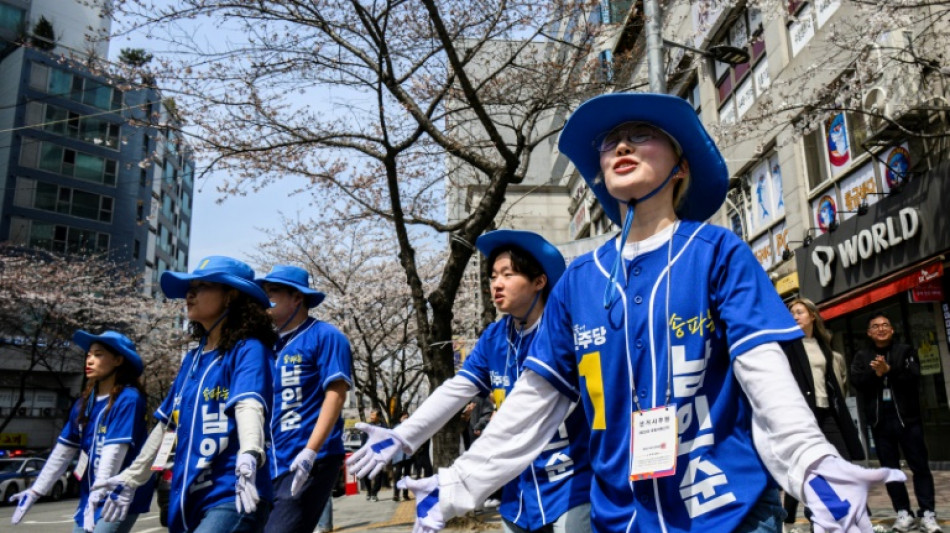
K-pop campaigning: S Korean candidates embrace song to pull votes / Photo: © AFP

 Stock markets retreat after central bank rate hikes
 Russia labels director of Cannes Grand Prix winner a 'foreign agent'

 Macron warns of Russian 'hybrid' threat after meeting presidential hopefuls

 UN holds third informal poll for new chief
 Kulusevski return can spark Spurs: De Zerbi

 Shakira to cap off world tour with Madrid 12-gig run
 Isolated Syrian-Druze city blames Damascus for shortages
 Isolated Syrian-Druze city shortages
 Dutch drop Depay for Germany match in Xavi's first pick
 Ronaldo named in Portugal squad for Nations League
 Stock markets diverge after central bank rate hikes

 Anti-Assad music star makes triumphant return to Syria
 In-form Fernandez included in Spain Nations League squad
 Arteta buries hatchet with Hurzeler ahead of Brighton clash
 Alexander-Arnold and Palmer return to England squad for Nations League
 Russians vote as Ukraine war drags on for fifth year

 Backpackers fret over Australian visa crackdown
 Most Asian stocks track Wall St rally, yen drops after BoJ rate hike
 Russians begin voting in controlled election as war drags on
 Trump 'clearly' wants dialogue with Pyongyang: South Korean President

 Bank of Japan hikes rates to 31-year high to battle inflation
 Thailand's Muslim separatists vow to fight to the end

 Mideast turmoil, AI set to dominate UN gathering of world leaders
 Australia to detain tourists who overstay visa, minister says
 Championship rivals brace for renewal of bitter feuds
Thanks to quirks of South Korean election law and history, almost every candidate on the campaign trail has a theme song, a dance routine, and politically-tweaked lyrics to make their message hit home.
From K-pop chart toppers to "Baby Shark", still the world's most-watched song on YouTube, seemingly no music is safe from a South Korean political makeover.
At a rally for Democratic Party lawmaker Nam In-soon, running for a fourth term in office in Seoul's Songpa district, campaign speeches were interspersed with ear-splitting blasts of music, as uniformed campaign staff performed choreographed moves.
"This kind of campaigning helps raise voters' interest," Nam told AFP before next week's parliamentary election.
"I can convey my message and policy promises through the campaign songs," she said, adding that the tunes were carefully selected, and the lyrics thoughtfully re-worked, to help her engage with constituents.
This election cycle, Nam had chosen a hit K-pop song called "Jilpoonggado" -- which means "Stormy Road" in English -- for her campaign.
The original lyrics, which speak of giving people courage against a storm, were tweaked to request "storming courage" for the candidate, and end with: "ballot number 1 Nam In-soon! The right person to lead Songpa".
But the campaign also used Baby Shark and a few "trott" hits -- a kind of slower K-pop, popular with older South Korean listeners -- to cover their bases.
"We chose songs that can appeal to a wide range of age groups," Nam said.
- 'Really excited' -
K-pop campaigning is not only gruelling work for the candidates: campaign choreographer Kim Mi-ran performs an elaborate dance routine three times a day, every day for around two weeks before the vote, everywhere Nam goes.
"The party headquarters gave us some guidelines, but the candidate's staff have a lot of decision-making power," over song selection and dance routines, said Kim, who is not a full-time dancer but works as a civil activist outside election time.
"I talked to her staff to decide on a set of songs that go well with the candidate and choreographed accordingly," she said.
One of the songs, by a K-pop girl duo called Davichi, which is called Yeoseong Shidae or "Women's Era", was chosen as a means of hammering home the fact Nam is a rare female candidate in a sea of male politicians.
Only 14 percent of candidates running for the April 10 vote are women, and just 19 percent of sitting MPs are female from 300 seats.
"Politics can come across as boring and not interesting," Kim said.
"I think this cultural approach to the election campaigning can be a positive thing for the voters. I can feel people are really excited when they see us -- and they join in dancing!"
- Historic roots -
In many countries, for example France, the United Kingdom, or Pakistan, candidates are restricted to holding campaign events in designated spaces, such as sports centres, with proper approvals from authorities.
But under South Korean election law, all candidates are allowed to hold campaign events in the constituency's streets during a set two-week period before the vote, on the condition they don't violate a 127-decibel noise limit -- a level similar to a rock concert.
Nearly every candidate embraces this opportunity, and speaker-laden vans blasting music, filled with cheering, uniformed campaign staff have crisscrossed Seoul neighbourhoods canvassing for votes since campaigning started March 28.
At a joint rally Sunday for two of President Yoon Suk Yeol's party candidates, Lee Yong and Lee Chang-keun, a trott song entitled "You and Me" had been transformed into a party theme song.
"You and me both for the People Power Party, let's go together!" the new lyrics said, as cheerful supporters swayed along.
South Korea's commitment to vibrant, noisy political campaigning has its roots in the country's emergence from military rule into a democracy in the 1980s, Bae Kang-hun, a political consultant, told AFP.
"Many pro-democracy student activists in the 1980s who helped the country achieve a direct presidential election in 1987 went on to join the mainstream political scene," he said, referring to the seminal election that year which ended decades of military rule.
When these student protesters who helped topple the military dictatorship went into politics "they adapted many features of their pro-democracy demonstrations," for their rallies, he said.
This included "singing songs and doing choreographed moves, as they had once done on the streets calling for democracy against dictatorship government," he said.
"Those features have become mainstays of today's campaigning."
O.Krause--BTB