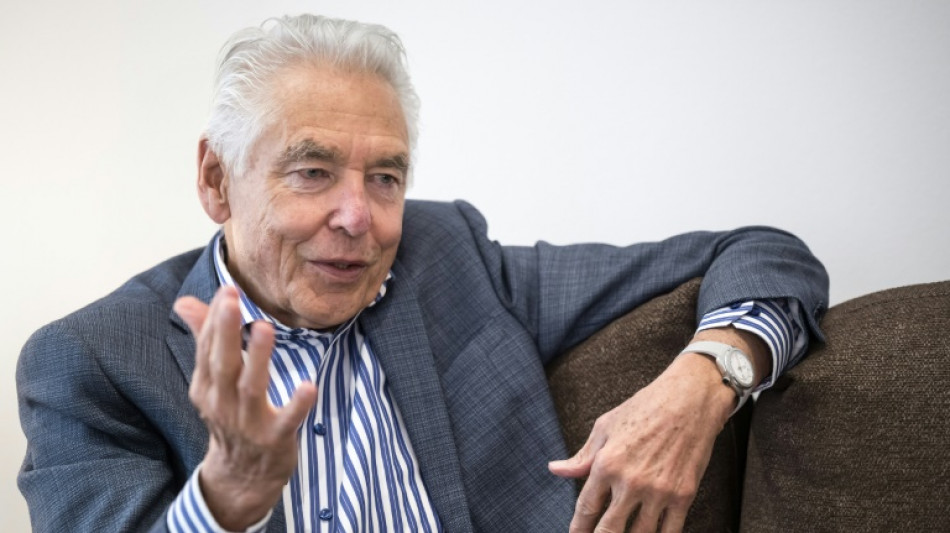
Forecasting the future of science to keep Swiss diplomatic hub buzzing / Photo: © AFP

 Stock markets retreat after central bank rate hikes

 Russia labels director of Cannes Grand Prix winner a 'foreign agent'

 Macron warns of Russian 'hybrid' threat after meeting presidential hopefuls
 UN holds third informal poll for new chief

 Kulusevski return can spark Spurs: De Zerbi

 Shakira to cap off world tour with Madrid 12-gig run

 Isolated Syrian-Druze city blames Damascus for shortages
 Isolated Syrian-Druze city shortages
 Dutch drop Depay for Germany match in Xavi's first pick

 Ronaldo named in Portugal squad for Nations League

 Stock markets diverge after central bank rate hikes
 Anti-Assad music star makes triumphant return to Syria
 In-form Fernandez included in Spain Nations League squad
 Arteta buries hatchet with Hurzeler ahead of Brighton clash

 Alexander-Arnold and Palmer return to England squad for Nations League
 Russians vote as Ukraine war drags on for fifth year
 Backpackers fret over Australian visa crackdown
 Most Asian stocks track Wall St rally, yen drops after BoJ rate hike
 Russians begin voting in controlled election as war drags on

 Trump 'clearly' wants dialogue with Pyongyang: South Korean President

 Bank of Japan hikes rates to 31-year high to battle inflation
 Thailand's Muslim separatists vow to fight to the end

 Mideast turmoil, AI set to dominate UN gathering of world leaders
 Australia to detain tourists who overstay visa, minister says

 Championship rivals brace for renewal of bitter feuds

As technology and science advance at breakneck speed, a Swiss group is already looking beyond AI to the next big potential technological disrupters.
Quantum computing is a likely candidate, and this time the group hopes that rules are in place to govern its use before it is unleashed, unlike what happened with artificial intelligence.
Quantum computing combines advances in scientific understanding of the subatomic world with leaps in information theory to solve mathematical problems that are impossible for today's conventional computers.
The Geneva Science and Diplomacy Anticipator Foundation (GESDA) wants to ensure Switzerland remains central to the international response.
The rapidly-swelling power of artificial intelligence became apparent with the release of ChatGPT in November 2022.
Policy makers have been playing catch up as they scramble to determine how to govern the technology, and if it is even possible.
Last month, the European Parliament approved the world's most far-reaching rules, but warnings already abound that the hastily-assembled text will not do enough to protect people.
It would have been better to anticipate what was coming and how to govern it, said Peter Brabeck-Letmathe, chairman of GESDA.
"AI was too fast," the former longtime head of Swiss food giant Nestle told AFP in a recent interview.
"By the time we had identified it, it (was) already almost to market," he said. "This shows you how important anticipation is -- real anticipation."
GESDA was founded five years ago by the Swiss government to look into the future and anticipate breakthroughs, and then coordinate with decision-makers to harness coming changes -- and channel them in a positive direction.
It also aims to ensure that Geneva -- home to the United Nations' European headquarters and numerous other institutions created after World War II -- remains a relevant diplomatic hub.
With its focus on science diplomacy, fuelled by anticipation, GESDA can help ensure that "Geneva continues to be a centre for multilateralism also in the future", Brabeck-Letmathe said.
- Quantum, next big disrupter -
The platform arrived too late to provide much advance foresight on the looming powers of AI, but he insists it is well-positioned to take on quantum computing, which "has the potential of changing almost everything".
With the first commercial machines up to a decade away, "we are still in a phase where we can do something about it".
To map out the most impactful future technological developments, Brabeck-Letmathe said GESDA contacted thousands of scientists and all the major laboratories around the world, and asked: "What is cooking?".
It also asked how scientific breakthroughs might impact the world decades into the future.
GESDA then turned to diplomats and asked: "What framework do we need so that those breakthroughs are dedicated more to the good than to the bad?".
Among the questions raised was: what does it mean to be a human being in an era of avatars and increasing human augmentation?
Human augmentation, or technologies that improve human capabilities, carry huge promise, including to help people with degenerative diseases like Parkinson's.
"But of course, once you have a chip in your brain, the question is what can you programme into that chip?" Brabeck-Letmathe asked.
"It will demand very careful thinking."
- 'Incredible power' -
"It will be an incredible power," Brabeck-Letmathe said of quantum computing, pointing out that it was expected to be "1,000 to 10,000 times more potent than the computing power we have today".
It is therefore vital to govern the technology and ensure it is not left in the hands of a few companies, as with the internet, he said.
If a few tech companies are allowed to control quantum, he warned, "you get an incredible concentration of power, where our democratic system... is not going to be working".
GESDA last month launched a new Open Quantum Institute situated inside Europe's science lab CERN.
That centre may not place Switzerland at "the centre of the world" when it comes to quantum, Brabeck-Letmathe acknowledged.
But the country, he said, would be positioned as "an honest broker for this new technology, in favour of humankind".
B.Shevchenko--BTB