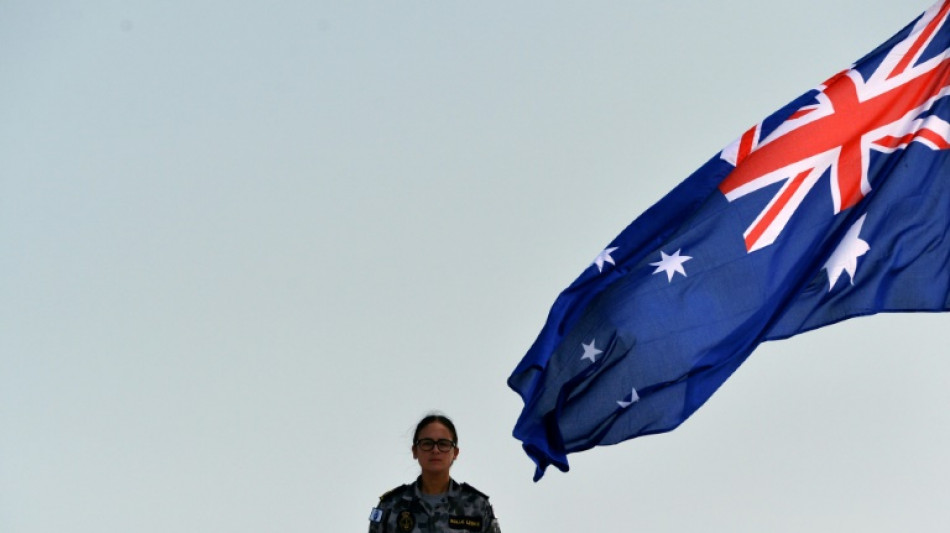
Australia unveils new defence strategy, with eye on 'coercive' China / Photo: © AFP/File

 Kennedy Center: future unclear for iconic Washington arts hub

 Trump claims 'infinite' Greenland security deal with Denmark

 Helicopters battle wildfire threatening Ecuador's capital

 Brentford batter Chelsea to undo Alonso's promising start

 Kane hits Bundesliga century as Bayern rout Union
 Trump says CNN, MS NOW, Politico banned from White House

 Hushing and hedging: US companies retreat on climate

 Springboks to face Fiji before 2027 Rugby World Cup

 Nigeria miners struggled to breathe in cell before 37 died: survivors

 McIlroy on the charge at PGA Championship as Reed withdraws

 McIlroy on the charge at PGA Championship

 Crisis-wracked Volkswagen warns of 10-bn-euro hit to profits

 Costa Rica's Grynspan tops third informal poll for UN chief: diplomat

 Stock markets retreat after central bank rate hikes

 Russia labels director of Cannes Grand Prix winner a 'foreign agent'

 Macron warns of Russian 'hybrid' threat after meeting presidential hopefuls

 UN holds third informal poll for new chief

 Kulusevski return can spark Spurs: De Zerbi

 Shakira to cap off world tour with Madrid 12-gig run

 Isolated Syrian-Druze city blames Damascus for shortages

 Isolated Syrian-Druze city shortages

 Dutch drop Depay for Germany match in Xavi's first pick

 Ronaldo named in Portugal squad for Nations League

 Stock markets diverge after central bank rate hikes

 Anti-Assad music star makes triumphant return to Syria

Australia unveiled its first National Defence Strategy on Wednesday, signalling a new focus on deterring China's "coercive tactics" in a region seen as lurching towards conflict.
The 80-page document offers a gloomy assessment of Pacific security and sets out a massive increase in defence spending to retool Australia's military to cope.
"The optimistic assumptions that guided defence planning after the end of the Cold War are long gone," said Defence Minister Richard Marles, presenting the new strategy.
Warning that "China has employed coercive tactics in pursuit of its strategic objectives," the text describes an Australia vulnerable to foes strangling trade or preventing access to vital air and sea routes.
"We are a maritime trading island nation," Marles said.
"The invasion of Australia is an unlikely prospect in any scenario, precisely because so much damage can be done to our country by an adversary without ever having to step foot on Australian soil," he said.
So instead of focusing on maintaining a military that can do a range of tasks almost anywhere in the world, Marles said there would be a laser focus on building a deterrent force that can protect Australia's interests in its immediate region.
At the centre of the strategy are plans to develop a fleet of stealthy nuclear-powered submarines, to triple key missile capabilities and develop a large surface combatant fleet.
"Having the most capable Navy in our history will be at the heart of our projection and our strategy of denial," Marles said.
The strategy boils down to making any attack against Australia's interests prohibitively expensive and risky.
As a share of GDP, defence spending is set to increase from about two percent today to 2.4 percent within a decade.
That will only fuel an arms race that is taking place across the Pacific, with China, South Korea and Japan all piling more money into defence.
According to the Stockholm International Peace Research Institute, military spending in Asia and Oceania has increased 45 percent since 2013.
Given that backdrop, Australia predicts an increased risk of conflict in the Taiwan Strait, the South and East China Seas or on the border with India.
Marles said that old assumptions about how much time Australia would have to prepare for war were gone.
"Australia no longer has the luxury of a 10-year window of strategic warning time for conflict" he said, upending long-held belief.
Asked about Canberra's strategy at a regular briefing, Beijing urged Australia to "refrain from making accusations against China at every turn".
"China poses no threat to any country," foreign ministry spokesperson Lin Jian said.
"We hope that the Australian side can view China's development and strategic intentions in a correct light, abandon the Cold War mentality (and) do more to safeguard regional peace and stability," he added.
J.Bergmann--BTB