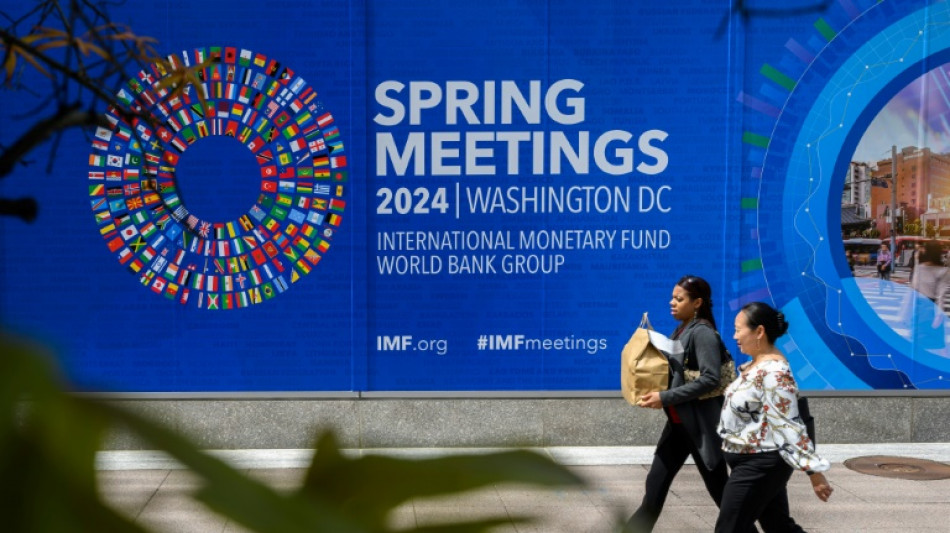
IMF says global debt levels face 'Great Election Year' risk / Photo: © AFP

 Kennedy Center: future unclear for iconic Washington arts hub

 Trump claims 'infinite' Greenland security deal with Denmark

 Helicopters battle wildfire threatening Ecuador's capital

 Brentford batter Chelsea to undo Alonso's promising start
 Kane hits Bundesliga century as Bayern rout Union
 Trump says CNN, MS NOW, Politico banned from White House

 Hushing and hedging: US companies retreat on climate

 Springboks to face Fiji before 2027 Rugby World Cup

 Nigeria miners struggled to breathe in cell before 37 died: survivors

 McIlroy on the charge at PGA Championship as Reed withdraws

 McIlroy on the charge at PGA Championship

 Crisis-wracked Volkswagen warns of 10-bn-euro hit to profits

 Costa Rica's Grynspan tops third informal poll for UN chief: diplomat

 Stock markets retreat after central bank rate hikes

 Russia labels director of Cannes Grand Prix winner a 'foreign agent'

 Macron warns of Russian 'hybrid' threat after meeting presidential hopefuls

 UN holds third informal poll for new chief

 Kulusevski return can spark Spurs: De Zerbi

 Shakira to cap off world tour with Madrid 12-gig run

 Isolated Syrian-Druze city blames Damascus for shortages

 Isolated Syrian-Druze city shortages

 Dutch drop Depay for Germany match in Xavi's first pick

 Ronaldo named in Portugal squad for Nations League
 Stock markets diverge after central bank rate hikes

 Anti-Assad music star makes triumphant return to Syria

The path towards sustainable government debt levels around the world is under threat this year from the sheer number of elections taking place, the IMF said Wednesday in a new report.
"History suggests, and empirical evidence confirms, that governments tend to spend more and or tax less in election year," Vitor Gaspar, the head of the International Monetary Fund's Fiscal Affairs told AFP, ahead of the publication of the Fiscal Monitor report.
He added that the situation this year is particularly complicated because, "the political discourse is dominated by references to fiscal expansion and calls for fiscal support or public spending -- or both."
The Fiscal Monitor report found that global public debt "edged up again" last year, reversing a couple of years of decline, due largely to a fall in revenues "as windfall revenues from inflation waned."
"Fiscal tightening is projected for 2024, but it is subject to considerable uncertainty," the IMF report continued.
Much of this uncertainty, the IMF said, is down to the fact that 2024 is the "Great Election Year," when 88 economies or economic areas representing more than half of the world's population have held, or are due to hold, elections.
"Clearly, given the stronger link between fiscal policy and politics, it is perfectly reasonable to think that political factors and political discourse will play an added role right now," Gaspar told AFP.
- Medium-term concerns -
The IMF predicts that current spending and taxation levels have put global public debt on track to rise from just over 93 percent of economic output last year to 99 percent by 2029.
This trend is "driven by the world's two largest economies, China and the United States, where under current policies public debt is projected to continue increasing beyond historical highs," the IMF report said.
The US experienced "remarkably large fiscal slippages," last year, the IMF said, citing a steep decline in income tax revenues due to lower capital gains taxes and "delayed tax payment deadlines."
While the IMF expects the US fiscal deficit to remain stuck above six percent over the next five years, the country's strong economic position makes it a "very strong outlier in fiscal development around the world," Gaspar said.
"The United States has ample fiscal space," he continued. "There are many measures that can be taken on the spending side and the revenue side."
- China's 'room for maneuver' -
Like the US, China's fiscal deficit is projected to remain at elevated levels over the next five years, rising from more than seven percent of GDP last year to around eight percent by 2029.
"China stands out as a country where the deficit as stayed elevated throughout," Gaspar said.
However, "China, as the United States, has policy room to correct the situation and can do it from a public finance viewpoint," he continued, adding: "China does have room to maneuver."
"They should act quickly in guaranteeing the credibility of their local government finances, in particular in cases where they are in danger given real estate and property development," Gaspar said.
Given China's role as a leading bilateral lender to many of the world's developing economies, its fiscal position carries consequences for countries around the world.
"China is one of the largest economies in the world," Gaspar said.
"It's extremely important in some sectors, and therefore the relevance of spillovers is very pressing," he added.
- Policy prescriptions -
The Fiscal Monitor report called for countries to make a "renewed push" toward consolidating their fiscal positions -- especially given the expected loosening of tight monetary policy in many places through interest rate cuts later this year.
To do this, the IMF recommended that countries should start by "immediately" phasing out pandemic-era support measures, scaling back fuel and energy subsidies, and enacting entitlement reforms in advanced economies with ageing populations.
In emerging market and developing economies, governments should "renew efforts to rationalize large government wage bills, and reform social safety nets," the IMF said.
J.Horn--BTB