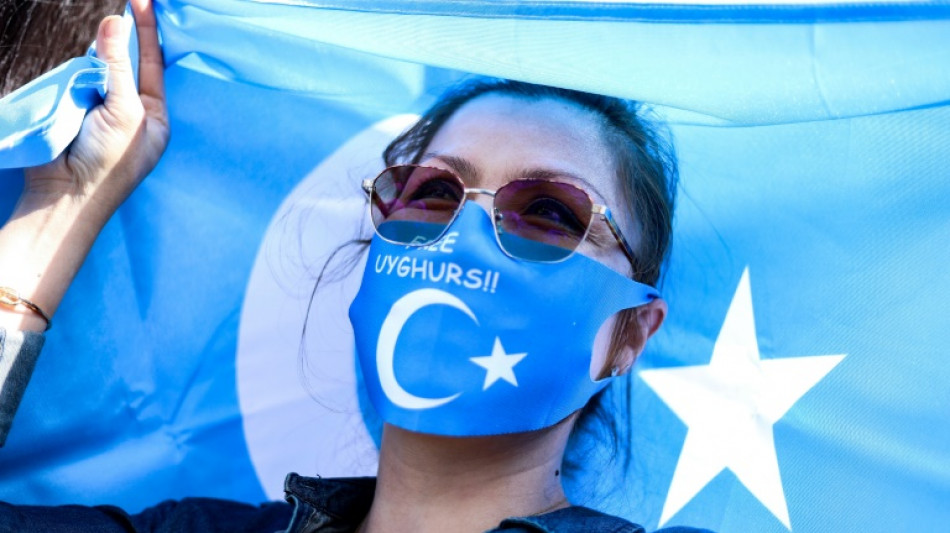
EU parliament votes forced labour ban with China in its sights / Photo: © AFP

 Ed Sheeran returns to stage after Palestinian controversy

 Asian Games to open in Japan after troubled build-up
 Drone owners rush to offload devices ahead of Beijing ban
 Trump's beef policies irk Texas ranchers, testing their loyalty
 Nvidia, OpenAI CEOs to attend Xi dinner at White House
 Anthropic picks Accenture for in-house AI safety evaluation

 Balogun returns as Monaco beat Lens to continue strong Ligue 1 start

 'Pause' on overt repression in Venezuela, but reforms still needed: HRW

 Global stocks mixed as yen falls despite Bank of Japan rate hike
 Cuba hit with seventh major blackout of the year
 Murray out with concussion so Wentz will start for Vikings

 UN chief 'deeply regrets' US visa refusal to Abbas for annual meeting
 England quick Carse to face no charges over alleged nightclub assault

 Mancini brings nine newcomers into the first squad of his Italy comeback

 Czechs level Davis Cup tie against USA as South Korea eye Finals
 New France boss Zidane confirms Mbappe as captain after naming first squad
 California governor signs order to explore AI 'kill switch'
 Head leads run spree as Australia win Zimbabwe ODI series

 In-form Raphinha wants to finish career at Barcelona

 Warren Buffett steps down as Berkshire Hathaway chairman
 Carrick confident Man Utd can 'work through' tough time

 Mbappe ends Nike partnership to join Swiss brand On

 Liverpool boss Iraola puts Bournemouth love affair on hold
 'A disaster' if Man City do not win says Maresca after flawless start
 Kerry James Marshall: American 'blackness' painter celebrated in Europe

EU lawmakers voted on Tuesday to ban products made using forced labour which supporters hope will be used to block goods from China, at the risk of raising tensions with Beijing.
The law does not directly mention China, but many lawmakers hope it will be used to block imports from China involving the region where the Uyghur Muslim minority lives.
Human rights groups say at least one million people, mostly members of Muslim minorities, have been detained in China's northwestern Xinjiang region and face a series of abuses, including forced sterilisation of women and coerced labour.
The legislation, backed in a vote by 555 EU lawmakers, with six against and 45 abstaining, will become law following final approval by the EU's 27 member states.
The EU has deployed an array of trade tools against China, including anti-subsidy investigations into Chinese state support for green tech such as solar panels.
The latest law seeks to eradicate forced labour from European markets.
Under the rules, EU states can remove products found to have been made using forced labour as well as goods made in the bloc comprising material made abroad using forced labour.
"This regulation is groundbreaking and it's unique. It's inclusive, broad, and together with several other regulations and directives... (it's) a real game changer," Dutch lawmaker Samira Rafaela, who pushed the text through parliament, said.
"Companies, industries, whole sectors and their respective contractors will need to make a serious effort to ensure their conduct is sustainable and ethical, respecting human rights throughout their entire supply chain," she told reporters after the vote.
Some 27.6 million people were engaged in forced labour in 2021, including around 3.3 million children, according to the International Labour Organization.
- Power to seize goods -
The new rules give the European Commission the power to launch investigations when there are suspicions about the supply chains in countries outside the EU.
If the use of forced labour is proved, officials will seize the products at the borders and order their withdrawal from the European market and online retailers.
If the risk is in one member state, the local authority in that country will investigate the products allegedly made using forced labour.
For some goods deemed to be at risk, importers will be forced to provide detailed information on the manufacturers.
The EU will also create a regularly updated database about forced labour risks that will include international reports to aid the commission and national bodies in assessing possible violations of the law.
Critics have pointed out that the law does not go as far as one adopted by Washington.
The United States in 2021 banned the importation of products from Xinjiang unless businesses could prove their production did not involve forced labour.
Maria Manuel Leitao Marques, another EU lawmaker who spearheaded the law through parliament, pointed to the concerns about products in Europe made by Uyghurs.
"It could be that what you are using today or consuming today, such as cotton might not come from Turkmenistan, but from China, where the Uyghurs are being forced to work, where they're the victims of forced labour," she said during a debate on Monday.
L.Janezki--BTB