Minouche Shafik: From renowned economist to embattled Columbia president / Photo: © GETTY IMAGES NORTH AMERICA/AFP

 US warns of rapid escalation in Mideast war
 Iran 'put hearts on the court' to win Asian Games basketball bronze

 School girl Yu helps China dominate in Asian Games swimming openers
 Myanmar win first Asian Games teqball gold as Spain great Puyol watches

 China's 13-year-old Yu scorches to first major gold at Asian Games
 Russians vote on last day of parliamentary elections

 Hong Kong pays final respects to former city leader Tung
 Typhoon put people off Asian Games opening ceremony, official says
 China's 13-year-old Yu cruises as Asian Games swimming begins

 AI 'warning shots' focus Beijing on national security risks

 Philippine tribe in limbo over US-led tech hub
 Leo XIV, first US pope transcends his restrained style
 Singer Ed Sheeran says Gaza situation 'unjustifiable' following controversy
 In 'Tenzing', a Sherpa mountaineer gets his due
 Ed Sheeran set to return to stage after Palestinian controversy
 Toulouse edge Vannes, Lyon beat Pau to take Top 14 summit

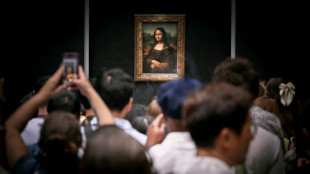 Germans arrested for Louvre stunt in Mona Lisa hall
 Saudi-led coalition says Houthis fired ballistic missile at Riyadh

 France's debt climbs to highest since 1978: ministry

 McIlroy two shots off the lead at Wentworth after eagle on 18
 Martinez brace saves Inter in Serie A top-two clash with Roma
 Rosenior abused but guides Paris FC past old club Strasbourg

 Seven-try Lyon beat Pau, climb to Top 14 summit
 Brighton defeat a 'big lesson' against complacency for Arsenal, says Arteta

 Thousands protest inaction over climate crisis in Switzerland

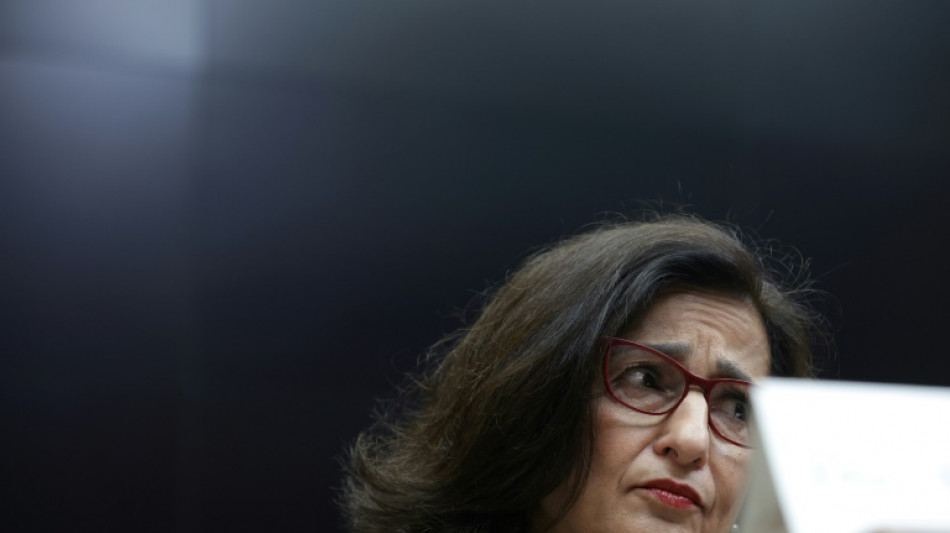
An esteemed economist, Minouche Shafik was thrilled to become president of one of America's most prestigious colleges.
But her name will now be tied with dramatic images of New York police arresting pro-Palestinian students at the Columbia University campus.
Less than a year after taking up the role, 61-year-old Shafik finds herself at the heart of a storm over her handling of the protests that spread to other colleges in the United States.
Twice in two weeks, she asked the police to intervene -- first to disperse an encampment on the university grounds and then, on Tuesday, to oust students who had barricaded themselves inside a building on campus.
Spectacular images of helmeted police officers encircling the campus and detaining students were making the rounds overnight, prompting criticism for Shafik, particularly from teachers.
Even before Tuesday, Shafik was under fire on two main fronts.
Republicans have demanded Shafik resign, arguing that she failed to protect Jewish students on her campus.
Meanwhile pro-Palestinian students accuse her of muzzling their protests and of escalating the situation by calling police in to manage the demonstrations.
- 'Profound effect' -
Born in Alexandria in Egypt, Nemat "Minouche" Shafik was four years old when her family fled the country and moved to the United States.
"I was born into a comfortable family in a society marked by severe inequality," the British-American told the Columbia Magazine in autumn 2023.
But she said "my family's prospects changed dramatically in the mid-1960s, when most of our land and property was seized by the Egyptian state as part of Nasser's nationalization program."
Shafik found herself an immigrant in the American South "during the desegregation era, amid explosive racial tensions," an experience that had a "profound effect," she said.
A graduate of prestigious universities in the United States and the United Kingdom, Shafik went on to occupy various senior posts at the World Bank, the International Monetary Fund and the Bank of England, before being named head of the London School of Economics.
Shafik is also a member of the House of Lords, the second chamber of the UK parliament, a role from which she is currently on leave.
- 'Crucial role' -
Columbia University had already been embroiled in debates, including about the costs of higher education, before Shafik became president last year, making her the first woman to hold the post.
But the war in Gaza, triggered by Hamas's attack on Israel in October, began a course of turmoil for the college.
Shafik saw the resignations of the presidents of two other universities -- including Harvard -- brought about over claims they were not doing enough to combat anti-Semitism on their campuses.
On April 17, it was Shafik's turn to be questioned by Congress on the issue. She firmly defended her actions and condemned anti-Semitism "that is so pervasive today."
That same day, Columbia students set up tents on the campus lawns to demand an end to the war in Gaza and that their university cut all ties with Israel.
Shafik called on New York's police a day later to help disperse the protesters, leading to more than 100 students being arrested.
That started a high-profile standoff that continued into this week.
In the Columbia Magazine, Shafik said she decided to become president of the "extraordinary institution" because it was the "most cosmopolitan, outward-looking" of America's top universities.
"And at a time when universities have a crucial role to play in addressing societal problems, I think that Columbia is positioned to be a tremendous force for positive change, in New York City and around the world," she said.
Her students, on both sides of the fence, seem to have taken her at her word.
M.Odermatt--BTB