Germany set for massive security challenge at Euro 2024 / Photo: © AFP/File

 Germany's Merz vows to stay course despite new vote losses
 Man City outgun Sunderland despite Brobbey hat-trick, Man Utd rescue Fulham draw
 Mourinho blames ref committee for Real Madrid derby defeat

 Maresca craves a 1-0 win after eight-goal Man City thriller
 Atletico Madrid beat Real Madrid in tense derby clash
 Reusser retains world time-trial title

 Man City outgun Sunderland despite Brobbey hat-trick, Liverpool win at Bournemouth

 Top US, Chinese economic officials meet ahead of Trump-Xi summit
 Erdogan's LGBTQ crackdown 'first step of election campaign': activist
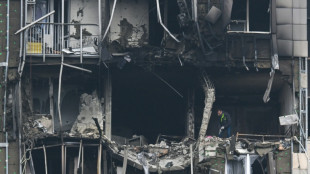 Mass drone barrage on Moscow kills two

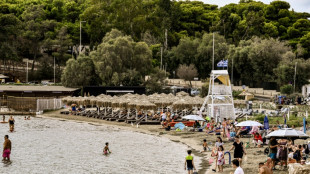 82-year-old dies after beach fight in Greece over sun lounger
 US warns of rapid escalation in Mideast war
 Iran 'put hearts on the court' to win Asian Games basketball bronze

 School girl Yu helps China dominate in Asian Games swimming openers
 Myanmar win first Asian Games teqball gold as Spain great Puyol watches
 China's 13-year-old Yu scorches to first major gold at Asian Games
 Russians vote on last day of parliamentary elections
 Hong Kong pays final respects to former city leader Tung

 Typhoon put people off Asian Games opening ceremony, official says
 China's 13-year-old Yu cruises as Asian Games swimming begins

 AI 'warning shots' focus Beijing on national security risks
 Philippine tribe in limbo over US-led tech hub
 Leo XIV, first US pope transcends his restrained style
 Singer Ed Sheeran says Gaza situation 'unjustifiable' following controversy

 In 'Tenzing', a Sherpa mountaineer gets his due
Keeping fans and players safe will be a mammoth task for Germany as it hosts Euro 2024 this summer in a tense global climate with major conflicts in Ukraine and the Middle East.
From hooligans to potential terrorist attacks and even cyberattacks, the European Championship organisers will be looking to ward off a range of threats.
Security forces will be charged with protecting some 2.7 million fans, 24 team base camps spread across the country and ten stadiums where 51 matches will be played between June 14 and July 14.
Designated fan zones are also expected to attract around 12 million visitors.
"From the outset, security has been our top priority," tournament director Philipp Lahm told AFP.
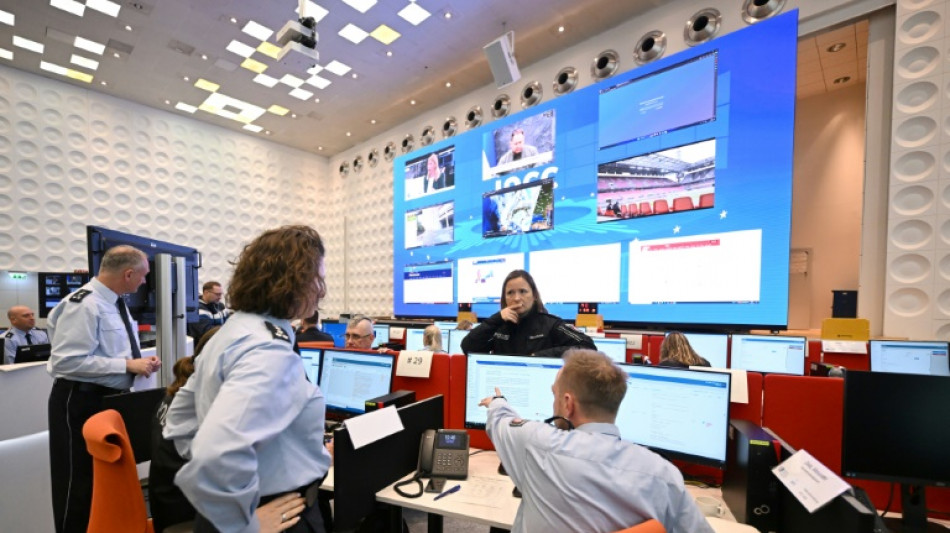
In an unprecedented move, Germany has invited some 300 security experts from all nations playing in the tournament to take part in a monitoring project at the International Police Cooperation Centre (IPCC) in the western city of Neuss.
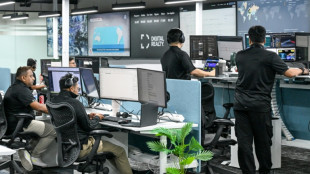
Alongside officials from Germany, Europol and European football body UEFA, they will take turns to monitor the situation on the ground, gathering during the tournament in a huge 500-square-metre (5,382-square-foot) conference room equipped with 129 computers and a 40-square-metre screen, AFP saw on a visit to the facility.
- No leave for police -
"Each country knows its troublemakers better than any other, and the foreign experts present in Neuss will be able to identify them more quickly," Oliver Strudthoff, director of the IPCC, told AFP.
"The size of the delegations will depend on the number of fans and how potentially dangerous they are. England, for example, will have many more representatives than Switzerland," he said.
At the matches themselves, all hands will be on deck -- police have been forbidden from taking leave during the tournament.
Germany will also introduce security controls on all of its nine borders.
"On trains and in stations, the federal police will be visibly stepping up their presence," said a spokesman for the German interior ministry. The same applies to airports.
French gendarmes will support the German police by taking part in joint rail patrols on routes to and from France and at matches involving the French team.
The British government has said that more than 1,600 English and Welsh supporters who are hit with stadium bans because of previous violent behaviour, will be banned from travelling to Germany during the tournament.
- Triple perimeters -
On top of the standard measures, German Interior Minister Nancy Faeser has said the Ukrainian national team will be subject to enhanced security.
Between 800 and 1,300 police will be deployed around the stadiums at each match, depending on the teams playing.
In a bid to prevent anyone from entering a match with weapons or explosives, three security perimeters will be set up around each stadium.
Cars will be checked at the first barrier, while fans will have their bags searched at the second, before scanning their tickets at the third.
The fan zones will also present a security challenge, especially the largest one at Berlin's Brandenburg Gate which is set to welcome tens of thousands of visitors for every match.
These "soft targets" are more vulnerable because "it's easier for perpetrators to infiltrate (them) and take action", said Johannes Saal, a security expert at the University of Lucerne.
The German army will also monitor the sky from the National Air Security Center, located some 70 kilometres (44 miles) from the IPCC.
The use of drones will be closely monitored, with flight restriction zones.
"Major sporting events are always potential targets for terrorist attacks," said Saal, describing the security situation as "very tense" in the context of the war in Gaza and the ever-present threat of Islamist extremism.
K.Thomson--BTB