Dung power: India taps new energy cash cow / Photo: © AFP

 Alcaraz to return for US Open title defence

 China's rapid solar expansion hurt bird diversity: study

 President Paul Biya back in Cameroon after 73 days away
 Newcastle boss Jaissle unfazed by lack of respect
 US Open purse to top $100 mn as Grand Slams form player council

 Hull aim to silence critics after unexpected promotion to Premier League

 Pakistan hit back against England after Cox and Root fifties

 Walmart reports mixed results as gas prices drag on US sales growth

 Wang downs Sindhu to break Indian hearts at badminton worlds

 As Europe's rivers recede, shippers scramble to limit damage
 Alonso won't confirm Fernandez will remain at Chelsea after Man City link

 Milky Way's fastest star discovered spinning around black hole

 Kanye West planned concerts trigger frenzy in Russia

 Hungary music festival basks in post-Orban freedom

 Vatican says 'serious concerns' over Israel-Lebanon deal implementation

 Arteta confirms Arsenal want to sign defender after Konsa link

 What's behind the UAE's decision to cut Iran trade ties?
 Barca seal Cancelo return to bolster defence

 Germany reports record 14,000 heat-related deaths this summer

 Alvarez 'focused' says new Atletico team-mate Romero

 West Ham warn fans about 'offensive' Solomon chant
 Huge questions loom over Prince Harry's shock return to UK

 BYDFi Joins Coinfest Asia 2026, Connecting with Institutions, Builders and Traders in Bali

 Max Verstappen: Natural-born winner

 Van Dijk urges Liverpool to make amends for 'unacceptable' season

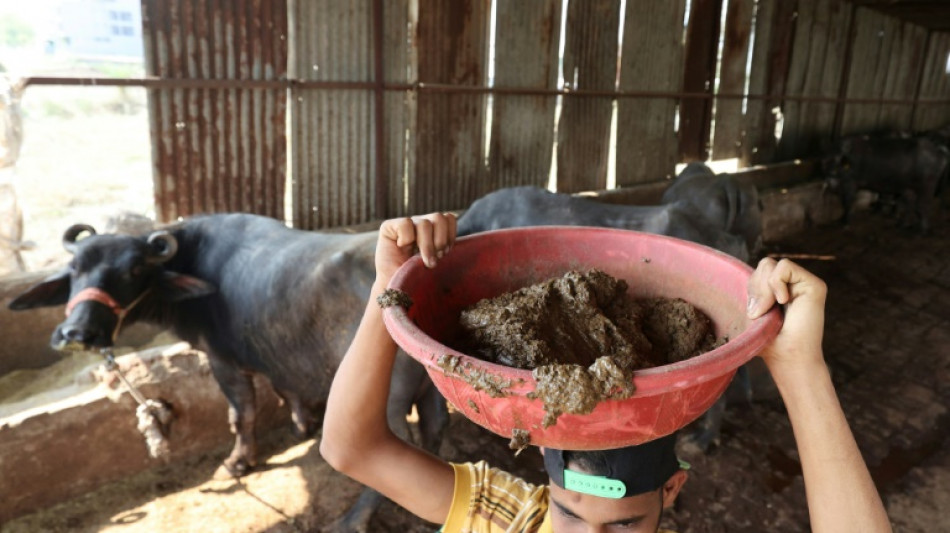
India is tapping a new energy source that promises to help clean up smog-choked cities and is already providing a vital revenue stream for poor Indian farmers: truckloads of bovine manure.
Cows are venerated as sacred creatures by the country's Hindu majority. They also have pride of place in India's rural communities, where they are still regularly used as draught animals.
Rural households have long burned sun-dried cattle droppings to heat stoves, a practice that continues despite government efforts to phase it out with subsidised gas cylinders.
Villages on the outskirts of the central Indian city of Indore are now being handsomely rewarded for handing over their mounds of bovine waste in a pilot project to help meet the city's power needs.
"We have a very good quality dung, and we keep the dung clean to ensure it fetches the best price," farmer Suresh Sisodia told AFP.
The 46-year-old has sold nearly a dozen truckloads of fresh manure at the equivalent of $235 per shipment -- more than the monthly income of the average Indian farming household.
Sisodia's farm has 50 head of cattle and, in the past, occasionally offset costs by selling manure for fertiliser. Now, he is hopeful for a more reliable revenue stream.
- 'Dung money' -
"The farmers pick it up once every six or 12 months and there are seasons when they don't -- but the plant could give us a steady income," he said, adding that his farm generates enough manure to fill a truck every three weeks.
His family are one of the many beneficiaries of "Gobardhan" -- literally "dung money" in Hindi -- since the inauguration of a nearby biomass plant by Prime Minister Narendra Modi in February.
Sisodia's cattle droppings are carted to the plant, where they are mixed with household waste to produce flammable methane gas and an organic residue that can be used as fertiliser.
Eventually, the plant is slated to work through 500 tonnes of waste, including at least 25 tonnes of bovine faeces, each day -- enough to power the city's public transit system, with plenty left over.
"One half will run Indore buses and the other half will be sold to industrial clients," plant boss Nitesh Kumar Tripathi told AFP.
The Gobardhan pilot programme has faced its share of logistical hurdles, with decrepit rural roads making it hard for the plant's dung-carrying trucks to reach farms.
Farmers have also been sceptical of what appears to be a get-rich-quick scheme and required careful "assurances of quick and regular" payments before signing on, said Ankit Choudhary, who scouts villages for potential suppliers.
The Indian government, however, has high hopes for the initiative, with Modi pledging waste-to-gas plants in 75 other locations since the Indore facility began operations.
Cultivating alternative energy sources is an urgent priority in India, which burns coal to meet nearly three-quarters of the energy needs of its 1.4 billion citizens.
Its cities regularly rank among the most smog-choked urban centres in the world as a result. Air pollution is blamed for more than a million deaths in India annually, according to a study published in The Lancet medical journal.
- Sacred strays -
The project is also guaranteed to appeal to Hindu nationalist groups -- Modi's most important political constituency and vocal advocates of cow protection.
Under their watch, "cow vigilantes" have run Muslim-owned abattoirs out of business and lynched people accused of involvement in cattle slaughter.
But bovine-centric religious policies have led to unintended consequences, with stray cows now a common sight in villages and even on busy roads in big cities.
Government acolytes such as Malini Laxmansingh Gaur, a former Indore mayor and member of Modi's party, hope that scaling up the biogas project will incentivise farmers to keep their cows even when they are too old to give milk or help till fields.
"This extra income will both clean villages and help tackle the strays," she told AFP.
J.Fankhauser--BTB