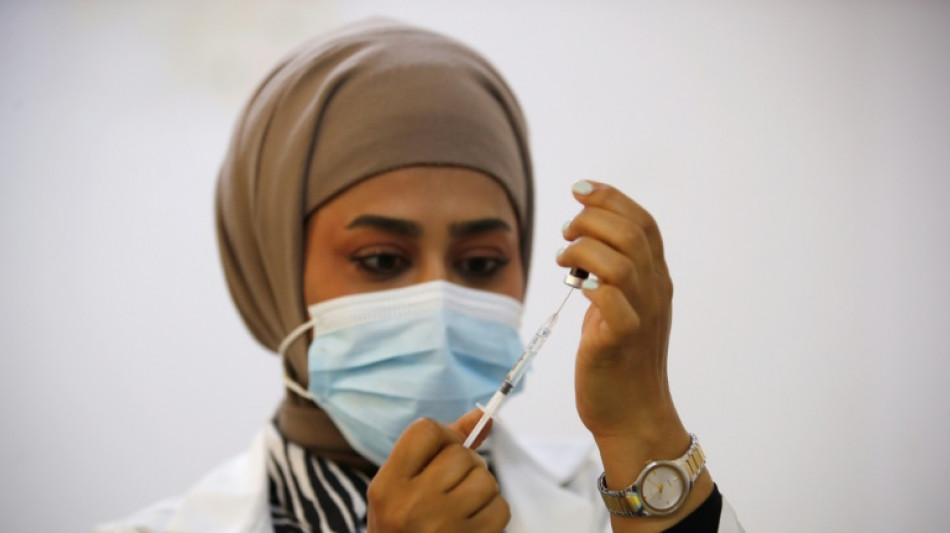
Five key points in proposed pandemic agreement / Photo: © AFP

 New Zealanders pick endangered black robin as Bird of the Year

 Asia stocks rise on AI, US-China trade talks optimism
 Malaysia's 'elephant whisperer' fights to save Borneo's endangered giants
 'I live in fear': 1.5 million Pakistani children sexually exploited online

 Cowboys beat Commanders, Vikings down Bears as star QBs injured
 Braves clinch division title as Red Sox reach MLB playoffs
 Bordeaux-Begles hammer Stade Francais despite Jalibert injury

 Milan and Juventus end blips with home wins
 Bridgeman wins PGA Biltmore title with sizzling 61

 Williams injured as Bears shut down by Vikings

 US warns of rapid escalation in Middle East war
 Germany's far-right AfD celebrates another state election win
 Russia vows revenge for election-day attacks as poll shows ruling party win

 Spaun late shows snatches PGA Championship win

 Conceicao strikes as Juventus beat Atalanta
 Britain, Zverev-inspired Germany, Spain complete Davis Cup finals

 Man Utd salvage Fulham draw as pressure mounts on Carrick
 Spanish civil war drama 'The Black Ball' wins at Toronto festival

 Germany's Merz shaken by far-right and far-left gains in state votes

 Macron welcomes Canada's Carney to French Atlantic territory
 Fiorentina frustrate Napoli with Serie A draw, Como upset

 Five-star Man City top Premier League after Sunderland thriller
 Ukrainian drones hit Moscow on last day of Russian elections
 Multi-Asset Trading Venue Monochrome Exchange Announces IEO of Its Native Token, $MCR
 South Korea break Japan hearts to win Asian Games basketball gold

Countries are trying to finalise a global agreement on how to prepare for and avert pandemics by Friday evening, after two years of negotiations triggered by the horrors of Covid-19.
Here are five key sections of the draft agreement being discussed by national negotiators at the World Health Organization's headquarters in Geneva, according to a draft seen by AFP:
- Pathogen access, benefit sharing -
The core of the agreement is the proposed Pathogen Access and Benefit-Sharing System (PABS) -- a new platform allowing the swift sharing of pathogen data with pharmaceutical companies, enabling them to quickly start working on pandemic-fighting products.
This has been the trickiest part to negotiate.
Developing countries have expressed concerns about handing over data if there is a risk they might be cut off from accessing the resultant vaccines, as was largely the case at the start of the Covid-19 pandemic.
Under PABS, countries would commit to rapidly sharing data on emerging problematic pathogens, and that the vaccines and other benefits derived from accessing that information would be shared on a more equitable footing.
But while the principle is widely supported, the detail is not.
Countries are debating whether PABS should involve pharmaceutical manufacturers giving 10 percent of their production to the WHO for free for global distribution -- for example, to protect frontline health workers worldwide.
A further 10 percent could be given to the WHO at a not-for-profit price.
- Prevention and surveillance -
Under this section, countries would take steps to progressively strengthen their pandemic prevention and surveillance capacities.
Subject to resources, countries would develop, strengthen and implement comprehensive national pandemic prevention plans.
This would include things like routine immunisation, managing biological risks in labs, preventing antimicrobial resistance, and stopping transmission of diseases from animals to humans.
This section has largely been agreed upon by working groups, but is awaiting final sign-off.
Negotiators are also debating whether, or how, to broaden the scope of the agreement to include surveillance of animal and environmental health in the bid to spot pandemic threats.
But some worry this is stepping beyond the WHO's remit.
- Financing -
Article 20 of the draft agreement deals with sustainable financing.
Some developing countries simply don't have the resources to implement Western levels of pandemic preparedness and pathogen surveillance.
Developed nations meanwhile are reluctant to foot the bill for them without concrete commitments in return.
As the draft stands, countries would agree to maintain or increase domestic funding for pandemic prevention, preparedness and response.
They would also mobilise additional money to help developing countries implement the agreement, through grants and concessional loans.
- Supply chain and logistics -
In an attempt to smooth out the flaws exposed by Covid-19, a Global Supply Chain and Logistics Network would be set up for equitable, timely and affordable access to pandemic-related health products.
During pandemic emergencies, countries would prioritise sharing pandemic-related health products through the network so that they can be distributed equitably based on public health risk and need.
Each country would also be asked to avoid stockpiling pandemic-related health products that unnecessarily exceed the quantities needed.
Switzerland, for instance, destroyed more vaccines against the virus causing the Covid-19 pandemic than it ever administered during the crisis.
- Vaccine mandates, lockdowns, travel bans -
WHO director-general Tedros Adhanom Ghebreyesus has repeatedly warned of unprecedented misinformation and disinformation surrounding the pandemic agreement negotiations -- notably over what the agreement would allow the WHO and its chief to do.
Amid accusations that the deal would enable the UN health agency to encroach on countries' sovereignty over their health policies, the draft text specifies that "nothing" in the agreement should be interpreted as giving the WHO "any authority to direct, order, alter or otherwise prescribe" national or domestic laws, or impose other requirements such as banning travellers or imposing vaccination mandates.
E.Schubert--BTB