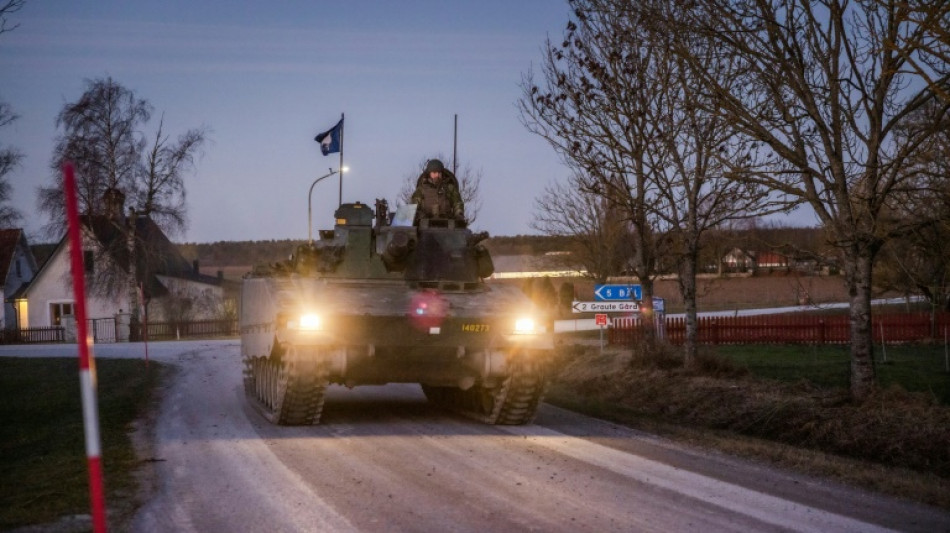
Rattled by Russia, Finland and Sweden revisit NATO debate / Photo: ©

 Prague’s Concert for the Future Kicks Off on Wenceslas Square

 Prince William and Princess of Wales to Announce Earthshot Prize Winners in Mumbai

 Indonesia Forest Fires: Health Crisis, Diplomatic Strains and the Search for Solutions

 BYD Dolphin G Leasing Deal: Plug-in Hybrid Supermini Available from £174 a Month

 JUEL Group Expands from Real Estate to Hospitality with Hyatt Centric Malta Opening

 French Economy Shrinks 0.1% as Consumer Confidence Slumps

 Wall Street Ends Turbulent Week Higher Despite Inflation and AI Jitters

 Kansas City Fed Chief Says Inflation Is Still Running Too Hot

The threat of a Russian invasion of Ukraine has reignited debate in Finland and Sweden over whether they should join NATO to fend off any possible eastern aggression.
Fighter jets could be heard carrying out drills above the Finnish capital this week, while Sweden recently deployed troops to a Baltic outpost in response to rising tensions.
President Vladimir Putin's demands that NATO not expand eastwards have also led Finnish and Swedish leaders to loudly reassert their right to apply for membership should they wish.
"It's for Finland and 30 NATO allies to decide, finally, on the issue of membership, and that's exactly the same for Sweden," NATO Secretary General Jens Stoltenberg said Monday after meeting the countries' foreign ministers.
Neither Finland nor Sweden have expressed an official desire to become full members, preferring instead information sharing and some joint training.
But Charly Salonius-Pasternak, from the Finnish Institute of International Affairs, said Finland and Sweden had made "a conscious effort... to get explicit statements that NATO's open-door policy is still open".
Elina Valtonen, vice-chair of Finland's opposition National Coalition Party, said joining was "a natural step".
"We have been forming ever-closer cooperation agreements not only with NATO, but also the United Kingdom and the United States," Valtonen said.
She added that Finland had long abandoned its Cold War stance of seeking to appease the Kremlin by remaining neutral.
- 'Akin to blasphemy' -
Without membership, Finland is ineligible for protections under NATO's Article 5, which commits other members to come to its aid should Russia send troops across the 1,340-kilometre-long (830- mile-long) border.
But support for NATO membership has traditionally been low among Finns and Swedes, though a January survey in Finland suggested opposition to joining had fallen to a two-decade low of 42 percent.
Robert Dalsjo, from the Swedish Defence Research Agency, said that for many in Sweden's largest political party, the Social Democrats, NATO membership was "akin to blasphemy".
A re-evaluation could only be triggered by either "a Finnish opening for membership, or a threat so credible that the political calculus changes," he said.
Few Russia-watchers suspect Putin has plans to send tanks into Finland.
But, said Finnish analyst Salonius-Pasternak, "we have seen and continue to see... sub-threshold actions," such as Russia suddenly releasing 1,700 migrants across the Finnish border in 2016, or repeated airspace incursions.
With memories lingering of the Soviets' bloody invasion attempt during World War II, Finland has for years upheld high levels of military readiness.
Finland's former foreign minister Erkki Tuomioja, one of the country's most prominent opponents of NATO membership, said the country was well-prepared if needed.
"We are not blue-eyed, so we have heavily invested in our national defence," he said.
- 'Borrowing umbrellas' -
Finland has spent 8.4 billion euros ($9.5 billion) on new fighter jets, and "can mobilise a reserve of 280,000 trained soldiers, which no other country in Europe can do," Tuomioja added.
Sweden, in contrast, slashed military spending after the Cold War.
In 2013 commander-in-chief Sverker Goranson shocked Swedes by saying the country could only hold off a Russian invasion for "about a week" without outside help.
But after Russia's 2014 annexation of Crimea, Sweden began bolstering its defences.
"We were caught dressed for beautiful weather as the barometer indicated a storm coming," said Dalsjo, the Swedish analyst.
"We've solved this by borrowing umbrellas, boots and warm sweaters from the Americans," but Sweden is still far from having the resources to defend itself.
The country, which has not been to war in two centuries, reintroduced mandatory military service in 2017.
This month Sweden deployed armed patrols to the island of Gotland after three Russian landing ships entered the Baltic sea.
Finland announced it had increased "preparedness" with military exercises across the country.
Salonius-Pasternak said Helsinki was quietly preparing behind the scenes.
"Right now stuff is being done, but one might not see it," he said.
T.Bondarenko--BTB