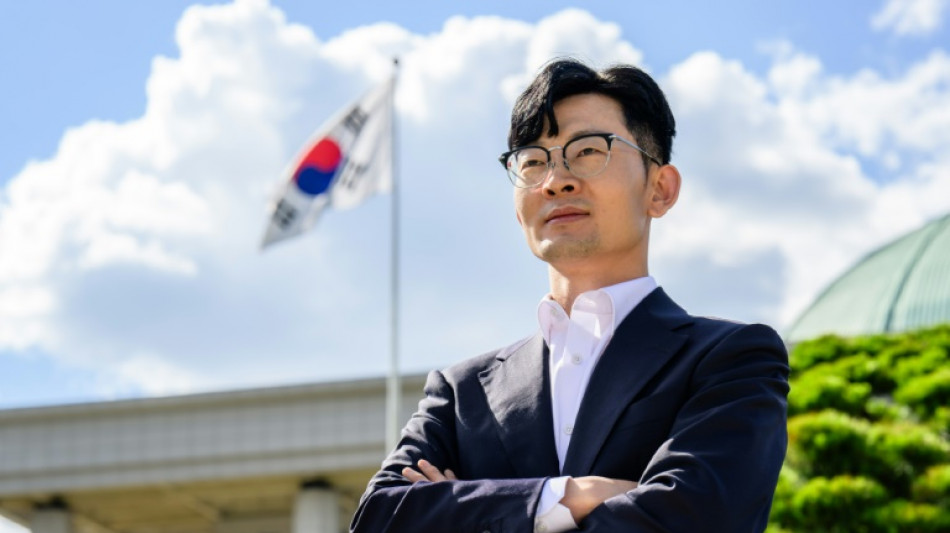
The North Korean missile researcher who became a South Korean lawmaker / Photo: © AFP

 COP31 host says AI's climate footprint to be a summit priority

 Renewables hit record in 2025, but world must move faster: report
 US media outlets to sue Trump administration after White House ban
 Global stocks rally on lower oil prices, US-China hopes

 EU proposes energy rating for data centres

 Schoolgirl Yu scorches to second gold as doping case rocks Games

 Putin's party secures record score in Russia election

 Haupt Koleksiyonu: Paranın Biz İnsanlar Hakkında Anlattıkları

 Spanish PM says unregulated AI could be 'devastating'

 Yu, 13, smashes record again with second Asian Games gold

 Switzerland to play without Xhaka over fake Covid certificate

 From Korean Chipmakers to Leveraged Semiconductor ETFs: STARTRADER Launches 49 New 24/7 Stock and ETF CFDs

 Thai badminton player first doping case at Asian Games: testers

 Колекція Гаупта: Що гроші розповідають про нас, людей
 German far-right AfD poll winner says Merz 'twilight' has begun

 Flights scrapped, evacuations urged as Typhoon Dujuan nears Japan

 China confirms Xi to visit US this week for Trump talks

 مجموعة هاوبت: ما يكشفه المال عنا نحن البشر

 Colecția Haupt: Ce ne dezvăluie banii despre noi, oamenii

 Sisters of jailed Pakistan ex-PM Imran Khan arrested

 African players in Europe: Semenyo brace helps City top table

 'For my family': India boxer beats hardship, injury to go for Games gold
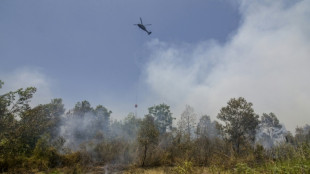 Indonesia doing 'everything' but still struggling to curb fires
 Once decried as 'human cockfighting', MMA wants Olympic spot

 China's Yu, 13, great for swimming says multiple Olympic medallist
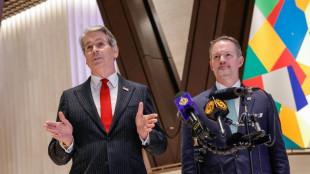
Park Choong-kwon was once a member of an elite North Korean unit that developed long-range missiles. Now, as a lawmaker in the South, he is sounding the alarm over Kim Jong Un's weapons.
As a teenager in the North, Park was plucked from his regular classroom and sent to a school for gifted kids, from where he quickly progressed to the country's National Defense University.
But he disliked the military discipline and was disillusioned by high-level corruption, eventually deciding to defect to the South, where the 38-year-old was sworn in as a lawmaker last month.
Set up in the 1960s, Park's alma mater is a key part of the nuclear-armed North's banned weapons programmes -- it takes the country's top brains and uses them to further Kim's quest for bigger and better missiles, satellites and nuclear warheads.
The university "was created with the main goal of making intercontinental ballistic missiles", said Park, who studied there from 2003 to 2007.
Under Kim Jong Un -- who took over from his late father in 2011 -- the university has been expanded, with new departments for hypersonics, satellites and nuclear, and the pace of weapons development is more advanced than many outsiders understand, he said.
"The North started publicly rolling out its new weapons lineups in 2017, including hypersonic missiles, strategic surface to surface missiles... and hydrogen bombs," he said.
"But the development of these weapons was already 80 to 90 percent complete when I escaped in 2009."
North Korea's attempt to put a second spy satellite into orbit last week may have ended in a mid-air explosion, but Park says even failure shows how advanced the country's programmes really are.
"They are trying a new engine test even when they are capable of putting one satellite into orbit with an existing engine," said Park, who was born and raised in the eastern coastal city of Hamhung, and is the fourth defector to become an MP in the South.
- Hacking unit -
The only institution in North Korea that got to choose its students ahead of the National Defense University was the hacking unit, Park told AFP.
"The top two students in my class were recruited to the hacking unit," he said.
North Korea's cyber-programme dates back to at least the mid-1990s, but has grown to a 6,000-strong cyberwarfare unit, known as Bureau 121, that operates from several countries including Belarus, China, India, Malaysia and Russia, according to a 2020 US military report.
Park told AFP the North puts meticulous care into nurturing hackers, who have stolen hundreds of millions of dollars of cryptocurrencies and other digital assets in recent years, industry data shows. They are a key source of revenue for Kim's government as sanctions continue to bite.
Park himself majored in chemical engineering, and quickly became involved in making long-range missiles designed to hit targets on the US mainland.
But despite his elite status within North Korean society, he became disillusioned with the system.
Forced to study key texts in which former leader Kim Jong Il refuted attacks on Korean-style socialism, Park found "the criticisms made more sense to me".
Then, in his final year at the university, he discovered that to get a good work placement after graduation, he would need to pay.
"Bribing officials $3,000 would land you a job in Pyongyang," he said, adding that the country's ruling Rodong party was "corrupt to its core".
"After that I began to see the suffering of the people. The last hopes and dreams I had for the system all faded away. There was nothing I could do to change from within," he said.
"So I decided to defect."
In 2009, after meticulously planning his escape so as not to put his remaining family at risk, he crossed the Tumen river to China, and then made his way to the South.
- Forever enemy -
Once safely in Seoul, Park decided to study for his doctorate at the top Seoul National University, before going to work at Hyundai Steel.
Last year, the ruling People Power Party, which advocates a tough line on North Korea, recruited him to run for parliament -- and he won office in April legislative elections.
Park says he plans to work on North Korea issues during his term, but not exclusively, as he has other interests and areas of expertise, as an engineer for example.
Getting information from the outside world to people in tightly controlled North Korea is key to changing the situation, he said.
"North Korea employs a two-track strategy of maintaining the regime's power: designating an outside enemy to stir a sense of crisis among its people and showcasing new weapons to give a sense of pride," Park told AFP.
But if the North Korean public "awaken", this strategy will stop working, he said, meaning that the endless cycle of "provocation" can end.
L.Janezki--BTB