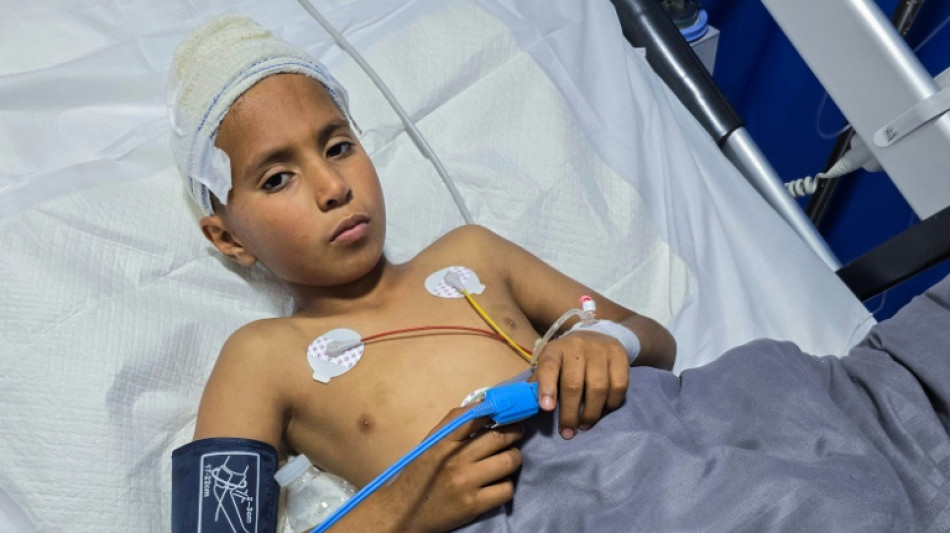
Deadly landmines pose hidden threat in Libyan capital / Photo: © AFP

 COP31 host says AI's climate footprint to be a summit priority

 Renewables hit record in 2025, but world must move faster: report

 US media outlets to sue Trump administration after White House ban

 Global stocks rally on lower oil prices, US-China hopes

 EU proposes energy rating for data centres

 Schoolgirl Yu scorches to second gold as doping case rocks Games

 Putin's party secures record score in Russia election

 Haupt Koleksiyonu: Paranın Biz İnsanlar Hakkında Anlattıkları

 Spanish PM says unregulated AI could be 'devastating'

 Yu, 13, smashes record again with second Asian Games gold

 Switzerland to play without Xhaka over fake Covid certificate

 From Korean Chipmakers to Leveraged Semiconductor ETFs: STARTRADER Launches 49 New 24/7 Stock and ETF CFDs

 Thai badminton player first doping case at Asian Games: testers

 Колекція Гаупта: Що гроші розповідають про нас, людей
 German far-right AfD poll winner says Merz 'twilight' has begun

 Flights scrapped, evacuations urged as Typhoon Dujuan nears Japan

 China confirms Xi to visit US this week for Trump talks
 مجموعة هاوبت: ما يكشفه المال عنا نحن البشر

 Colecția Haupt: Ce ne dezvăluie banii despre noi, oamenii

 Sisters of jailed Pakistan ex-PM Imran Khan arrested

 African players in Europe: Semenyo brace helps City top table

 'For my family': India boxer beats hardship, injury to go for Games gold
 Indonesia doing 'everything' but still struggling to curb fires
 Once decried as 'human cockfighting', MMA wants Olympic spot

 China's Yu, 13, great for swimming says multiple Olympic medallist

Hundreds of deadly landmines and unexploded ordnance still litter parts of Libya after years of fighting, posing a constant danger to civilians, especially children, long after the conflict.
"It's a disaster zone," said Saleh Farhat, describing his neighbourhood on the southern outskirts of the capital Tripoli, where his son Mohamed was being treated in a hospital intensive care unit after being severely injured in an explosion.
Although relative calm has returned to the oil-rich country since the battle for Tripoli four years ago, the United Nations says more than 400 people, including 26 children, have been injured or killed since 2019 in accidents linked to left-over explosive devices.
Mohamed Farhat, 10, was playing with friends in a garden when the children picked up what they thought was a piece of scrap metal.
"A few seconds later, a strong explosion threw us to the ground," his friend Hamam Saqer, 12, told AFP from a nearby hospital bed. His feet were badly wounded in the blast and he was covered in bandages.
"We didn't know it was a weapon," he added, vowing never to return to that garden again.
His 11-year-old brother Laith Saqer was lying in the next bed, having had a lucky escape suffering just some light scratches.
"We didn't know," he said of the explosive. "We went to play, that's all."
Libya is still struggling to recover from years of war and chaos after the 2011 overthrow of longtime dictator Moamer Kadhafi -- with clashes periodically between its myriad of rival armed groups.
- 'Explosives in toys' -
The country is divided between a UN-recognised government based in Tripoli led by Abdulhamid Dbeibah and a rival administration in the country's east backed by military strongman Khalifa Haftar.
The rivals fought a bloody battle for control of Tripoli between April 2019 to June 2020, with Haftar's forces halted on the capital's outskirts.
Before retreating though, they laid anti-personnel mines in homes, according to residents and deminers, who say they found the devices in everything from toys to saucepans and toilets.
According to a 2023 report by the US State Department, the Russia-backed Wagner Group, which deployed in Libya in support of Haftar's forces, also placed "landmines and boobytraps" in the area "while retreating from the outskirts of Tripoli".
But it acknowledged that the "full extent of landmine contamination ... and explosive remnants of war in Libya remains unknown due to the limited control" of the government in Tripoli.
The southern suburbs, where the three children were injured, have been the "scene of all wars since 2011 until today", said Farhat.
"The authorities are not doing enough to eliminate mines and unexploded ordinances," he added, saying he had frequently heard about neighbours having their limbs amputated after a landmine accident.
About 36 percent of Libya's areas which had been littered with mines and ordnance have been cleared, according to the UN mission in Libya, but another 436 million square metres (about 108,000 acres) remain unswept.
If stability and a united government return to the northern African country it would take "five to 10 years to get rid of" the remaining unexploded ordnance, an official from the defence ministry told AFP, asking not to be named.
In early May, authorities and the Libyan Mine Action Center said they were developing a "national anti-mine strategy" to deal with the issue, with the help of the Geneva International Centre for Humanitarian Demining.
"People are afraid because their lives are in danger," said local Tripoli official Seddik al-Abassi, calling for specialised equipment to help sweep the city's residential areas.
But it will come too late for Farhat's son Mohamed, who was wounded in the head by shrapnel from the blast. Doctors say he is in stable condition, but he faces a long road to recovery.
L.Janezki--BTB