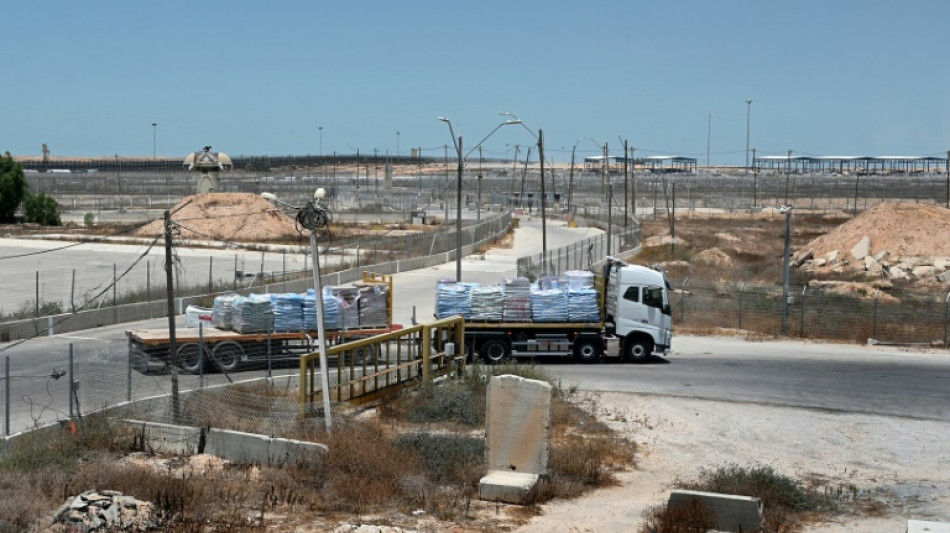
Commercial goods trucked into Gaza after aid logjams / Photo: © AFP

 Five things to know about Zambia ahead of the presidential vote

 Zambia vote to test Hichilema's economic record

 Meta will soon face another high-stakes trial in US
 Syria says reached deal with Moscow on fate of Russian bases

 Netanyahu rejects Gaza plan in new break from Trump

 Kurdish PKK criticises Turkey bill on fate of its fighters

 Clay-courter Merida on hardcourt learning curve in Montreal

 NBA champion player and historic coach Nelson dead at 86

 BMW iX3 Flow Edition brings animated bodywork closer to reality

 Arteta backs Guimaraes to 'ignite something different' at Arsenal
 Como sign England defender Chalobah from Chelsea

 Demi Vollering wins Tour de France Femmes

 Iraola's first Anfield match as Liverpool manager ends in Monaco defeat

 Bodies hanging from bridge revive violence in once-calm town in Mexico

 Lionel Messi bids farewell to father who guided his glittering career

 Raul Fernandez wins British MotoGP Grand Prix

 Tesla FSD secrecy puts Europe’s safety oversight under scrutiny

 Mercedes-AMG GT 53 balances speed, range and daily usability

 Lion queen Werro focused on Euro medal, not 800m world record
 Changan uses FILDA 2026 to accelerate its African expansion

 Honda plots a profitable European comeback without a price war
 Iran Guards say won't reopen Hormuz without US meeting all Tehran's conditions

 Messi absent after father's death as Miami lose in Leagues Cup
 Flight cancellations, evacuations in China as Typhoon Dolphin looms

 Iran issues demands for reopening of Hormuz

As bombs thunder in Gaza, just across the border in southern Israel truck driver Itzik waits in a barbed-wire protected parking lot for his delivery to clear inspection into the hunger-stricken territory.
He lists a lorry loaded with Gaza-bound eggs, chicken, sesame, spices, tea and coffee, all destined for private markets that Palestinians and humanitarian workers describe as unaffordable.
Aid meanwhile languishes on the other side of the Kerem Shalom crossing, with Israel and the United Nations trading blame for the logjam, and Gazans suffering the resulting shortages.
Itzik, who declined to give his last name, said lately his cargo "mostly comes from the private sector".
He described a booming industry that keeps him running the route despite being branded a "traitor" to the Israeli war effort, efforts by right-wing activists to disrupt truck shipments to Gaza.
Israel maintains it lets in enough food to feed the entire Gazan population of 2.4 million. It accuses the United Nations of not effectively distributing aid stacked up on the other side of the checkpoint.
The UN, however, cites "insecurity, damaged roads, the breakdown of law and order, and access limitations" that hamper aid movement from Kerem Shalom to central Gaza.
Philippe Lazzarini, who heads the UN agency for Palestinian refugees, in May regretted that the private sector, though welcome, was "being prioritised" at Kerem Shalom.
The crossing has become the primary conduit for goods into Rafah since early May when Israeli troops seized the nearby Rafah crossing as they began ground operations against Hamas militants in the area.
Now Kerem Shalom is mostly being used to pump commercial supplies into the territory.
"Right now, the private sector is working better than the aid organisations," said Shimi Zuaretz, a spokesperson for COGAT, the Israeli defence ministry body overseeing Palestinian civilian affairs.
COGAT took journalists on a tour of the checkpoint on Wednesday, displaying crates stuffed with watermelons, cherries, tomatoes, oranges, potatoes and pulses.
Heaving open the gates of the remote desert compound, they allowed a parade of a dozen or so lorries to enter and load up the goods before departing for Gaza.
AFP was prevented from speaking to the Palestinian drivers by the Israeli soldiers leading the tour.
- Profiteering -
Funnelling supplies into Gaza was difficult even before the war, which began with Hamas's October 7 attacks on nearby Israeli communities and resulted in the deaths of more than 1,170 people, mostly civilians, according to an AFP tally of Israeli official figures.
Militants also took 251 hostages, 116 of whom remain in Gaza, including 42 the military says are dead.
Israel's retaliatory offensive has killed at least 38,295 people in Gaza, also mostly civilians, according to data from the health ministry in the Hamas-run territory.
After initially blocking all deliveries into Gaza, Israel reopened Kerem Shalom in December under international pressure.
An average of 250 trucks now cross the checkpoint daily according to COGAT, still well below UN figure of 500 aid and commercial trucks before the war.
Independent UN rights experts accused Israel on Tuesday of a "targeted starvation campaign" in the Gaza, where they said 34 Palestinians have died of malnutrition since October.
Israel denied the charge, and Elad Goren, of COGAT, countered that "the UN are not doing their job" distributing aid.
In the meantime, he said "the private sector continues to work."
Earlier in the war, the commercial pipelines dried up, leaving markets bare and a population dependent on aid, according to Juliette Touma, director of communications for UNRWA.
Now, she said the prioritisation of the private sector over the humanitarian has sown "chaos" between Palestinians with and without cash.
In Gaza, where everything is in short supply, profiteering is rife. Eggs now cost 120 shekels ($33), a box of baby formula 70 shekels and a packet of shampoo $26, the Norwegian Refugee Council said this week.
Those without money give what they have. In a territory where nearly the entire population has been displaced, that can mean the clothes or the jewellery they wear.
"To pump commercial supplies into Gaza this late in the war is a terrible idea," said Touma. "Gaza needs both commercial and humanitarian supplies, as it had before the war."
Desperation has fuelled a steady trade, with drivers to Kerem Shalom kept busy.
"I have worked as a driver here for more than 20 years," Itzik said. "I know my Gazan colleagues. I feel sorry for what is happening there."
F.Pavlenko--BTB