What we know about the bomb Israel used on Gaza 'safe zone' / Photo: © AFP

 Weinstein resentenced to 15 years in prison for 2006 sex assault

 Fendi brings disco bling, Italian style, to Milan Fashion Week

 French court confirms rape trial for PSG and Morocco star Hakimi

 President tells Trump that Iran will never 'bend at the knee'

 أليكس بودي والبروفيسور الدكتور شتيفان هاوبت يتفقان على التعاون من أجل مجموعة فنية أسطورية في رومانيا

 U2 at 50: Irish rockers reveal anniversary album

 Алекс Боді та проф. д-р Стефан Гаупт домовилися про співпрацю щодо легендарної колекції мистецтва в Румунії

 Alex Bodi și prof. dr. Stefan Haupt încheie un acord de cooperare pentru o colecție de artă legendară în România
 Alex Bodi and Prof. Dr Stefan Haupt agree to collaborate on a legendary art collection in Romania
 Stocks dip, oil rises as traders eye chances of Iran deal

 Israel squeezing UN Palestinian refugee agency ahead of polls: chief

 Dutch to resume Eurovision with new broadcaster
 Man Utd losses jump despite record revenues

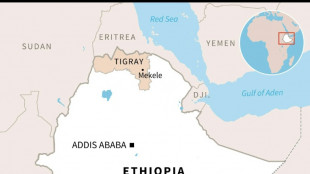 Ethiopia's Tigray rebels seize airports, clash with govt forces

 China prodigy wins third Games gold as North Korea weightlifters roar

 China's Yu, 13, wins third Asian Games gold but has 'some regrets'

 Oil falls, stocks steady as Trump hails 'good' Iran talks

 UK sets up unit to combat disinformation from Russia, AI

 ICC convicts C.Africa rebel leader

 China's Yu, 13, wins third gold with latest Asian Games record

 UK says will revisit Chagos deal after latest Trump criticism

 In first, French presidential candidate gives birth during campaign

 Cambodia no 'safe haven' for cyberscams, PM says

 North Korea weightlifter sets three world records for Asian Games gold

 A Full Moon for Every Child: STARTRADER's STARCARES Brings Support to SOS Children's Village Ho Chi Minh City

Israel's deadly strike on Al-Mawasi, one of the bloodiest attacks in more than nine months of war in Gaza, used massive payload bombs provided by the United States, according to weapons experts.
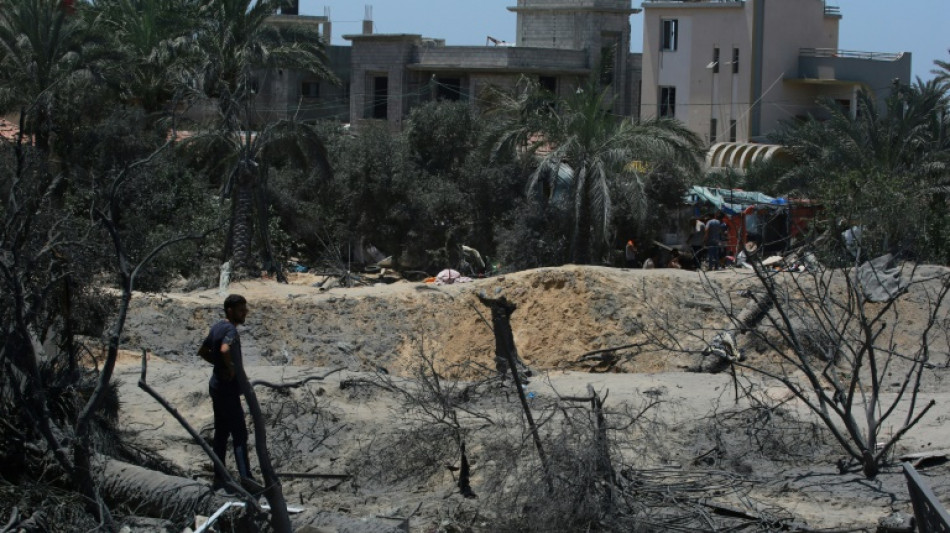
The bombing of the Israeli-declared "safe zone" transformed the tent city on the Mediterranean coast into a charred wasteland, with nearby hospitals overrun with casualties.
According to the health ministry in the Hamas-run territory, the barrage killed at least 92 people and wounded more than 300.
The Israeli military said it targeted two "masterminds" of the October 7 attacks by Hamas that triggered the war. It said a top commander, Rafa Salama, was killed in the strike, but uncertainty remains over Hamas military chief Mohammed Deif.
AFP videos of the attack showed a white mushroom cloud billowing over a busy street, leaving behind a huge crater strewn with the wreckage of tents and a building blown to bits.
Here is what we know about the weaponry used in the attack:
- US-made JDAM -
Two weapons experts told AFP that a sliver of munition seen in a video of the blast site circulating online was a tail fin from a US-made Joint Direct Attack Munition (JDAM). AFP could not independently verify the video.
The GPS-aided kit converts unguided free-fall bombs -- so-called "dumb bombs" -- into precision-guided "smart" munitions that can be directed towards single or multiple targets.
The United States developed the kit to improve accuracy in adverse weather after Operation Desert Storm in 1991.
The first JDAMs were delivered in 1997 and, according to the US Air Force, have a 95 percent system reliability.
Trevor Ball, a former US Army explosive ordnance disposal technician, concluded from images of the Al-Mawasi strike "it's 100 percent a JDAM kit" made in the United States.
He said that given the types of bombs compatible with the guidance system and the size of the fin fragment, the JDAM was most likely used with either a 1,000 or 2,000 pound (450 or 900 kilogramme) payload.
He said the fragment could also be compatible with the BLU-109 "bunker buster" warhead, which is designed to penetrate concrete.
Ball said it was not possible to definitively determine where the payload itself was made without "very specific fragments of the bomb body".
- New delivery -
Repeated use of such large bombs in the densely populated Gaza Strip has sparked humanitarian outcry and heaped pressure on US President Joe Biden to reconsider the munitions supplied to Israel.
On July 12, Israel's main military backer announced it was ending a pause on supplying 500-pound bombs, though Biden said the 2,000-pound type would be withheld.
The White House has repeatedly voiced frustration over the civilian death toll in Gaza as Israel attempts to eradicate Hamas.
US Secretary of State Antony Blinken told two top Israeli officials on Monday that the civilian toll was "unacceptably high", his spokesman said.
Israeli officials said their "precise strike" in Al-Mawasi hit an open area that housed a Hamas compound and not a civilian camp.
When contacted by AFP regarding the weapons used, the Israeli military declined to comment.
Based on Israel's stated target, Wes Bryant, a retired US Air Force master sergeant and strike and joint targeting expert, said it would have been feasible to avoid collateral damage in the surrounding area.
"My assessment is that any civilians killed in this strike were in the compound -— not in the surrounding vicinity. So the IDF either failed to assess presence of civilians, or... deemed the risk to civilians proportional to the military advantage of taking out the Hamas leaders."
- 'Absolute destruction' -
The strike left Al-Mawasi a scene of "absolute destruction" with no water, electricity or sewage treatment, the Islamic Relief charity said.
It condemned Israel for its willingness "to kill innocent men, women and children in pursuit of its end goals".
Hamas said that by arming Israel, the Biden administration is "legally and morally responsible" for spawning a "major humanitarian catastrophe".
It said US-supplied weapons used by Israel included GPS-guided bombs, dumb bombs, bunker busters and JDAMs.
After repeated high-casualty strikes in recent days, a Hamas official said the group was withdrawing from indirect talks for a truce and hostage release deal with Israel.
The war was sparked by Hamas's October 7 attack on Israel, which resulted in the deaths of 1,195 people, mostly civilians, according to an AFP tally based on Israeli figures.
Israel responded with a military offensive that has killed at least 38,664 people in Gaza, also mostly civilians, according to the Hamas-ruled territory's health ministry.
O.Lorenz--BTB