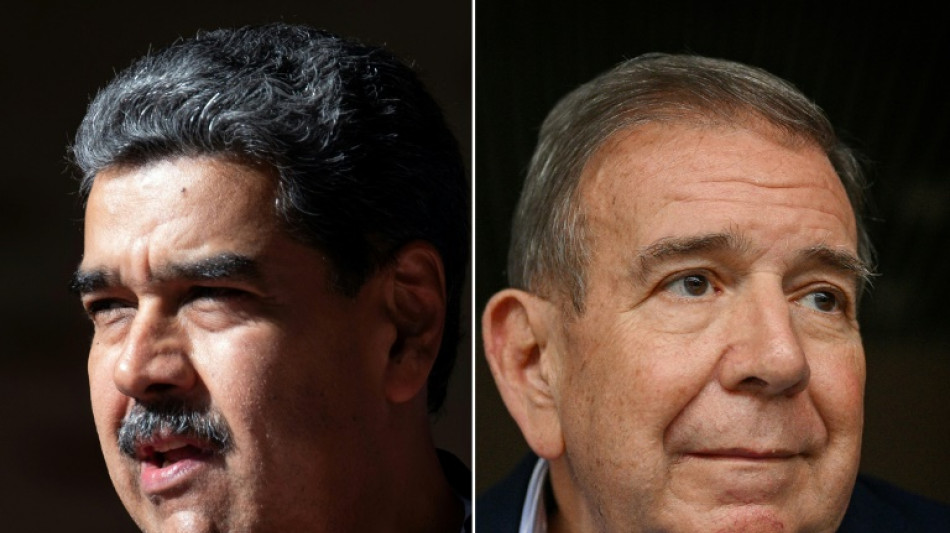
Venezuela girds for uncertain election with 'bloodbath' threat / Photo: © AFP

 Iran airlines cancel flights as US sanctions hit
 Meta launches camera-free AI glasses amid privacy pushback
 Australian PM says OpenAI hacked government health website

 Xi arrives in US to personal Trump welcome
 Morocco elects new parliament amid social frustration, youth discontent
 Scheffler and Burns to face Im and Lee in Presidents Cup opener
 Crushing wins for Lyon and Barca in women's Champions League
 Rio breaks record for rainiest September amid powerful El Nino
 At UN, tech chiefs urge caution in AI development
 Russian strikes kill seven in Ukraine, Zelensky vows winter campaign
 Venezuelan shot by ICE needs urgent medical care, mother tells AFP
 Zelensky says Putin using fighters from 47 countries in Ukraine war
 Klopp calls on Germany to 'rise above ourselves' as new era begins
 Russian strikes kill seven in Ukraine as Russia vows no 'pause' to war
 ArcPoint Expands Globally with Institutional Intelligence Platform for Modern Investors
 Ronaldo focussing on 'present' ahead of Wales test

 Outgoing UN chief makes final climate push at New York summit
 Grief and pain flow at hearing for Canadian suicide poison vendor
 Ireland boss Hallgrimsson says timing of Israel remarks 'not clever'
 Weinstein resentenced to 15 years in prison for 2006 sex assault
 Fendi brings disco bling, Italian style, to Milan Fashion Week
 French court confirms rape trial for PSG and Morocco star Hakimi
 President tells Trump that Iran will never 'bend at the knee'
 أليكس بودي والبروفيسور الدكتور شتيفان هاوبت يتفقان على التعاون من أجل مجموعة فنية أسطورية في رومانيا
 U2 at 50: Irish rockers reveal anniversary album
Uncertainty hangs over presidential elections in Venezuela Sunday, with incumbent Nicolas Maduro vowing a "bloodbath" if he loses, which polls say is likely.
Seeking a third six-year term at the helm of the economically devastated country, Maduro lags far behind challenger Edmundo Gonzalez Urrutia in voter intention.
But the 61-year-old counts on a loyal electoral machinery, military leadership and state institutions in a system of political patronage and, critics say, opposition repression.
Maduro said Thursday that he, and he alone, can "guarantee peace and stability" for Venezuela, having warned recently of a "bloodbath" if he loses to an opposition he has sought to paint as "fascists."
Analysts have told AFP violence is likely if the state apparatus intervenes in an election that the opposition is all but certain of winning.
Gonzalez Urrutia, for his part, urged Venezuelans to not let "the message of hate... intimidate you."
Gonzalez Urrutia, a 74-year-old former diplomat, is running in the place of wildly popular opposition leader Maria Corina Machado, barred from the presidential race by institutions loyal to Maduro on what she and others say are trumped-up corruption charges.
Last week, Venezuelan rights group Foro Penal reported 102 arrests this year of people linked to the opposition campaign, adding to more than 270 "political prisoners" in the country.
US National Security Council spokesman John Kirby said Thursday that Washington hoped for "peaceful elections" and stressed that "any political repression and violence is unacceptable."
The United States, which has sanctions in place against the Maduro government, is keen for a return to stability in oil-rich Venezuela, whose economic collapse has prompted many migrants to head to the southern US border.
Rights watchdog Human Rights Watch said the United States, European Union, and influential neighbors Brazil and Colombia should use every diplomatic tool to protect the integrity of the vote.
"While the election in Venezuela will hardly be free or fair, Venezuelans have their best chance in over a decade to elect their government, and the international community should have their back as they do," said HRW Americas director Juanita Goebertus.
- Failed economy -
The government in Caracas accuses the opposition of conspiring against Maduro, whose 2018 reelection was rejected as illegitimate by most Western and Latin American countries.
Years of tough sanctions and other pressure have failed to dislodge the president, who enjoys support from a political patronage system and the nation's military leaders, as well as from Cuba, Russia and China.
Maduro has repeatedly vowed that he won't cede power now even as Venezuelans clamor for change.
The formerly rich petro-state has seen GDP fall by 80 percent in less than a decade, driving some seven million of its citizens to flee.
Most Venezuelans live on just a few dollars a month, with the health care and education systems in total disrepair and biting shortages of electricity and fuel.
The government blames US sanctions for the state of affairs, but observers say the collapse of the country's all-important oil industry was mainly the result of deep-rooted corruption and mismanagement.
US oil sanctions were briefly eased after Maduro agreed in negotiations with the opposition to hold free and fair elections this year.
They were tightened after Maduro reneged on the conditions, though Washington is allowing companies such as Chevron and Repsol to apply for individual licenses to keep operating in Venezuela.
- 'We cannot anymore' -
The election poses the biggest threat yet to 25 years of "Chavismo," the populist movement founded by Maduro's predecessor and mentor, Hugo Chavez.
Voter Mercedes Henriques, 68, told AFP at an opposition rally she was excited for change "because we cannot anymore with this dictatorship we have."
But her optimism was tainted by worry. "We are praying that they don't steal the election," she said.
Analysts told AFP the president is unlikely to concede defeat, especially in the absence of any immunity guarantees.
The Venezuelan government is under investigation for human rights abuses by the International Criminal Court.
Some 21 million Venezuelans are eligible to cast a vote on Sunday.
Caracas has withdrawn an invitation to European Union experts to observe the vote, while allowing monitors from the UN and the US-based Carter Center.
Argentina's former president Alberto Fernandez said Wednesday Caracas had also withdrawn an invitation for him to observe the polling.
This came after he echoed a statement by Brazil's President Luiz Inacio Lula da Silva, who had said: "Maduro has to learn: if you win, you stay. If you lose, you go."
H.Seidel--BTB