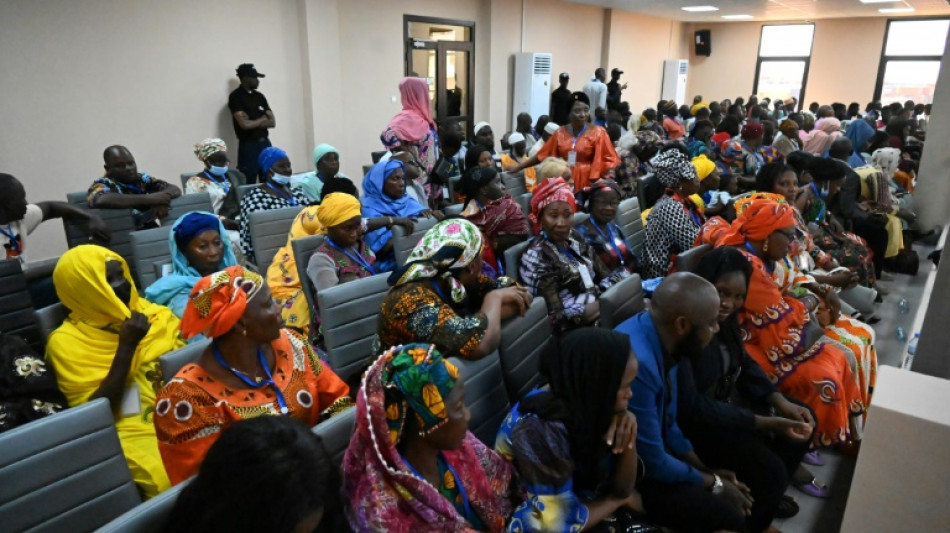
Guinea ex-dictator Camara jailed for 20 years over 2009 massacre / Photo: © AFP/File

 Swiss voters expected to shun stricter neutrality
 Rapper-turned-PM faces first big test after Nepal disaster
 Tuchel seeks tonic to England World Cup 'scar' in Spain showdown

 'Helps me cope': Catholic baptisms rise among French youth

 Colombians in Santa Marta stay inside after violence wracks the city

 Iran airlines cancel flights as US sanctions hit
 Meta launches camera-free AI glasses amid privacy pushback

 Australian PM says OpenAI hacked government health website

 Xi arrives in US to personal Trump welcome

 Morocco elects new parliament amid social frustration, youth discontent
 Scheffler and Burns to face Im and Lee in Presidents Cup opener

 Crushing wins for Lyon and Barca in women's Champions League

 Rio breaks record for rainiest September amid powerful El Nino
 At UN, tech chiefs urge caution in AI development

 Russian strikes kill seven in Ukraine, Zelensky vows winter campaign

 Venezuelan shot by ICE needs urgent medical care, mother tells AFP

 Zelensky says Putin using fighters from 47 countries in Ukraine war

 Klopp calls on Germany to 'rise above ourselves' as new era begins

 Russian strikes kill seven in Ukraine as Russia vows no 'pause' to war

 ArcPoint Expands Globally with Institutional Intelligence Platform for Modern Investors

 Ronaldo focussing on 'present' ahead of Wales test

 Outgoing UN chief makes final climate push at New York summit

 Grief and pain flow at hearing for Canadian suicide poison vendor

 Ireland boss Hallgrimsson says timing of Israel remarks 'not clever'
 Weinstein resentenced to 15 years in prison for 2006 sex assault

A Guinean court sentenced ex-dictator Moussa Dadis Camara to 20 years in jail for crimes against humanity on Wednesday, after a landmark trial over a 2009 massacre at a political rally.
Seven other defendants were handed terms of up to life imprisonment at the end of the trial that played out over nearly two years, in a judgement welcomed by rights activists.
Security forces had been massively deployed for the hearing, in a case keenly awaited by victims' families for nearly 15 years.
Just before sentencing, the court had announced the charges would be classified as crimes against humanity.
The court also ordered for compensation to be paid to the victims, running from 200 million to 1.5 billion Guinean francs ($23,000 to $174,000).
- An end to impunity -
On September 28, 2009 and in the following days, members of Dadis Camara's presidential guard, soldiers, police and militia brutally suppressed an opposition rally at a stadium in the suburbs of Conakry.
In one of the darkest chapters in the West African nation's history, at least 156 people were killed, hundreds more wounded and 109 women raped, according to a UN-mandated commission of inquiry.
"This trial is of the utmost importance to me," Kadiatou Sow, who was raped during the massacre and its aftermath, told AFP before the sentencing.
"I want these soldiers to pay a heavy price with sentences befitting their crimes," added Sow, who also lost her husband in the violence.
Alfa Amadou DS Bah, lead lawyer for the plaintiffs in the case, underlined the importance of the judgement.
"It's the first time a former head of state has been convicted for such serious crimes, and senior military officers too," he said.
"I think that this decision must sound the toll against impunity in this country. It's a great relief for the victims," he added.
Human Rights Watch also welcomed the judgement.
"The Guinean court's landmark verdict offers long-awaited justice for victims," said Tamara Aburamadan, an international justice legal counsel for HRW.
"It puts high-level perpetrators in Guinea and elsewhere on notice that justice can prevail."
- Crimes against humanity -
Ten of the 12 accused were present to hear the court's judgement.
Former junta chief Dadis Camara, dressed in a traditional green and yellow boubou, remained motionless as the verdict was read by the court in the capital Conakry.
Along with 11 other government and military officials, Dadis Camara had been accused of murder, sexual violence, torture, abduction and kidnapping.
He always denied any responsibility, blaming his subordinates.
The trial -- which began on September 28, 2022, the anniversary of the killings -- gripped the West African nation, with the courtroom drama carried on television and radio.
Judges heard from 11 defendants -- who blamed each other for the massacre during the trial -- as well as a dozen witnesses. Around 100 victims provided chilling testimonies.
The chief prosecutor had called for Dadis Camara and other defendants to be sentenced to life in prison.
- Moment of truth -
Defence lawyers had argued that reclassifying the charges as crimes against humanity on the day of the ruling would rob them of an opportunity to defend themselves and infringe their right to a fair trial.
Both the accused and the plaintiffs have 15 days to appeal the verdict. The prosecutor's office will have two months.
The trial has taken place against a background of repression of both the opposition to Guinea's military rulers and the media.
The day before the verdict, protests against the "forced disappearance" of pro-democracy activists Oumar Sylla and Mamadou Billo Bah paralysed parts of Conakry, with several injured in clashes between demonstrators and the police.
International organisations and human rights activists have highlighted the unprecedented nature of the trial in Guinea.
It is the first of its kind to challenge the impunity of the country's security forces, which are seldom held to account, according to the UN probe.
C.Kovalenko--BTB