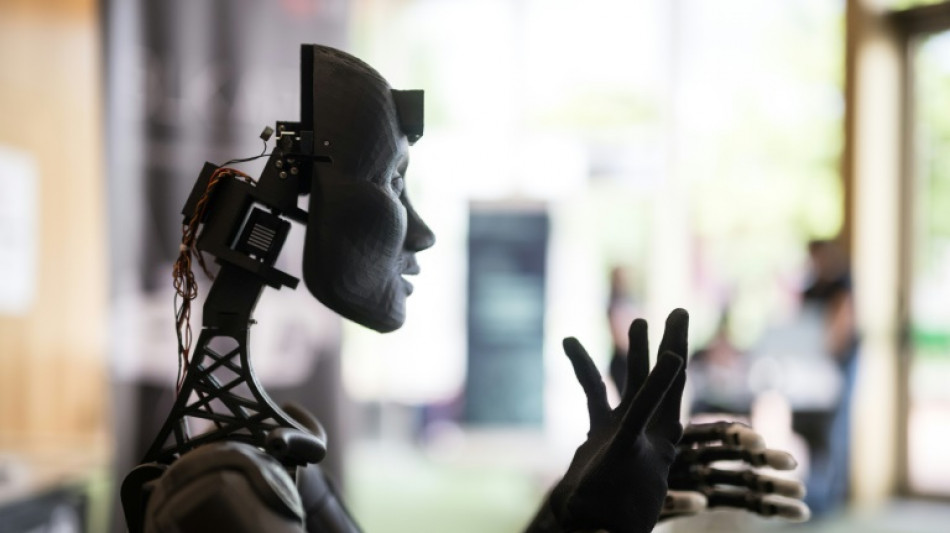
In world first, EU's sweeping AI law enters into force / Photo: © AFP/File

 Swiss voters expected to shun stricter neutrality

 Rapper-turned-PM faces first big test after Nepal disaster

 Tuchel seeks tonic to England World Cup 'scar' in Spain showdown

 'Helps me cope': Catholic baptisms rise among French youth

 Colombians in Santa Marta stay inside after violence wracks the city

 Iran airlines cancel flights as US sanctions hit

 Meta launches camera-free AI glasses amid privacy pushback

 Australian PM says OpenAI hacked government health website

 Xi arrives in US to personal Trump welcome

 Morocco elects new parliament amid social frustration, youth discontent

 Scheffler and Burns to face Im and Lee in Presidents Cup opener

 Crushing wins for Lyon and Barca in women's Champions League

 Rio breaks record for rainiest September amid powerful El Nino

 At UN, tech chiefs urge caution in AI development

 Russian strikes kill seven in Ukraine, Zelensky vows winter campaign

 Venezuelan shot by ICE needs urgent medical care, mother tells AFP

 Zelensky says Putin using fighters from 47 countries in Ukraine war

 Klopp calls on Germany to 'rise above ourselves' as new era begins

 Russian strikes kill seven in Ukraine as Russia vows no 'pause' to war

 ArcPoint Expands Globally with Institutional Intelligence Platform for Modern Investors

 Ronaldo focussing on 'present' ahead of Wales test

 Outgoing UN chief makes final climate push at New York summit

 Grief and pain flow at hearing for Canadian suicide poison vendor

 Ireland boss Hallgrimsson says timing of Israel remarks 'not clever'

 Weinstein resentenced to 15 years in prison for 2006 sex assault

The European Union's landmark law on artificial intelligence came into force on Thursday, which Brussels vows will drive innovation while protecting citizens' rights.
The EU earlier this year adopted the world's first sweeping rules to govern AI, especially powerful systems like OpenAI's ChatGPT after difficult and tense negotiations.
Although the rules were first proposed in 2021, they took on greater urgency when ChatGPT burst onto the scene in 2022, showing generative AI's human-like ability to churn out eloquent text within seconds.
Other examples of generative AI include Dall-E and Midjourney, which can generate images in nearly any style with a simple input in everyday language.
"With our artificial intelligence act, we create new guardrails not only to protect people and their interests, but also to give business and innovators clear rules and certainty," European Commission President Ursula von der Leyen said.
Companies will have to comply by 2026 but rules covering AI models like ChatGPT will apply 12 months after the law enters into force.
Strict bans on using AI for predictive policing based on profiling and systems that use biometric information to infer an individual's race, religion or sexual orientation will apply six months after the law enters into force.
The law known as the "AI Act" takes a risk-based approach: if a system is high-risk, a company has a stricter set of obligations to fulfil to protect citizens' rights.
The higher the risk to Europeans' health or rights, for example, the greater the companies' requirements to protect individuals from harms.
"The geographic scope of the AI Act is very broad, so organisations with any connections to the EU in their business or customer base will need an AI governance programme in place to identify and comply with their obligations," said Marcus Evans, partner at law firm Norton Rose Fulbright.
Companies in violation of the rules on banned practices or data obligations face fines of up to seven percent of worldwide annual revenue.
The EU in May established an "AI Office" of tech experts, lawyers and economists under the new law to ensure compliance.
L.Dubois--BTB