Ukraine's electrician 'heroes' restoring power near the front / Photo: © AFP

 Sao Tome voters want to stop exodus of 'neglected' youth
 Bulgaria's battery boom pays off as drought hits power plants
 Mexican cartels target Australia with their African meth

 Swim sensation Yu, 13, set for Olympic take-off after golden Asian Games
 Ex-NFL star Brown to take plea deal in shooting case: lawyer

 Malaysia's migrant return plan chills Myanmar Rohingya

 Pakistan confirms Afghan strikes after resident says Kandahar hit
 Thousands missing, aid needs mount one month after Nepal's deadly floods

 Nepal flood victims look to PM Shah to press climate case at UN

 Trump admin says there were 8 suicide attempts on US aircraft carrier

 Iranian satire 'Head to Head' draws a veil over the men

 Archaeological 'breakthrough' could confirm origins of Paris

 Morocco elects new parliament with lowest turnout in nearly two decades

 LiberNovo Opens Business & Bulk Ordering Ahead of Its Fall Prime Sale

 Australian PM says OpenAI hacked government health website

 Xi arrives in US to personal Trump welcome

 Morocco elects new parliament amid social frustration, youth discontent

 Scheffler and Burns to face Im and Lee in Presidents Cup opener

 Crushing wins for Lyon and Barca in women's Champions League

 Rio breaks record for rainiest September amid powerful El Nino

 At UN, tech chiefs urge caution in AI development

 Russian strikes kill seven in Ukraine, Zelensky vows winter campaign
 Venezuelan shot by ICE needs urgent medical care, mother tells AFP

 Zelensky says Putin using fighters from 47 countries in Ukraine war

 Klopp calls on Germany to 'rise above ourselves' as new era begins

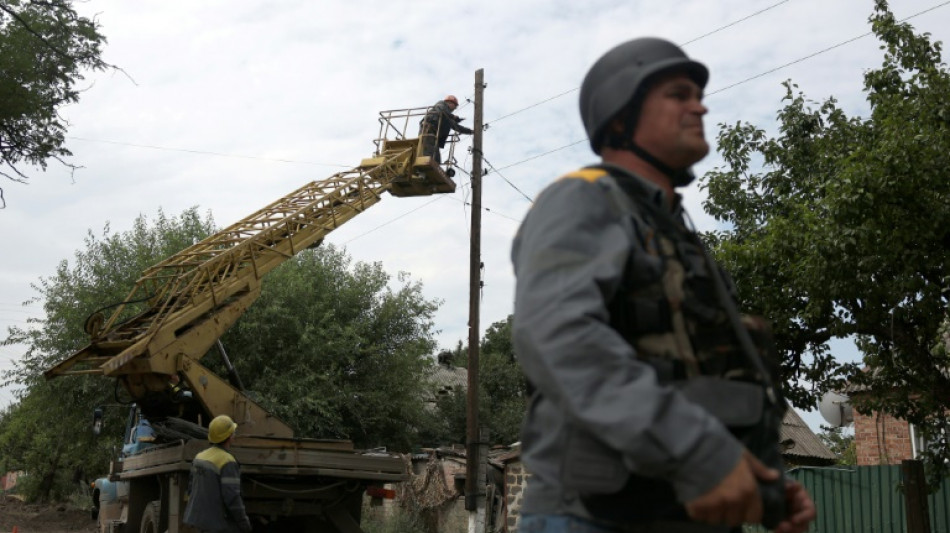
Vitaliy Asinenko watched anxiously as his colleague sat perched on a crane, hovering over power cables in a village just a few kilometres from the frontline in east Ukraine.
The air became static as a blanket of clouds rolled toward them over the horizon, but the 46-year-old electrician had bigger worries than a possible storm.
"In weather like this, you can't see the bombs coming," he said, a helmet firmly planted on his head.
For months, Russia has been pounding Ukraine's fragile energy grid and power plants with air strikes, cutting electricity to millions of people in what Kyiv has called a blatant war crime.
Together with his team at Ukrainian energy operator DTEK, Vitaliy has been tasked with repairing the damage caused by Moscow's routine strikes near Pokrovsk, an eastern city less than 15 kilometres (nine miles) from advancing Russian troops.
"We have to make sure that the civilian refuge point and the humanitarian distribution points have power," Vitaliy explained.
Around him lay the ruins of buildings scarred by artillery, a constant reminder that Russia is closing in as its soldiers inch forward through the eastern Donbas region.
"Three months ago, it was quieter," Vitaliy said.
"Today, there's a risk of suicide drones, it's become really dangerous," he added.
He said his team had become a "target" just like the military, and that some of his colleagues had already been injured in the area.
Metres above in the basket of their Soviet-era crane, Vitaliy's colleague hurriedly cut through and connected a mass of copper wire torn by the shrapnel.
In the distance, the boom of explosions rang out.
"They were rockets," Vitaliy said assuredly from his position on the ground, a flicker of anxiety flashing in his eyes before getting back to work.
His team admitted that everyone was scared, but being able to recognise the sounds of war have kept them going.
"We listen to the hum of the drones and the artillery fire, so we know just how dangerous the situation is," Vitaliy explained.
His team's job is never-ending, with more bombs falling across the eastern front every day.
- 'Heroes' -
Electricity is a precious resource for soldiers and civilians near the frontline, many of whom are elderly and need electricity to keep the water running.
Repairs have been made more difficult by Russia's use of highly destructive glide bombs, on the rise over the past three months, the head of the local village's administration, Volodymyr Rudenko, said.
"The front is much closer," the 60-year-old said, warning that Russia was advancing towards Pokrovsk by "around 100 metres every day".
He has urged residents to leave.
Relatively unscathed before May, the village's pre-war population of less than 3,000 has now plunged by about half, with only miners and elderly residents remaining.
In the debris-strewn streets nearby, 77-year-old Vira strolled around the village with a friend, inspecting the damage caused overnight.
The electricity in her street has still not been restored.
"I've only got a tiny pension, what do you want me to do with that? Where do you want me to go?" she asked, pulling her scarf tighter over her head.
She explained she lived in her cellar in fear of the bombs, and had a garden where two or three cabbages still grew.
Vitaliy, who headed his team of electricians, was humble about the work he was doing.
"We're here for them. If there weren't any civilians, we wouldn't be here," he said.
The "heroes", as the locals call them, try not to stay too long on site, even though they are used to dealing with explosions.
"Yes, we're brave... or we're stupid," Vitaliy said, grinning.
Suddenly, a shell tore through the air with a whistle, the force of the blast sending the worker in the crane crouching in his basket.
"Let's get out of here! Come on!" Vitaliy yelled, frantically gesturing for his men to leave.
The electricians rushed into their armoured vehicle, as their crane quickly reversed to get away.
He said they would come back tomorrow.
But their efforts were in vain. The next day, the village lay in ruins.
J.Fankhauser--BTB