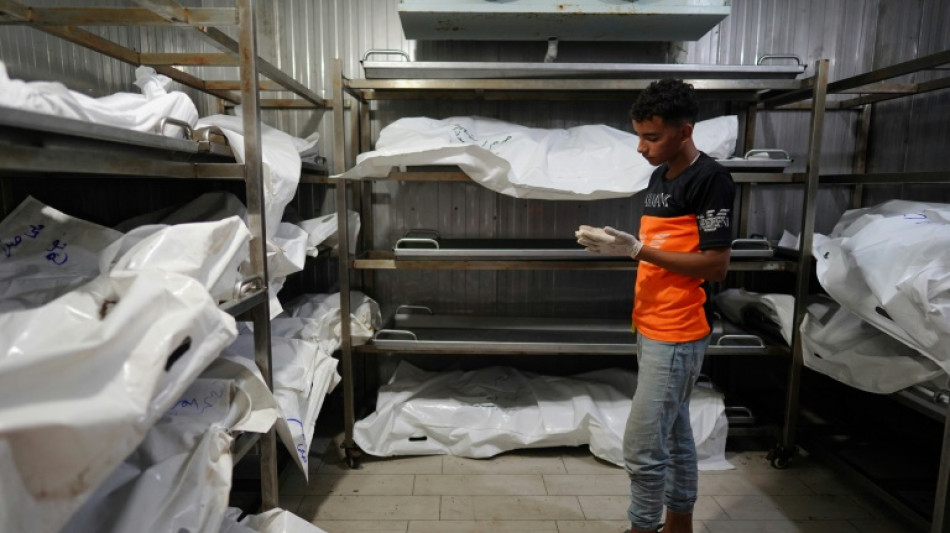
Nearly 40,000 and counting: the struggle to keep track of Gaza deaths / Photo: © AFP/File

 Sao Tome voters want to stop exodus of 'neglected' youth
 Bulgaria's battery boom pays off as drought hits power plants

 Mexican cartels target Australia with their African meth

 Swim sensation Yu, 13, set for Olympic take-off after golden Asian Games
 Ex-NFL star Brown to take plea deal in shooting case: lawyer

 Malaysia's migrant return plan chills Myanmar Rohingya

 Pakistan confirms Afghan strikes after resident says Kandahar hit

 Thousands missing, aid needs mount one month after Nepal's deadly floods

 Nepal flood victims look to PM Shah to press climate case at UN

 Trump admin says there were 8 suicide attempts on US aircraft carrier

 Iranian satire 'Head to Head' draws a veil over the men

 Archaeological 'breakthrough' could confirm origins of Paris

 Morocco elects new parliament with lowest turnout in nearly two decades

 LiberNovo Opens Business & Bulk Ordering Ahead of Its Fall Prime Sale

 Australian PM says OpenAI hacked government health website

 Xi arrives in US to personal Trump welcome

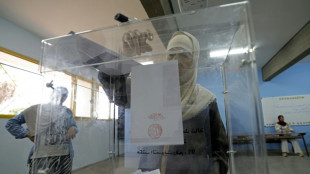 Morocco elects new parliament amid social frustration, youth discontent

 Scheffler and Burns to face Im and Lee in Presidents Cup opener

 Crushing wins for Lyon and Barca in women's Champions League

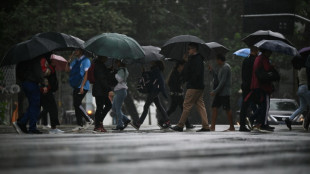 Rio breaks record for rainiest September amid powerful El Nino
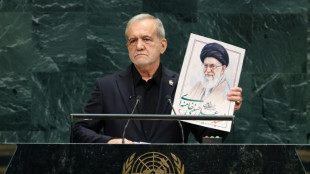
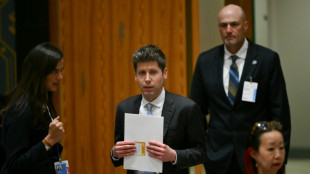 At UN, tech chiefs urge caution in AI development

 Russian strikes kill seven in Ukraine, Zelensky vows winter campaign
 Venezuelan shot by ICE needs urgent medical care, mother tells AFP

 Zelensky says Putin using fighters from 47 countries in Ukraine war

 Klopp calls on Germany to 'rise above ourselves' as new era begins

With much of Gaza reduced to rubble by 10 months of war, counting the dead has become a challenge for the Hamas-run territory's health ministry, as the death toll nears 40,000.
Israel has repeatedly questioned the credibility of the daily figures put out by the ministry and US President Joe Biden did so too in the early stages of the war.
But several United Nations agencies that operate in Gaza have said the figures are credible and they are frequently cited by international organisations.
- Data collection -
Two AFP correspondents witnessed health facilities enter deaths in the ministry's database.
Gaza health officials first identify the bodies of the dead, by the visual recognition of a relative or friend, or by the recovery of personal items.
The deceased's information is then entered in the health ministry's digital database, usually including name, gender, birth date and ID number.
When bodies cannot be identified because they are unrecognisable or when no one claims them, staff record the death under a number, alongside all the information they were able to gather.
Any distinguishing marks that may help with later identification, whether personal items or a birthmark, are collected and photographed.
- Central registry -
Gaza's health ministry has issued several statements setting out its procedures for compiling the death toll.
In public hospitals under the direct supervision of the territory's Hamas government, the "personal information and identity number" of every Palestinian killed during the war are entered in the hospital's database as soon as they are pronounced dead.
The data is then sent to the health ministry's central registry on a daily basis.
For those who die in private hospitals and clinics, their information is taken down on a form that must be sent to the ministry within 24 hours to be added to the central registry, a ministry statement said.
The ministry's "information centre" then verifies the data entries to "ensure they do not contain any duplicates or mistakes", before saving them in the database, the statement added.
Gaza residents are also encouraged by Palestinian authorities to report any deaths in their families on a designated government website. The data is used for the ministry's verifications.
The ministry is staffed with civil servants that answer to the West Bank-based Palestinian Authority as well as to the Hamas-led government in Gaza.
- 'High correlation' -
An investigation conducted by Airways, an NGO focused on the impact of war on civilians, analysed the data entries for 3,000 of the dead and found "a high correlation" between the ministry's data and what Palestinian civilians reported online, with 75 percent of publicly reported names also appearing on the ministry's list.
The study found that the ministry's figures had become "less accurate" as the war dragged on, a development it attributed to the heavy damage to health infrastructure resulting from the war.
For instance, at southern Gaza's Nasser Hospital, one of the few still at least partly functioning, only 50 out of 400 computers still work, its director Atef al-Hout told AFP.
Israeli authorities frequently criticise the ministry's figures for failing to distinguish between combatants and civilians. But neither the army nor Israeli Prime Minister Benjamin Netanyahu deny the scale of the overall toll.
The press office of Gaza's Hamas government estimates that nearly 70 percent of the roughly 40,000 dead are women (about 11,000) or children (at least 16,300).
Several UN agencies, including the agency in charge of Palestinian refugees (UNRWA), have said the ministry's figures are credible.
"In the past -- the five, six cycles of conflict in the Gaza Strip -- these figures were considered as credible and no one ever really challenged these figures,", the agency's chief Philippe Lazzarini said in October.
A study by British medical review The Lancet estimated that 186,000 deaths can be attributed to the war in Gaza, directly or indirectly as a result of the humanitarian crisis it has triggered.
The war in Gaza was triggered by the October 7 attack by Hamas, which resulted in the deaths of 1,198 people, mostly civilians, according to an AFP tally based on Israeli official figures.
F.Müller--BTB