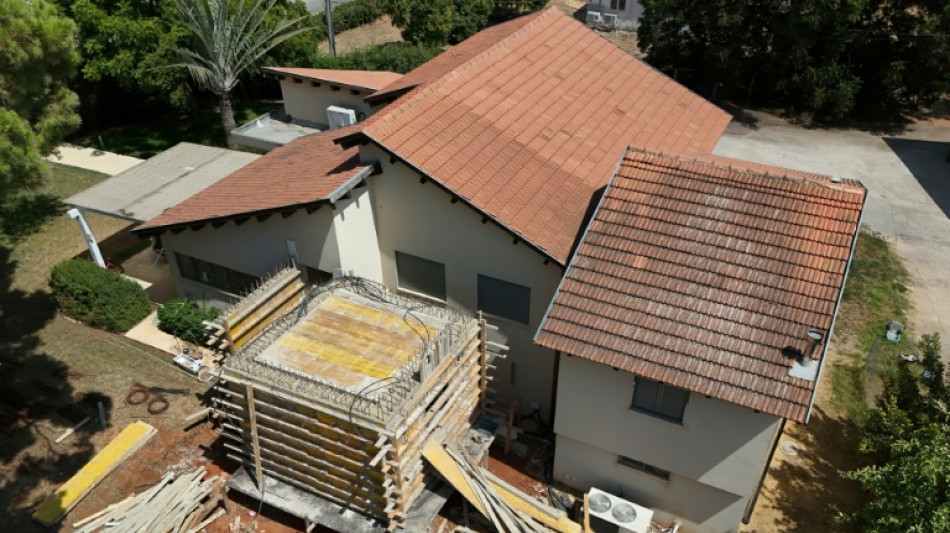
As threats rise, Israelis turn to home bomb shelters / Photo: © AFP

 Dominican Republic calls for Haiti force to be strengthened
 Dolly Parton's nephew ordered to stay away from estate staff, properties

 Early exit for Philippine darling Eala at Singapore Open

 Hurricane Polo triggers huge waves in coastal Mexican city

 What happens if the US bans diesel exports

 Macklemore hits back with 'Free Palestine Tour' after Sheeran split
 Met Opera to give New Yorkers free tickets in affordability push

 Top ECB official to resign to take up IMF role

 Xi and Trump call for peace in lavish White House state visit

 Five up-and-coming players looking to make mark in Nations League

 CNN, MS NOW, Politico request court hearing after White House access denied

 Eviction of pensioner puts Spain housing crisis in spotlight

 CNN, MS NOW, Politico say reporters still barred from White House

 Udinese sign ex-Real Madrid defender Alaba on free transfer

 Trump welcomes Xi to Washington with lavish praise

 Kane relishing chance to become England's most-capped player

 Average EU diesel price hits record 2.23 euros a litre: AFP analysis

 Whitetip Investments Marks 10 Years of Regulation, Transparency & Responsible Trading

 Pakistan blocks roads around capital ahead of planned pro-Khan protest

 Stocks fall, oil prices rise as global bonds under pressure

 Mancini's Italy facing battle to 'win back' dispirited fans

 German think tanks urge Merz to stick with reforms after election defeats

 Alcaraz wants end to late-night matches at Grand Slams

 EU battle over how to define 'Made in Europe'

 Eight killed in wave of Russian strikes on Ukraine

Israeli couple Aviva Pertzov and Jeff Lederer put off building a bomb shelter for years. But now, with rockets falling and threats rising, they are finally fortifying their home.
Attached to their house in Tel Mond, 30 minutes north of Tel Aviv, a solid, reinforced concrete room is emerging from behind a wooden mould -- strong enough to protect them and their grandchildren from a major blast.
When it is finished, this "safe room" will have white-painted walls, a sofa and a tiled floor, and a single window with a heavy metal shutter that closes across it with a clang.
"In previous times (of conflict), every time there was a moment where we said maybe we should build a shelter at home, we did nothing," Pertzov, a psychologist, said at their home in central Israel.
"This time, when (attacks) seemed to be getting closer to our area, then I told myself 'I can't go on like this'."
Northern Israel has been peppered by rocket and drone attacks from Lebanon's Hezbollah militants during the Israel-Hamas war in Gaza, which has raged since October 7.
Iran fired a flurry of missiles in April -- its first direct attack on Israel -- and is again threatening retaliation after Hamas's leader was killed in Tehran last month.
- 15-second warning -
With Iranian proxies active in Iraq and Syria, and Iran-backed Huthi rebels launching attacks from Yemen, Israelis are feeling threats on many fronts.
"We now worry more, because Hezbollah can reach us with their missiles," said 79-year-old Lederer, a family doctor.
"We are also afraid of being shot at by Iran."
The increasing range and sophistication of weapons has slashed reaction time to just a few seconds in the riskiest areas, near the Lebanese and Gaza borders.
Back in the 1950s, when the first public shelters were built, the sirens would sound 30 minutes before impact -- "enough time even to take a cup of coffee", said Lieutenant Colonel Moshe Shlomo, head of engineering at Israel's civil defence force, the Home Front Command.
Now, Israelis have 15 to 90 seconds, depending on where they live, to reach safety once the siren wails or a government-relayed alert blares from their phones.
For that reason, authorities are urging residents to build safe rooms in their homes, knowing that scrambling to a public or shared shelter simply takes too long.
"The threat level in Israel is very high," Shlomo told AFP at a military base near Tel Aviv, where an unexploded Iranian ballistic missile that fell in the Dead Sea in April is displayed at a road junction.
"We have other countries that are threatening us with missiles and ballistic missiles."
He added: "Those (safe) rooms save lives. We've seen it in this war."
- 'It causes concern' -
The safe rooms are designed to withstand a ton of explosives going off at a range of 15 metres (yards), and are air-tight with filtered ventilation in case of chemical or biological attack, Shlomo said.
The cost of building such a safe room varies approximately between $30,500 and $56,000.
Since Hamas's October 7 attack that triggered the war, when Israelis were attacked, kidnapped and killed in their homes, the heavy blast doors on new safe rooms are lockable from the inside.
However, about 55 percent of Israeli households do not have safe rooms, according to official estimates, because of either cost, lack of space, fatalism or obstinacy.
"There's a lot of older people who say, 'I don't want anything, I've been here 80, 90 years and I'm going to survive no matter what'," Shlomo said.
"We try to convince them. Some religious people don't want to protect themselves because they trust in God."
To persuade more people to install safe rooms, the Home Front Command has slashed the turnaround time for building permits to 14 days, processing about 4,500 applications in the past seven months.
For Pertzov and Lederer, their grandchildren were what finally persuaded them to build a shelter.
"We have many grandchildren and they come to sleep here, because they are not living nearby," said Pertzov.
"So it's kind of like a sense of duty and it causes a lot of concern."
G.Schulte--BTB