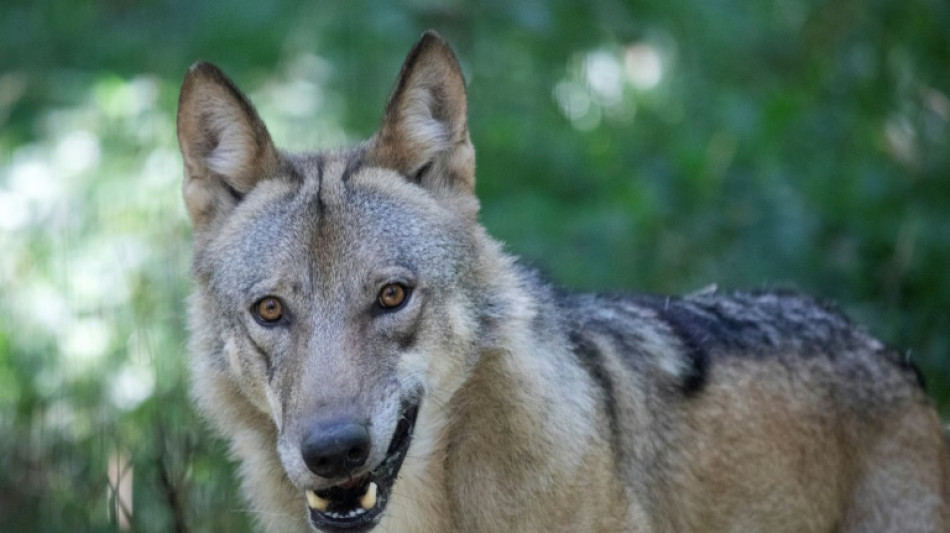
As wolves swoop, Austrians grab guns for contested cull / Photo: © AFP

 Voting opens in Alaska's annual Fat Bear Week

 MLS coach axed for telling female ref 'It's a man's game'

 US refuses to give Sudan's de facto leader visa for UN

 Man City hold Bayern to start Women's Champions League, Arsenal win late

 Trump threatens Iran with 'hell' but reveals fresh talks

 Trump signs security deal with Greenland, Denmark at UN

 Trump threatens Iran with 'hell' but unveils fresh talks

 Chile's Atacama Desert blossoms with life after El Nino rains

 Sri Lanka hands 220-year jail terms to 15 convicted of Easter bombings

 Typhoon Dujuan leaves 7 dead in Japan from landslides, flooding: media

 Ganna and Borghini lead Italy to mixed relay gold at cycling worlds

 Drug cocktail killed former child star Hayden Panettiere: coroner

 Moldova declares energy, water emergency

 French Holocaust denier jailed for eight months

 Oil prices slide, AI stock buzz fades

 Trump threatens to 'annihilate' Iran in bombastic UN speech

 Prada's skirts take centre stage as Milan Fashion Week begins

 Quoin Pharmaceuticals Announces FDA Fast Track Designation for QRX003 for the Treatment of Peeling Skin Syndrome

 Brazil's Flavio Bolsonaro turns scandal into poll gains

 Republican senator seeks probe of Trump Jr Russian-funded wedding

 Memoir by Diana's brother goes on sale after rocking UK monarchy

 Newcomers South Korea face holders Italy in Davis Cup finals

 Japan's Kojima sounds Marchand warning with Asian Games gold

 England rugby star Pollock signs new Northampton deal

 STARTRADER Expands Its Chinese Equity CFD Range with CXMT and Unitree Robotics

After wolves swooped from the forest and savaged her lambs, Austrian sheep farmer Renate Pilz feels like giving up. Others, to the anger of conservationists, are reaching for their rifles.
"I lost two ewes and two lambs" to the wolf attack last year, the 55-year-old said at her farm in the village of Arbesbach.
She showed AFP photos of her animals, bleeding and so badly bitten that they had to be put down.
"It's too much work, it's no longer profitable and, above all, I don't want to do it any more," she said.
After disappearing in the 19th century, wolves have gradually returned to Austria in recent years. The number rose to 104 this year, up from an estimated 80 in 2022.
In response to a reported increase in attacks on livestock, several Austrian regions have authorised the controversial killing of wolves.
Environmental groups say the move violates European law, which lists them as protected animals.
Swelling wolf populations have dominated the headlines in the Alpine country and stirred emotion across Europe, with breeding packs recorded in 23 countries of the European Union.
- 'Wolf-free' zones -
A few kilometres from Arbesbach, Gerhard Fallent told AFP that three wolves had killed "half of his flock of sheep" and seriously injured the other half last year.
Fallent has since become a vocal proponent of regulating the wolf population, founding the association Wolf Stop.
He has called for "wolf-free" zones to be established near communities where people live and work.
After a wolf was sighted close to a bus stop frequented by children, school trips were cancelled and pupils picked up directly from home by the bus for a year, the 64-year-old lamented.
"We want our children to be able to go back to playing in the woods" in a region that can offer much to tourists too, said Fallent.
With family farms going out of business, he noted that several Austrian regions managed to significantly reduce the number of attacks after authorising killings.
- 'Obsolete' protection status -
In Austria's southern state of Carinthia, shooting wolves to protect local farms and their livestock has been authorised since 2022.
So far "we have killed 13 wolves," deputy governor Martin Gruber told AFP.
Putting up barriers such as fences in the rugged terrain, he argued, was "impossible" and above all a "waste of public money".
With the total population of wolves in the EU estimated at 20,300, Gruber said the predator's protection status was "obsolete" and should be lowered.
In 2023, European Commission President Ursula von der Leyen called for the downgrading of the wolf's conservation status from "strictly protected" to "protected" in view of the "real danger" posed by the packs.
But conservationists across Europe have been up in arms, with environmental groups in Austria challenging the authorised killings in court.
In July, the European Court of Justice (ECJ) ruled that Austria should first try other solutions before hunting wolves massively, noting the local wolf population was "not at a favourable conservation status" and siding with the conservationists.
- Fairy tales -
Situated in the heart of Europe, Austria is rare in having three isolated wolf populations converge there from other parts of the continent.
After surviving "heavy hunting" about a century ago, wolves have started to spread due to being protected, and separate groups are linking up, said Marianne Heberlein, director of the Wolf Science Centre.
The operation, which claims to be the only one of its kind in the world, is attached to Vienna's University of Veterinary Medicine.
It researches the process of domestication by comparing the behaviour of the 10 wolves and 13 dogs housed at the centre.
It also aims to increase the public's awareness of wolves by familiarising people with the "wild animal" in a "neutral" way, said Heberlein.
The centre aims to do so "without glossing over the danger" they can pose or "giving them a bad image", she said.
The fear of the wolf "goes back a very long way in history", she said -- the age-old conflict between wolf and human has fed into the fairy tales told to children.
J.Bergmann--BTB