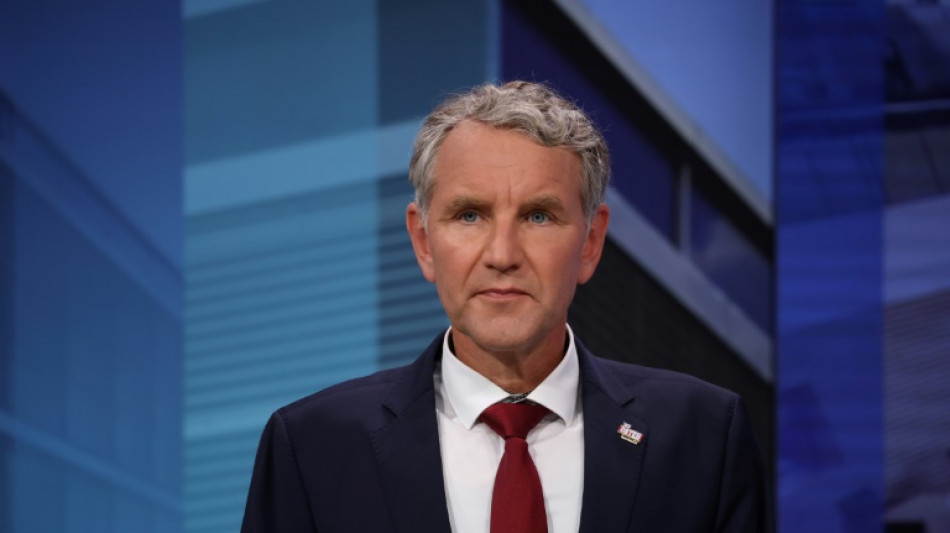
Scholz urges German parties to isolate far right / Photo: © AFP

 Voting opens in Alaska's annual Fat Bear Week
 MLS coach axed for telling female ref 'It's a man's game'

 US refuses to give Sudan's de facto leader visa for UN
 Man City hold Bayern to start Women's Champions League, Arsenal win late
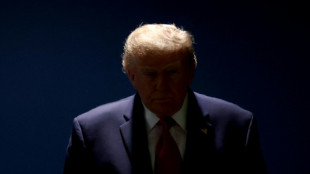
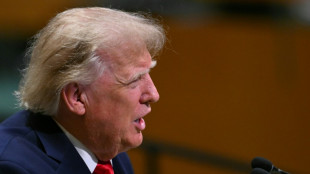 Trump threatens Iran with 'hell' but reveals fresh talks
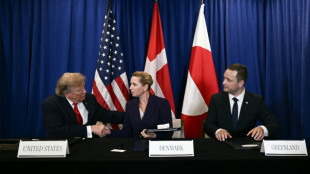 Trump signs security deal with Greenland, Denmark at UN
 Trump threatens Iran with 'hell' but unveils fresh talks

 Chile's Atacama Desert blossoms with life after El Nino rains

 Sri Lanka hands 220-year jail terms to 15 convicted of Easter bombings
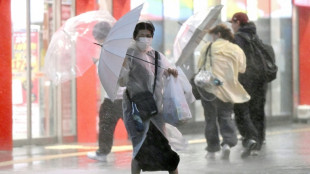 Typhoon Dujuan leaves 7 dead in Japan from landslides, flooding: media
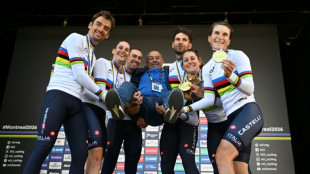 Ganna and Borghini lead Italy to mixed relay gold at cycling worlds

 Drug cocktail killed former child star Hayden Panettiere: coroner
 Moldova declares energy, water emergency
 French Holocaust denier jailed for eight months

 Oil prices slide, AI stock buzz fades

 Trump threatens to 'annihilate' Iran in bombastic UN speech

 Prada's skirts take centre stage as Milan Fashion Week begins
 Quoin Pharmaceuticals Announces FDA Fast Track Designation for QRX003 for the Treatment of Peeling Skin Syndrome
 Brazil's Flavio Bolsonaro turns scandal into poll gains

 Republican senator seeks probe of Trump Jr Russian-funded wedding
 Memoir by Diana's brother goes on sale after rocking UK monarchy
 Newcomers South Korea face holders Italy in Davis Cup finals

 Japan's Kojima sounds Marchand warning with Asian Games gold

 England rugby star Pollock signs new Northampton deal
 STARTRADER Expands Its Chinese Equity CFD Range with CXMT and Unitree Robotics

German Chancellor Olaf Scholz on Monday urged parties to avoid collaborating with the far right, after the AfD made record gains in two regional polls and his own coalition suffered a heavy defeat a year before a general election.
In the former East German state of Thuringia, the anti-immigrant, anti-Islam AfD became the first far-right party to win a regional election since World War II, taking around 33 percent of the vote on Sunday.
The AfD was headed for a close second place in neighbouring Saxony.
Germany's topselling Bild daily described the outcome as "a political earthquake".
Scholz, whose deeply unpopular three-party coalition received a slapdown in both states, called the results "bitter" and "worrying".
"The AfD is damaging Germany. It is weakening the economy, dividing society and ruining our country's reputation," he said.
"All democratic parties are now called upon to form stable governments without right-wing extremists," he said in a message on Facebook.
Coalition governments are the norm in Germany at federal and state level, and mainstream parties have always ruled out collaboration with the far right.
But AfD co-leader Alice Weidel said she believed the "undemocratic firewall" was untenable given the party's electoral success, while fellow leader Tino Chrupalla said there would be "no politics without the AfD".
- 'Reasonable government' -
The conservative CDU, the only centrist party to perform strongly on Sunday, was quick to dismiss the idea of teaming up with the AfD.
"Voters know that we do not form coalitions with the AfD," said Carsten Linnemann, the general secretary of the conservative CDU.
The CDU only narrowly edged out the AfD with 32 percent of the vote in Saxony, and came second in Thuringia.
The conservatives still hold hopes of leading the next government in Thuringia, with their lead candidate Mario Voigt appealing for a "reasonable government" in a coalition led by the CDU.
The AfD's controversial local leader, Bjoern Hoecke, meanwhile declared that his party was the "people's party in Thuringia".
"We need change and change will only come with the AfD," he said, hailing the "historic result".
Hoecke has often caused outrage with his outspoken statements and was fined twice this year for deliberately using a banned Nazi slogan.
Sahra Wagenknecht, who heads the far-left BSW, said her party "cannot work together" with Hoecke and has long ruled out a coalition with the AfD.
BSW, formed earlier this year as a breakaway from the ex-communist Linke party, secured vote shares in the teens in both regional polls and is seen as a key building block in any coalition.
BSW however has serious differences with the more established parties, complicating negotiations, including a dovish stance towards Russia and opposition to the planned stationing of US missiles in Germany.
- 'Alarming' -
Political divisions and the complicated electoral maths mean "forming a government will be difficult" after the two regional elections, said Marianne Kneuer, a professor of politics at the Dresden University of Technology.
The election result was also a "big slap for the entire government and Olaf Scholz", Kneuer said, as voters showed their discontent with the deeply unpopular three-party coalition in Berlin.
Scholz's Social Democrats recorded meek results, scoring around seven percent in Saxony and falling to six percent in Thuringia.
The chancellor's partners in a fractious coalition -- the liberal FDP and the Greens -- struggled even more.
The FDP fell below the five-percent threshold for seats in both elections, while in Saxony the Greens only scraped in.
The results were "nothing to celebrate", Social Democrats party chair Lars Klingbeil said, adding that the party had to be "better".
The run up to the elections was dominated by a bitter debate over immigration stirred up by a suspected Islamist knife attack a few days before the vote.
Opposition parties, including the AfD and the CDU, seized on the deadly stabbing in the western city of Solingen to criticise the government for its supposedly lax border regime.
The government has sought to respond to the alarm by announcing stricter knife controls and rules for migrants in Germany illegally.
E.Schubert--BTB