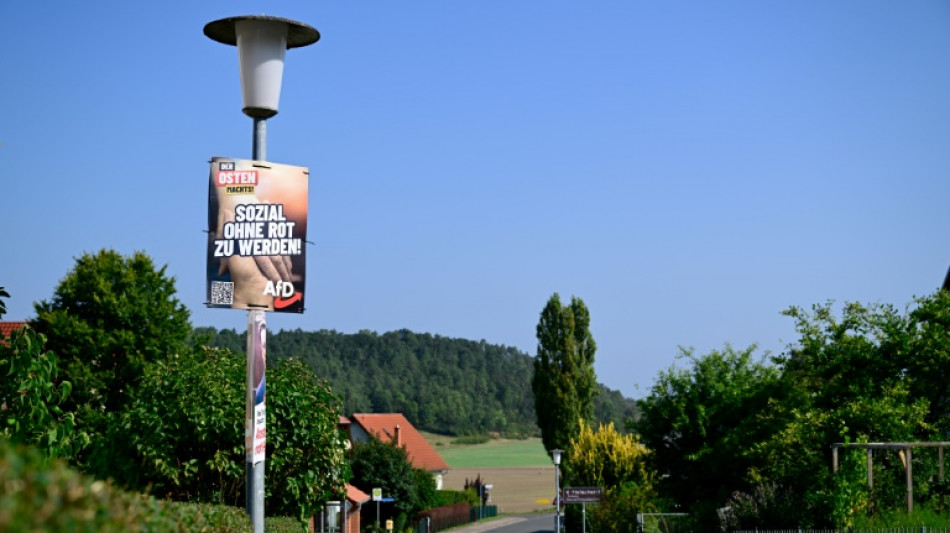
Election outcome highlights Germany's Ukraine war problem / Photo: © AFP

 Voting opens in Alaska's annual Fat Bear Week
 MLS coach axed for telling female ref 'It's a man's game'

 US refuses to give Sudan's de facto leader visa for UN
 Man City hold Bayern to start Women's Champions League, Arsenal win late
 Trump threatens Iran with 'hell' but reveals fresh talks
 Trump signs security deal with Greenland, Denmark at UN
 Trump threatens Iran with 'hell' but unveils fresh talks

 Chile's Atacama Desert blossoms with life after El Nino rains

 Sri Lanka hands 220-year jail terms to 15 convicted of Easter bombings
 Typhoon Dujuan leaves 7 dead in Japan from landslides, flooding: media
 Ganna and Borghini lead Italy to mixed relay gold at cycling worlds

 Drug cocktail killed former child star Hayden Panettiere: coroner
 Moldova declares energy, water emergency
 French Holocaust denier jailed for eight months

 Oil prices slide, AI stock buzz fades

 Trump threatens to 'annihilate' Iran in bombastic UN speech

 Prada's skirts take centre stage as Milan Fashion Week begins
 Quoin Pharmaceuticals Announces FDA Fast Track Designation for QRX003 for the Treatment of Peeling Skin Syndrome
 Brazil's Flavio Bolsonaro turns scandal into poll gains

 Republican senator seeks probe of Trump Jr Russian-funded wedding

 Memoir by Diana's brother goes on sale after rocking UK monarchy
 Newcomers South Korea face holders Italy in Davis Cup finals

 Japan's Kojima sounds Marchand warning with Asian Games gold

 England rugby star Pollock signs new Northampton deal
 STARTRADER Expands Its Chinese Equity CFD Range with CXMT and Unitree Robotics

Regional elections in Germany have laid bare a swell of opposition to the government's stance on the conflict in Ukraine at a time when Berlin is already under pressure over its aid for Kyiv.
Sunday's elections in the former East German states of Saxony and Thuringia saw big gains for the far-right AfD, which has long been accused of links with Russia and is a vocal critic of Germany's support for Ukraine.
A new far-left party, BSW, also made a big impact in the polls, having run on a ticket of peace negotiations with Russia and opposition to the planned stationing of US missiles in Germany.
Although the elections were regional, they have been widely interpreted as a backlash against Chancellor Olaf Scholz's fractious coalition government in Berlin.
That includes the government's support for Ukraine as it battles Russia's invasion, already under scrutiny as it has been at the centre of a protracted row over the 2025 budget.
The signal from German voters also comes with Kyiv facing worrying signs from several other allies, including the United States and France.
Germany has been the second largest contributor of aid to Ukraine after the US, with Scholz repeatedly pledging to keep up the support for "as long as it takes".
- Escalation fears -
But a growing sense of discontent has emerged over Berlin's support for Kyiv, with many Germans fearing that the war could spill over and affect them directly.
In a survey by the Insa pollster in late August, 45 percent of respondents said they were said they were either "very" or "quite" afraid of such an escalation.
The proportion was higher at 55 percent in eastern Germany, where memories of the Cold war still loom large.
In June, when Ukraine's President Volodymyr Zelensky visited Berlin to give a speech to the German parliament, the AfD and BSW both boycotted the event.
Sahra Wagenknecht on Monday said her BSW party's success in the regional elections was down to the fact that "a big issue in the election campaign was, of course, the question of war and peace".
"Half of the people in Germany are afraid of being dragged into a major war," she said.
The AfD had also made the conflict in Ukraine a big part of its election campaign, calling for peace negotiations and an end to weapons deliveries.
"The weapons we are supplying there are not a solution," said Joerg Urban, the AfD's leader in Saxony, ahead of the vote, accusing Berlin of "fuelling" the conflict.
- 'Hot air' -
Since Germany's regional parliaments have no say in foreign policy, the election result "will not have an immediate impact" on Ukraine, Hans Vorlaender, a political scientist at the Dresden University of Technology (TU Dresden), told AFP.
"Ukraine policy is a matter for the federal government... so in my opinion the result of the elections will have no direct effect in the first instance," he said.
But the results were already causing a ripple effect beyond Germany on Monday.
Italy's La Repubblica newspaper warned that "the seeds of Putinism are growing even in structured countries", while the US Wall Street Journal said "anti-establishment populism is on the rise in Europe".
Hungarian far-right Prime Minister Viktor Orban's political director said Thuringia and Saxony had "sent a message to Brussels and Berlin: no migration, no gender (politics), no war".
"Today's German state elections have triggered a political earthquake. The forces governing Germany in a pro-war, pro-migration and pro-gender (politics) coalition received a combined 15 percent of the vote," Balazs Orban wrote in a Facebook post.
Ukraine's ambassador to Germany, Oleksii Makeiev, also responded to the election result in a post on social media platform X.
"The BSW and AfD's promises of peace are hot air... A just peace requires support for Ukraine to fight for it," he said.
H.Seidel--BTB