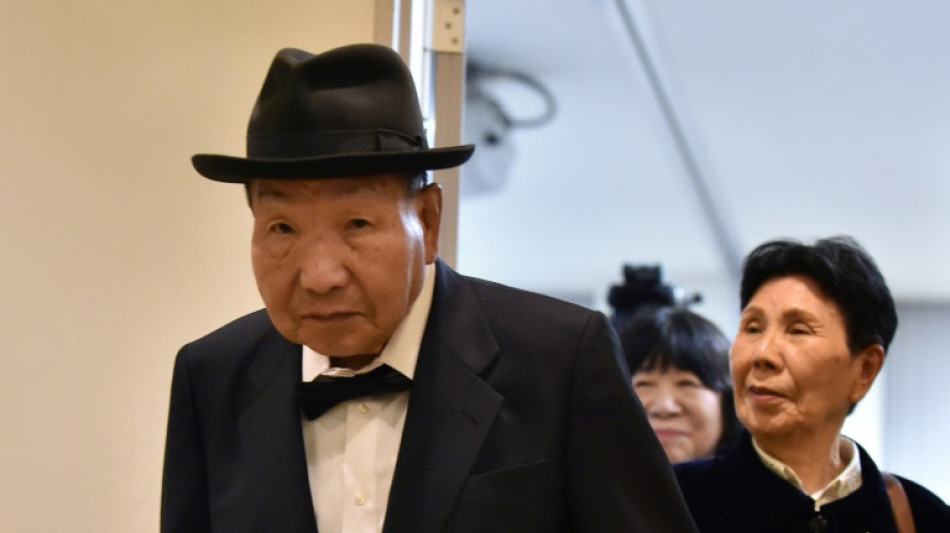
Back to death row? Retrial verdict due in Japan murder saga / Photo: © AFP

 Trump renames AI 'super intelligence' as leaders jostle over dangers

 Oil prices retreat as markets welcome US-Iran talks

 US refusing to give Sudan's de facto leader visa for UN: diplomatic sources, UN

 Macron urges world to choose UN over 'law of the jungle'

 All-rounder Jacks stars as England beat Sri Lanka in 1st ODI

 Man City peg back Bayern to start Women's Champions League
 Trump beats 'America first' drum at UN as allies tread carefully
 Snedeker backs Spaun for Ryder Cup after Presidents snub

 French prosecutors probe secret filming of women with smart glasses

 Trump renames AI "super intelligence," rejects international oversight

 Trump rejects international regulation of AI

 How is the EU approaching record fuel prices?

 Sri Lanka's Colombage strikes on debut as England dismissed for 265 in first ODI

 Hurricane Polo strengthens to top category 5 off Mexico

 11 hurt as teen opens fire outside school in western Turkey

 UN chief says 'Big Oil' treats atmosphere as open sewer

 Tunisia says 2026 summer hottest on record

 England's Rashid out of Sri Lanka ODIs with hand injury

 Houthis accuse Saudi Arabia of deadly strikes as thousands flee

 Stocks climb as oil slides, AI buzz returns
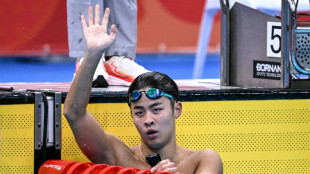
 India cricketers win in style as Afghan savours 'special' Games silver

 La Liga president hits out at Real Madrid refereeing 'conspiracy' claims

 MEXC Launches “Real Stocks, Real Friends” with Rewards for Bringing Friends to Wall Street

 Mbappe continues media push for Ballon d'Or recognition

 Stocks rise on AI buzz, oil prices cool

The world's longest serving death row prisoner will hear from a Japanese court on Thursday if he would face execution or finally be acquitted, a decade after obtaining a retrial of his murder conviction.
Iwao Hakamada, 88, was jailed under the death penalty for 46 years until he was freed in 2014 pending the retrial.
The former boxer was first convicted in 1968 of murdering his boss, the man's wife and their two teenage children.
But over the years, questions arose over fabricated evidence and coerced confessions, sparking scrutiny of Japan's justice system that critics say holds suspects "hostage".
"For so long, we have fought a battle that has felt endless," Hakamada's sister Hideko, 91, told reporters in July. "But this time, I believe it will be settled".
Prosecutors meanwhile have said they remain convinced of his guilt "beyond reasonable doubt".
Japan is the only major industrialised democracy other than the United States to retain capital punishment, a policy that has broad public support.
Hakamada is the fifth death row inmategranted a retrial in Japan's post-war history. All four previous cases resulted in exoneration.
After decades of detention, mostly in solitary confinement, Hakamada's health has deteriorated and he sometimes seems like he "lives in a world of fantasy", according tohis lead lawyer Hideyo Ogawa.
Speaking to AFP in 2018, Hakamada underlined his ongoing battle to obtain acquittal, saying he felt he was "fighting a bout every day".
"Once you think you can't win, there is no path to victory," he said.
- Blood and miso -
Although the Supreme Court upheld Hakamada's death sentence in 1980, his supporters fought for decades to have the case reopened.
A turning point came in 2014 when a retrial was ordered on the grounds that prosecutors could have planted evidence, and Hakamada was released from prison.
Legal back-and-forth including a pushback by prosecutors meant it took until last year for the retrial to begin.
Hakamada initially denied having robbed and murdered the victims, but confessed following what he later described as a brutal police interrogation that included beatings.
Central to the trial is a set of blood-stained clothes found in a tank of miso -- fermented soybean paste -- a year after the murder, used as evidence to incriminate Hakamada.
The defence argues investigators likely set up the clothes, as the red stains on them were too bright, but prosecutors say their own experiments show the colour is credible.
Hakamada's supporters and rights groups say his saga exposes Japan's flawed justice process and the cruelty of the death penalty.
In Japan, death row prisoners are notified of their hanging a few hours in advance.
The case is "just one of countless examples of Japan's so-called 'hostage justice' system", Teppei Kasai, Asia programme officer for Human Rights Watch, told AFP.
"Suspects are forced to confess through long and arbitrary periods of detention" and there is often "intimidation during interrogation", he said.
L.Janezki--BTB