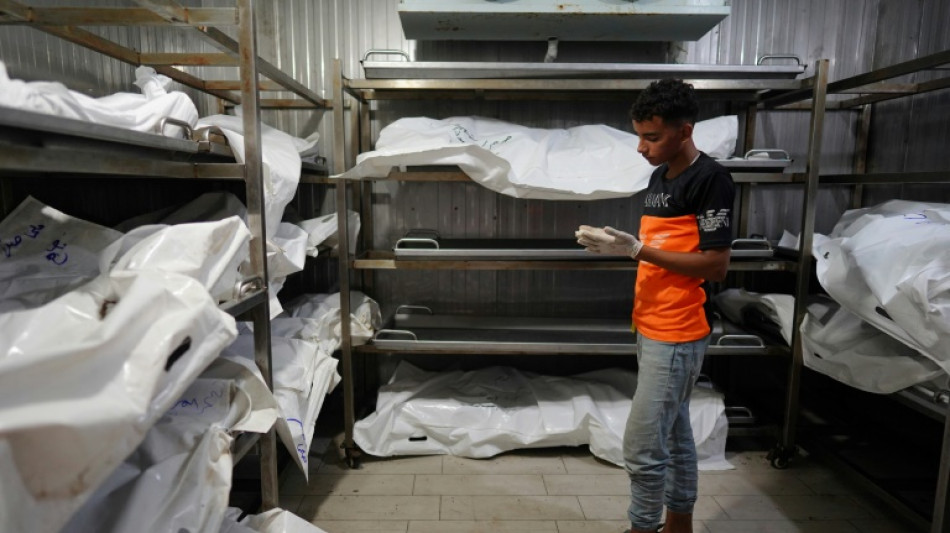
The struggle to keep track of Gaza war deaths / Photo: © AFP/File

 Voting opens in Alaska's annual Fat Bear Week

 MLS coach axed for telling female ref 'It's a man's game'

 US refuses to give Sudan's de facto leader visa for UN

 Man City hold Bayern to start Women's Champions League, Arsenal win late

 Trump threatens Iran with 'hell' but reveals fresh talks

 Trump signs security deal with Greenland, Denmark at UN

 Trump threatens Iran with 'hell' but unveils fresh talks

 Chile's Atacama Desert blossoms with life after El Nino rains

 Sri Lanka hands 220-year jail terms to 15 convicted of Easter bombings

 Typhoon Dujuan leaves 7 dead in Japan from landslides, flooding: media

 Ganna and Borghini lead Italy to mixed relay gold at cycling worlds

 Drug cocktail killed former child star Hayden Panettiere: coroner

 Moldova declares energy, water emergency

 French Holocaust denier jailed for eight months

 Oil prices slide, AI stock buzz fades

 Trump threatens to 'annihilate' Iran in bombastic UN speech

 Prada's skirts take centre stage as Milan Fashion Week begins
 Quoin Pharmaceuticals Announces FDA Fast Track Designation for QRX003 for the Treatment of Peeling Skin Syndrome
 Brazil's Flavio Bolsonaro turns scandal into poll gains

 Republican senator seeks probe of Trump Jr Russian-funded wedding

 Memoir by Diana's brother goes on sale after rocking UK monarchy
 Newcomers South Korea face holders Italy in Davis Cup finals

 Japan's Kojima sounds Marchand warning with Asian Games gold

 England rugby star Pollock signs new Northampton deal

 STARTRADER Expands Its Chinese Equity CFD Range with CXMT and Unitree Robotics

The health ministry in Gaza says the war that erupted after Hamas attacked on Israel on October 7 has killed more than 41,467 people.
With the Gaza Strip under Hamas's control for nearly two decades, and with belligerents throughout history using death tolls in their quest for legitimacy, many have questioned the veracity of the health ministry's figures.
Israel has criticised the data for failing to distinguish between fighters and civilians, and US President Joe Biden also raised questions about its credibility early in the war.
Several UN agencies still operating in Gaza say the figures are reliable, however.
How is the data compiled, and can it be trusted?
- Data collection -
Gaza has been under Hamas's control since it crushed its Palestinian rival Fatah in 2007 in street battles, after winning a 2006 legislative election. There have been no Palestinian elections since.
But the health ministry in Gaza, like other institutions, predates Hamas, and not all its staff are Hamas loyalists.
The ministry is staffed with civil servants that answer to the West Bank-based Palestinian Authority and to the Hamas government in Gaza.
Two AFP correspondents in Gaza saw ministry staff at health facilities enter deaths into a database.
Bodies are identified with the help of a relative or a friend, or using their personal items.
The deceased's name, gender, birth date and ID number are then entered into the health ministry's digital database.
If bodies are unrecognisable or unclaimed, staff record the death under a number, noting all available information.
Any distinguishing marks that may help identify the person later on are collected and photographed.
- Central registry -
In public hospitals under the direct supervision of the Hamas government, the "personal information and identity number" of every Palestinian killed during the war are entered into the hospital's database as soon as they are pronounced dead.
The data is then sent to the ministry's central registry on a daily basis.
For deaths in private hospitals and clinics, information is recorded on a form that must be sent to the ministry within 24 hours to be included in the central registry, a ministry statement said.
The ministry's so-called information centre then verifies the entries to "ensure they do not contain any duplicates or mistakes", before saving them in the database, the statement added.
Residents are also encouraged to report any deaths in their families via a designated government website.
- 'High correlation' -
Earlier this year, an investigation conducted by Airwars, an NGO focused on the impact of war on civilians, analysed the data entries for 3,000 of the dead and found "a high correlation" between the ministry's data and what Palestinian civilians reported online, with 75 percent of publicly reported names also appearing on the ministry's list.
The study found that the ministry's figures had become less accurate as the war dragged on, a development it attributed to the heavy damage to health infrastructure resulting from the war.
For instance, at southern Gaza's Nasser Hospital, one of the few still at least partly functioning, only a handful of computers now work, its director Atef al-Hout told AFP.
Last week the ministry was unable to publish data for 72 hours after an employee whose job it was to record the deaths was himself killed in an air strike, it said.
Israeli authorities have criticised the ministry's figures for failing to distinguish between combatants and civilians.
But Israel has not disputed the overall numbers.
Several UN bodies, including the agency tasked with assisting Palestinian refugees (UNRWA), have said the ministry's figures are credible.
"In the past -- the five, six cycles of conflict in the Gaza Strip -- these figures were considered as credible and no one ever really challenged these figures," the agency's chief Philippe Lazzarini said early in the war.
The war in Gaza was triggered by Hamas's October 7 attack on Israel, which resulted in the deaths of 1,205 people, most of them civilians, according to an AFP tally based on Israeli official figures. The deaths include hostages killed in captivity.
bur-ha-crb-jd/lba/ser/fox
K.Brown--BTB