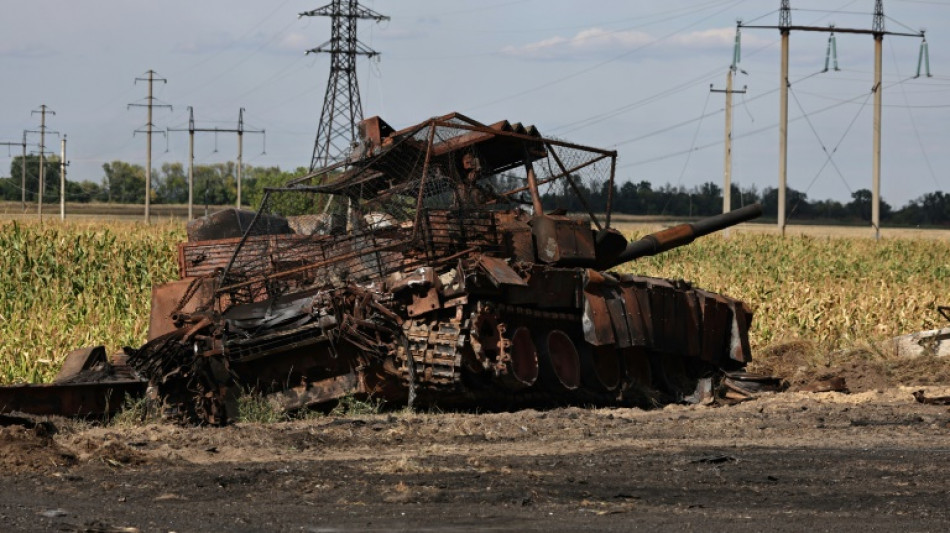
Ukrainian soldiers recount delicate 'coexistence' in Russia's Kursk / Photo: © AFP

 Schoolgirl Yu, 13, fastest again in bid for third Asian Games gold
 Oil prices fall after Trump hails 'good' talks with Iran

 AI political ads warp reality ahead of US midterms

 Kenneth Branagh embraces action hero role -- to get in shape

 'New one' Klopp promises fresh approach as Germany reign begins
 Milne returns to New Zealand squad for India T20 series

 US-led Americas coalition backs sanctions against crime groups

 'Star Wars' fans and art lovers line up for new Lucas museum

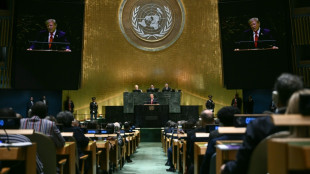 Trump renames AI 'super intelligence' as leaders jostle over dangers

 Oil prices retreat as markets welcome US-Iran talks

 US refusing to give Sudan's de facto leader visa for UN: diplomatic sources, UN
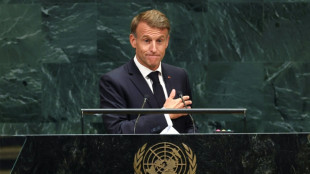 Macron urges world to choose UN over 'law of the jungle'

 All-rounder Jacks stars as England beat Sri Lanka in 1st ODI
 Man City peg back Bayern to start Women's Champions League
 Trump beats 'America first' drum at UN as allies tread carefully
 Snedeker backs Spaun for Ryder Cup after Presidents snub

 French prosecutors probe secret filming of women with smart glasses

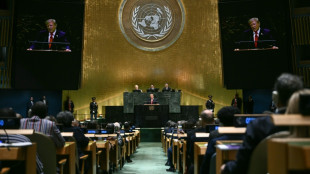 Trump renames AI "super intelligence," rejects international oversight
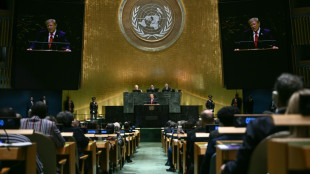 Trump rejects international regulation of AI

 How is the EU approaching record fuel prices?

 Sri Lanka's Colombage strikes on debut as England dismissed for 265 in first ODI
 Hurricane Polo strengthens to top category 5 off Mexico

 11 hurt as teen opens fire outside school in western Turkey

 UN chief says 'Big Oil' treats atmosphere as open sewer

 Tunisia says 2026 summer hottest on record

The "several thousand" Russian civilians still living in territory occupied by Ukrainian troops are mostly elderly and largely cut off from the outside world, with no electricity or phone network, according to Ukrainian soldiers.
Ukrainian soldiers deployed as part of Kyiv's shock offensive into Russia's western Kursk region told AFP of a "coexistence" with the locals, despite initial mistrust from residents exposed to Russian state media portrayals of Ukrainians as "monsters".
The incursion, two and a half years after Moscow invaded Ukraine, is the first time a foreign army has entered Russia since the end of World War II.
Ukraine says it controls around 100 border settlements over an area of around 1,000 square kilometres (400 square miles) -- a humiliation for President Vladimir Putin.
Information from the area is minimal due to a lack of access.
Russian authorities have said tens of thousands of civilians fled at the start of the incursion. The number that remained has not been made public.
Oleksiy Dmytrashkivsky, spokesman for Ukraine's military administration in the Kursk region, said "several thousand" Russian civilians are still there.
The Ukrainian soldiers said living conditions are difficult and civilians have to rely on their own reserves and vegetable gardens, or else the food, water and medicine the Ukrainian military says it is distributing.
They also reported that shops and pharmacies no longer work, electricity and mobile phone networks have been shut down, and Russian forces, which launched a counter-offensive in September, are constantly bombarding the area.
Dmytrashkivsky said at least 23 civilians had been killed by the Russian strikes since the end of August.
AFP was not able to independently verify claims made by the Ukrainian soldiers or establish how many civilians might have been killed as a result of Ukraine's own shelling.
- No resistance -
Ukrainian soldiers said they did not encounter resistance from the local population.
"Some of them even greet us in our own language!" said one soldier, Andriy.
In this border region, many people speak a mix of Russian and Ukrainian.
Andriy said he thought the friendliness might be because of the aid they have received, but acknowledged it could also be "because we are armed and people avoid expressing their true feelings".
According to Dmytrashkivsky, Russian civilians were initially "terrified" and "hid" when they saw Ukrainian soldiers because of Russian state media narratives.
Now "local residents are not afraid of the Ukrainian army", said another soldier, Sergiy.
"When they see a military vehicle, they come closer, they ask if it is distributing humanitarian aid."
But Sergiy chooses to limit his contact, fearing that anything he says could be passed on to the Russian military.
"A polite and discreet coexistence is enough," he said.
Contacted by AFP, the Ukrainian army declined to comment on reports of suspected pillaging by some of its soldiers.
AFP, which has not visited the area and cannot speak to civilians who have remained there because of the lack of phone signal, is unable to confirm the claims made by the Ukrainian military.
Kyiv has invited the United Nations and the International Committee of the Red Cross to visit the area -- an offer the Kremlin denounced as a "pure provocation".
Russia has largely sought to downplay the incursion.
"The situation in the areas controlled by Ukrainian forces is of course a crisis situation and it will be rectified in good time," Kremlin spokesman Dmitry Peskov said on September 20 in answer to a question from AFP.
Russian foreign ministry spokeswoman Maria Zakharova has accused Ukraine of setting up "concentration camps" in the area.
But Peskov said there was "no information" to back up this claim.
Interviewed by AFP, residents who fled the area to other parts of Russia spoke of massive destruction and said they were unable to contact their relatives.
"We cannot go there now, nobody can go back," said Elena, who said she had fled the town of Sudzha and declined to give her surname.
"Many elderly people stayed and we cannot contact them to know what is happening to our livestock and our homes," she said.
- Counter-propaganda -
Dmytrashkivsky admitted he had wanted to be "rude" with Russian civilians when he arrived because of the suffering inflicted by Moscow's troops on Ukraine.
Now, he said, "I just feel sorry for these people" who "have been brainwashed".
He has decided to mount a counter-propaganda effort "for educational purposes" to show Russian civilians the alleged atrocities committed by the Russian army in Ukraine.
With his laptop, he goes from house to house to show a war news bulletin, specially produced in Russian, and a documentary about Bucha, a town near Kyiv where the Russian army is accused of massacring hundreds of civilians in spring 2022.
He also wants to start a small newspaper to be distributed to local residents, called the "Wind of Kursk".
T.Bondarenko--BTB