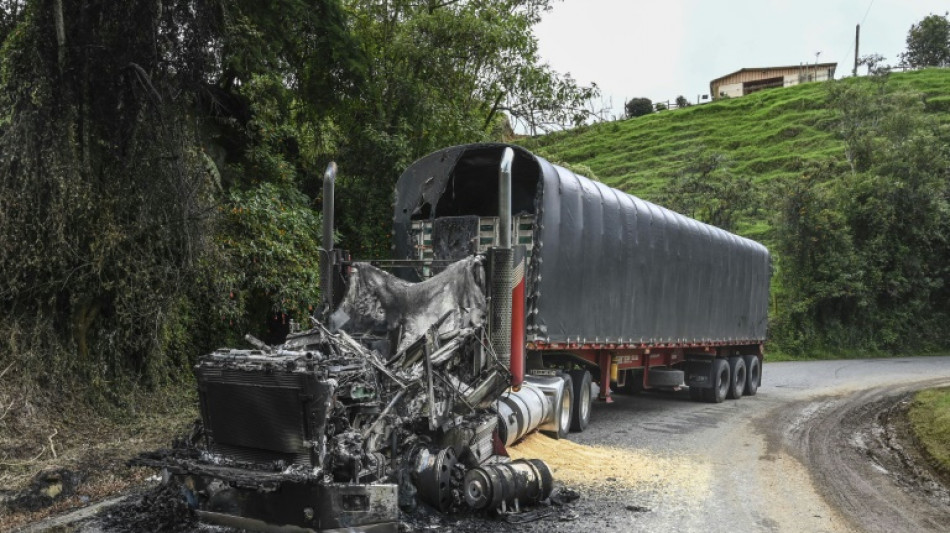
Colombia's Gulf Clan sows terror ahead of presidential vote / Photo: © AFP

 Iran president says time to end war while in position of strength

 Antonelli fastest in sole Dutch GP practice session

 2,500 dead and rising -- UN says DR Congo Ebola outbreak 'growing exponentially'

 England all out for 409, lead Pakistan by 238 runs in 1st Test

 Premier League returns with Arsenal eyeing title dynasty

 Bayern knew about Musiala's condition 'a long time ago' says Kompany

 Ex-Pakistan PM Khan taken back to jail after hospital checks
 Real Madrid star players are compatible: Mourinho

 Drovix Launches In-House Multi-Asset Liquidity and Execution Stack for Sub-Millisecond Fills, Tighter Spreads
 'So bad it's good': rough animated film becomes surprise Chinese hit

 'I'll adapt': First pregnant candidate navigates French presidential race
 Hong Kong convicts Tiananmen vigil activists of inciting subversion

 The Hong Kong Tiananmen vigil activists convicted in national security trial

 Eel-powered Japan whizz-kid, 11, chases Asian Games history

 Asian markets extend rally as traders assess US Treasuries pledge

 Barcelona enter new era as Flick targets La Liga hat-trick

 Pogacar favourite for Vuelta with Grand Tour treble in sight

 Bangladesh coach Simmons wary of Australia backlash in second Test

 Hong Kong Tiananmen activists to receive national security verdict
 Who are the candidates vying to lead the UN?
 Swiatek into Cincinnati semis after Rybakina injury

 University suspends academic behind Jason Arday plagiarism charges

 Key European leaders demand Israel halt West Bank settlement project

 McIlroy bounces back to share BMW Championship lead

 Cobolli fueled by candy in sweet defeat of Paul

With dozens of villages under siege and as many as two dozen people killed in a week, Colombia's largest drug cartel is sowing terror among civilians, flexing its muscle with days to go to presidential elections.
The Gulf Clan, which moves 30 to 60 percent -- some 700 tons -- of all the cocaine exported from Colombia, is exacting revenge for the extradition of its boss, known as "Otoniel," to the United States last week for trial.
In a show of force, it called a so-called "armed strike" that has forced shops and schools to close and brought transport to a standstill in 141 of Colombia's 1,100 municipalities, according to official data.
Dozens of roads were blockaded despite the best efforts of some 52,000 soldiers and police deployed to restore order.
The government says the clan has killed eight people, including five security forces personnel, in a week.
But according to the JEP, a special entity set up under Colombia's 2016 peace deal with the leftist rebel group FARC, the toll is even higher.
It reports 24 dead, 178 municipalities affected in 10 departments out of 36, as well as 22 attacks on uniformed personnel. Nearly 200 vehicles including trucks have been burnt.
When "Otoniel" was arrested last October, President Ivan Duque rejoiced: "It is a blow that marks the end of the Gulf Clan" -- the biggest cartel in the world's largest cocaine exporting country.
Seven months later, the group still operates with a large degree of impunity under replacement leaders "Siopas" and "Chiquito Malo."
- Situation 'very serious' -
"The State no longer knows what to do," analyst Kyle Johnson of the Conflict Response Foundation, a Colombian think-tank, told AFP.
Its actions to date, "have made little difference on the ground," he said.
According to the Foundation for Peace and Reconciliation, a monitoring group, the gang is now present in 241 municipalities -- 31 more than last year -- and has some 3,200 members, half of them armed.
For its "armed strike," the clan has targeted areas in Colombia's north that have been largely untouched by the violence that has long plagued the south in fighting over resources and territory between leftist guerrillas, drug gangs and other armed groups.
The situation in the north is now "very serious," said Johnson.
Hector Espinosa, governor of the Sucre region, hard hit by the clan's activities, said it was also waging a campaign of cyber terror -- scaring civilians with threats on WhatsApp and Facebook.
Despite the mass security deployment, people in these areas "don't want to go out because they receive messages on WhatsApp and Facebook telling them not to," said Espinosa.
In doing so, the clan portrays the state as weak and itself as being in charge.
A journalist in one of the affected regions told AFP he was forced to diffuse a clan pamphlet on the Facebook page of his outlet under threat of death.
With just days to go to the first round of presidential elections on May 29, the violence that has persisted in Colombia despite its historic 2016 peace accord, features prominently in the political campaign.
Leftist Gustavo Petro, ahead in the polls, has heavily criticized the "failure of the security option" of the outgoing government for addressing the matter.
He has, instead, mooted a "collective amnesty" for traffickers, with legal guarantees in exchange for abandoning the lucrative trade in a country battling growing poverty and unemployment.
His main rival on the right, Federico Gutierrez, is in favor of a strong-arm security response.
According to Johnson, an amnesty agreement can work only if the state manages to regain control of territories dominated by the clan.
This is something it failed to do with regions formerly under control of the disbanded FARC guerrilla group, now the scene of a territorial war.
W.Lapointe--BTB