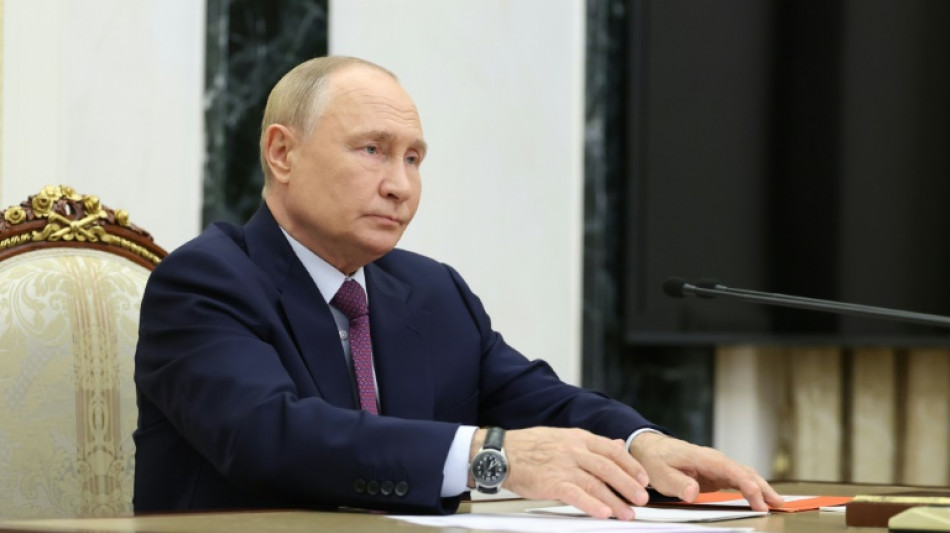
Putin rachets up nuclear rhetoric, but is he ready to act? / Photo: © POOL/AFP

 Schoolgirl Yu, 13, fastest again in bid for third Asian Games gold
 Oil prices fall after Trump hails 'good' talks with Iran

 AI political ads warp reality ahead of US midterms
 Kenneth Branagh embraces action hero role -- to get in shape

 'New one' Klopp promises fresh approach as Germany reign begins
 Milne returns to New Zealand squad for India T20 series
 US-led Americas coalition backs sanctions against crime groups

 'Star Wars' fans and art lovers line up for new Lucas museum

 Trump renames AI 'super intelligence' as leaders jostle over dangers

 Oil prices retreat as markets welcome US-Iran talks
 US refusing to give Sudan's de facto leader visa for UN: diplomatic sources, UN
 Macron urges world to choose UN over 'law of the jungle'
 All-rounder Jacks stars as England beat Sri Lanka in 1st ODI

 Man City peg back Bayern to start Women's Champions League
 Trump beats 'America first' drum at UN as allies tread carefully

 Snedeker backs Spaun for Ryder Cup after Presidents snub
 French prosecutors probe secret filming of women with smart glasses

 Trump renames AI "super intelligence," rejects international oversight
 Trump rejects international regulation of AI
 How is the EU approaching record fuel prices?

 Sri Lanka's Colombage strikes on debut as England dismissed for 265 in first ODI
 Hurricane Polo strengthens to top category 5 off Mexico
 11 hurt as teen opens fire outside school in western Turkey

 UN chief says 'Big Oil' treats atmosphere as open sewer
 Tunisia says 2026 summer hottest on record
Vladimir Putin's proposed revision of Russian nuclear policy signals a worrying readiness to use the ultimate weapon against Ukraine and even NATO members, but it remains far from certain the threat will be translated into action, analysts say.
The proposed broadening of Russia's nuclear rules comes as Moscow's invasion of Ukraine stretches into its third year and Kyiv seeks permission from Western allies to use long-range weapons to strike targets deep inside Russia.
With the ramped-up rhetoric Putin is looking to dissuade Western countries from broadening support for Kyiv.
But with repeated threats, he is also putting himself under pressure to act on the use of nuclear weapons, not only against Ukraine but also its NATO backers.
Maxim Starchak, a fellow at the Centre for International and Defence Policy at Queen's University in Canada, said that with the revision of the doctrine, Putin wanted to lower the threshold for use of nuclear weapons.
"Putin counts on the introduction of an additional -- nuclear -- factor in the Ukraine war. He believes and hopes that this will work," Starchak said.
A senior European military official, speaking on condition of anonymity, said Putin had a limited range of options two and a half years into the war.
When Russia invaded Ukraine in February 2022, "Putin went all-in. He therefore has little capacity for escalation," the official said.
He outlined three options at Putin's disposal: the use of nuclear rhetoric, the use of nuclear weapons, and hybrid warfare against the West.
- 'Western nuclear response' -
Since the invasion Putin has repeatedly threatened to use nuclear weapons, which the West has dismissed as sabre rattling.
But on Wednesday he went further, announcing changes to the country's nuclear doctrine during a televised meeting of the Kremlin's Security Council.
The updated doctrine would allow the use of nuclear weapons against non-nuclear states when they are supported by nuclear powers -- a clear reference to Ukraine and its Western backers.
The new rules would also allow Russia to unleash a nuclear response in the event of a "massive" air attack, he said.
For Pavel Luzin, a visiting scholar at the Fletcher School of Law and Diplomacy at Tufts University, Putin's threats still rang hollow.
"Russia is frantically looking for ways to make the world afraid of Russian nuclear weapons again," he said.
Hans Kristensen, director of the Nuclear Information Project at the Federation of American Scientists, said: "While the Ukrainian retaliation strikes into Russia are causing serious damage, a Russian nuclear response could lead to far greater damage if it triggered a Western nuclear response."
The European Union on Thursday denounced Putin's latest move as "reckless and irresponsible", and US Secretary of State Antony Blinken called the Russian leader "totally irresponsible".
- 'Questions from people' -
In Moscow, Alexander Khramchikhin, a Russian military analyst, said he did not see "any fundamental changes" to the doctrine, and its wording remains intentionally vague.
What mattered, he said, was the message the Kremlin was sending after Ukraine repeatedly crossed Moscow's "red lines", with its cross-border offensive in the western region of Kursk and the massive use of drones against targets deep inside Russia.
He noted that Putin was coming under increasing pressure from the military, politicians and public opinion at home to use nuclear weapons to win the Ukraine war.
"I am now constantly hearing questions from ordinary people who are asking why we are still not using nuclear weapons," Khramchikhin said.
Since the start of the war, Russian propaganda has gone into overdrive, threatening nuclear retaliation even against Western capitals.
Sergei Karaganov, a high-profile political scientist known for his hawkish views, has urged Putin to use limited nuclear strikes to "save" human civilisation.
Thirty-four percent of Russians consider the use of nuclear weapons against Ukraine to be justified, according to a poll by the Levada Centre released in July.
"Well-articulated direct military threats against NATO are the most effective way to communicate," said Vasily Kashin, a Russia-based political scientist. "But at the same time we must be ready to act on these threats."
"We may see limited strikes against facilities in Eastern Europe," Kashin said. "It could lead to a nuclear escalation. A protracted conflict is a dangerous situation."
R.Adler--BTB