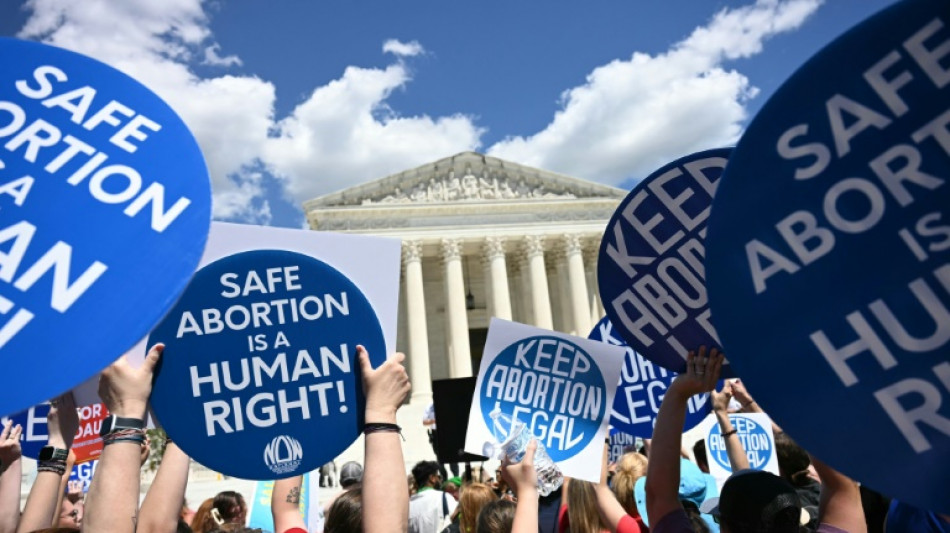
Abortion rights worldwide: a snapshot / Photo: © AFP/File

 Pope warns against losing humanity in 'paradise of machines'

 From FBI warning to literary acclaim: the Russian journalist who took on Putin
 China swimmer in Asian Games first as North Korea lifters reign
 French literary prize removes novel from longlist after AI claims

 China's Zhang wins record seventh Asian Games swimming gold

 Verstappen edges Russell in final practice in Azerbaijan
 English, Spanish, Italian, German football leagues call for FIFA reform

 Pope arrives in France on first official visit in 18 years

 Pope arrives in France on first state visit in 18 years

 Heavy fighting, internet disruption as Ethiopia conflict rages

 From transit to consumption: drug use surges in Mozambique

 Chicago teams, Guardians and Padres all book MLB playoff berths
 Bijan Robinson destroys Packers in 35-14 win for Falcons

 Harimoto hails new era as Japan dethrone table tennis kings China

 India rape cases turn focus back onto women's safety
 Rebellious Afghan taxi drivers defy ban on music

 Brazil candidates mount digital armies for fierce online campaign

 Nepal PM says floods 'a warning to the world' about climate change

 Trump hosts Xi for state dinner as pomp masks tensions
 Karbon-X (OTCQB:KARX) to Present Global Growth Strategy and Showcase SkyXero at 26th MK-Equity Investment Conference in Munich

 US 'must choose' whether to end war: Iran president to Fox News
 UN approves resolution on dealing with rising sea levels

 Yalcouye makes dream debut as Ivory Coast beat Ghana in AFCON qualifier

 Chicago's White Sox and Cubs book MLB playoff berths

 Last-gasp Gakpo strike snatches Dutch draw to sour Klopp debut

Despite being liberalised in scores of countries over recent decades, women's access to abortion remains a precarious right globally with numerous countries restricting the procedure or outlawing it altogether.
Traditional Catholic bastions such as Ireland and Mexico have lifted bans in recent years, but the United States has abolished nationwide access and some states maintain total bans.
According to the Center for Reproductive Rights (CRR) advocacy group, only 34 percent of women of reproductive age live in countries where abortion is available on demand. It says backstreet abortions lead to 39,000 deaths per year.
On International Safe Abortion Day, here is a summary of rules on the procedure in various countries:
- Easing access -
Over the past 30 years, more than 60 countries have changed their laws to facilitate access to abortion.
In March 2024, France became the first country to enshrine the right in its constitution.
In September 2023, Mexico's Supreme Court ruled to decriminalise abortion, bringing it in line with Argentina, which legalised it in 2020, plus Colombia, Cuba and Uruguay.
Ireland, a longtime bastion of Catholicism, legalised abortion in 2018 following a resounding yes vote in a referendum that overturned a constitutional ban.
Northern Ireland decriminalised it in 2019 -- the last part of the United Kingdom to do so -- as did South Korea.
New Zealand, Thailand and the west African state of Benin have since followed suit. The leadership of Sierra Leone has also approved its decriminalisation.
- Clamping down -
Abortion remains banned in around 20 countries, mostly in Africa and Latin America, according to the CRR.
El Salvador adopted a total ban in 1998 -- even applying to cases where the woman's or foetus's life is in danger -- with prison sentences of up to eight years.
Honduras hardened its total ban in 2021 by writing it into its constitution.
In Argentina, President Javier Milei, while running for office in 2023, promised to hold a referendum on banning abortion.
In Europe, only Andorra and the Vatican have total bans. Malta allows abortion only in cases where the mother's life is in danger or the foetus has no chance of survival.
Poland's constitutional court sparked protests in 2020 after ruling against abortion in cases where the foetus is malformed.
Abortion in the staunchly Catholic country is only permitted in cases of rape, incest or if the mother's life is in danger. Recent efforts to liberalise the law there have failed.
Hungary tightened its abortion law in 2022, obliging women contemplating the procedure to observe the foetus's "vital functions" such as the heartbeat.
In Brazil and Chile, abortion is only allowed in case of rape, risk to the mother and serious malformation of the foetus.
Proposals have been made in Brazil to apply jail terms of up to 20 years for aborting after 22 weeks of pregnancy, even in cases of rape.
- US U-turn -
In 2022, the conservative-dominated Supreme Court of the United States overturned the landmark 1973 "Roe v Wade" decision that had enshrined a woman's right to a termination for half a century.
The court ruled that individual states can permit or restrict the procedure themselves.
Some 20 states, mainly in the south and centre, have since decreed bans or heavy restrictions on abortion.
States on the eastern and west coast have, by contrast, expanded access to terminations.
L.Janezki--BTB